Every beautifully finished yacht has a story that begins long before the champagne bottle reaches the bow, hidden beneath the polished topsides, immaculate deck and carefully faired hull are the resins, composites, coatings, adhesives and finishing systems that modern boatbuilding depends upon. These are rarely the glamorous parts of the marine industry, yet without them there would be precious little glamour left afloat, which makes the 40th anniversary of Marineware an opportunity to look behind the finished boat and at one of the businesses that has spent four decades supplying the materials and technical knowledge needed to build, repair and protect it.
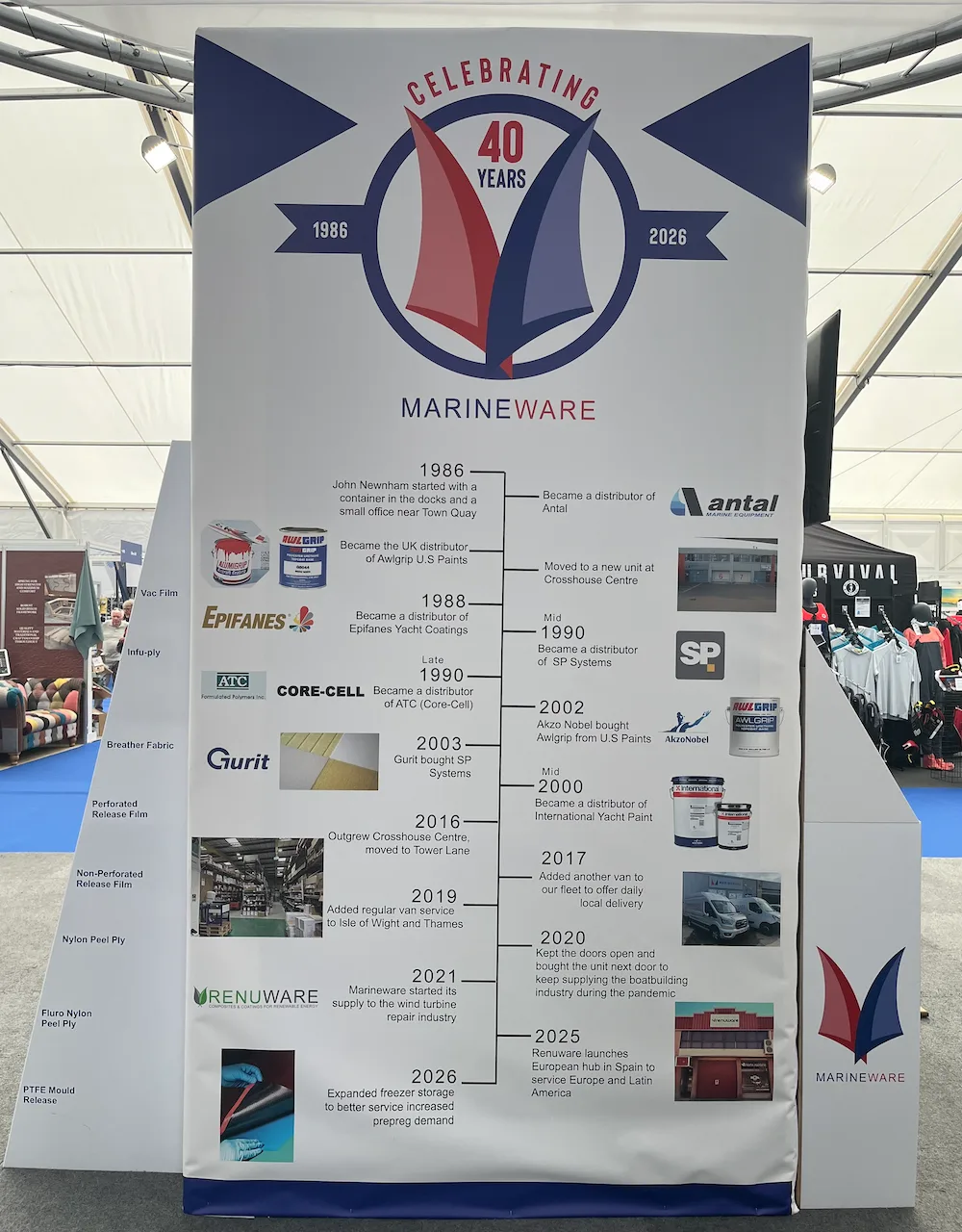
Marineware celebrates 40 years in 2026, having been founded by John Newnham in 1986, when the operation consisted of a container in the docks and a small office near Southampton's Town Quay. It was a modest beginning in a city where boats, ships, yards and marine businesses have long been woven into everyday life, although the timing placed the young company at an interesting point in the development of the modern leisure marine industry.
British boatbuilding was changing rapidly during the 1980s. Glass-reinforced plastic had already transformed yacht production during the previous decades, allowing builders to move beyond many of the limitations and labour requirements associated with traditional timber construction. Production yachts could be built in larger numbers, hull forms could be reproduced consistently and owners gained boats requiring a very different maintenance regime from the wooden yachts that had filled marinas and moorings only a generation earlier.
The change did not make boatbuilding simple, because composites brought their own demands for specialist materials, careful preparation and considerable technical understanding. Resins, gelcoats, reinforcements, fillers, adhesives and increasingly sophisticated coating systems became part of the boatbuilder's everyday vocabulary, while repair yards and refit businesses needed access not merely to products but to people who understood how those products behaved once brushes, rollers and mixing pots came out.
That was the world into which Marineware arrived.
Growing alongside British boatbuilding
From its Southampton beginnings, the company developed as a distributor of composites and coatings for the marine industry, eventually supplying customers across the United Kingdom and overseas. The physical scale of the business may have changed considerably since the days of the dockside container, although Marineware points to technical support as one of the threads running through its four decades.
That technical element matters more than outsiders sometimes appreciate. A tin of coating or drum of resin is only part of the answer when somebody is building or repairing a boat, because temperature, humidity, preparation, application methods, compatibility between products and curing conditions can all determine whether the finished job lasts for years or becomes an expensive lesson in doing it twice.
Marine materials have also become steadily more sophisticated since 1986. Modern composite construction encompasses an enormous range of techniques and materials, from comparatively straightforward glassfibre laminates to vacuum-infused structures, advanced cores and carbon reinforcement. Coating technology has developed alongside it, responding to demands for better finishes, greater durability, improved application and changing environmental requirements.
The yachts themselves tell the same story. Compare a typical production cruiser from the mid-1980s with a modern yacht and the differences extend far beyond styling. Today's builders routinely produce hull shapes, large structural components and interior modules using manufacturing methods that have evolved considerably during Marineware's lifetime, while lightweight structures and carefully controlled production processes have become increasingly important as designers chase performance, efficiency and greater interior volume.
Suppliers operating behind those builders have had to evolve at much the same pace.
Forty years hidden beneath the surface
One of the curious things about companies such as Marineware is that much of their contribution disappears by the time a yacht reaches the marina. Nobody strolling along a pontoon admiring a freshly launched boat is likely to spend much time thinking about the distribution network that supplied its composite materials or the technical conversations that took place during construction.
Owners generally notice coatings only when something goes wrong.
A gleaming topside finish attracts admiration, while the chemistry and preparation responsible for creating it remain largely invisible. The same applies below decks and beneath the waterline, where protective coatings, composite repairs and structural materials quietly perform jobs considerably more important than their lack of visibility might suggest.
Marineware's longevity therefore provides an interesting measure of the less visible side of Britain's marine sector. Boatbuilders have come and gone during the past four decades, yacht design has changed dramatically and entire categories of equipment have appeared that barely existed when the company started trading, yet boats still need to be built, repaired, protected and refinished.
The tools and chemistry have changed, while the fundamental requirement has remained remarkably familiar.
A Southampton story
There is also something fitting about Marineware having begun near Town Quay in Southampton, because few British cities have such a close relationship with the sea and the marine industry.
Southampton Water leads naturally towards the Solent, where commercial shipping, yacht racing, cruising boats, ferries, dinghies and motorboats share one of the busiest and most varied stretches of water in Britain. Around its shores developed a dense network of boatbuilders, sailmakers, engineers, chandlers, marinas and specialist suppliers, supported by generations of people whose working lives revolved around boats.
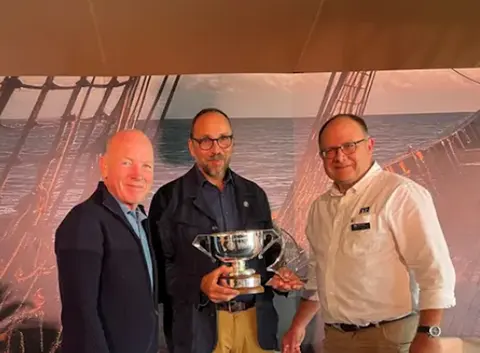
The annual Southampton International Boat Show has become one of the most visible celebrations of that industry, bringing finished boats and the companies behind them together beside the water. Marineware's 40th anniversary therefore feels particularly at home in Southampton, with the company marking the milestone during the 2026 show with a celebratory reception.
Forty years after beginning near Town Quay, the business remains connected to the same wider marine community from which it emerged.
People behind the products
Marineware is using its anniversary to recognise the employees, suppliers and customers who have accompanied it through those four decades, with founder John Newnham thanking customers for their loyalty and trust while also acknowledging the work of the company's staff.
His anniversary message recalls the many memories accumulated within the marine trade and looks towards what he describes as the company's next chapter.
That human element should not be underestimated, particularly within an industry where long-term relationships remain unusually important. Boatbuilding can be highly technical, although much of the marine trade still functions through conversations between people who know their products, understand the problem in front of them and have probably encountered something similar before.
Technical support is particularly valuable when the boat concerned is no longer sitting inside a modern production facility. Older yachts develop their own peculiar collection of repairs, previous coatings, unknown materials and modifications accumulated through decades of ownership, which means identifying the correct system can require rather more thought than simply reading the instructions on the side of a tin.
Experience becomes part of the product.
Looking towards the next 40 years
Marineware's anniversary is not being treated simply as an opportunity to look backwards. The company says it intends to expand further, taking its brands and services into new markets while continuing to emphasise technical support and specialist marine solutions.
The next decades are likely to bring another substantial period of change for composite manufacturing and marine coatings. Boatbuilders are already under increasing pressure to consider environmental impact, production efficiency, waste, energy consumption and what eventually happens to composite structures at the end of their working lives.
Those questions are not straightforward. Composite boats have provided extraordinary durability, with many yachts built decades ago still sailing perfectly happily today, although that same durability creates challenges when structures finally reach the point where recycling or disposal becomes necessary. Manufacturers and suppliers throughout the industry are consequently exploring new materials, processes and methods intended to reduce environmental impact without sacrificing the strength and longevity demanded at sea.
Coatings face their own evolution as environmental regulations, application requirements and customer expectations continue to change. The familiar marine workshop of 2046 may use products and processes that would seem as unfamiliar to today's boatbuilder as some modern composite techniques would have appeared to the industry in 1986.
Marineware will have to navigate those changes just as it has navigated the previous four decades.
There is something pleasingly appropriate about a marine company reaching 40 years by remembering a container beside the docks rather than pretending that success arrived fully formed. The marine industry is filled with businesses that began because somebody understood boats, recognised a problem and decided there had to be a better way of supplying what builders and owners needed.
Somewhere beneath the flawless finish of a new yacht, behind the carbon, glass, resin and layers of carefully applied coating, sits an entire industry that most sailors seldom see.
Marineware has spent four decades working in that hidden world, and from a small office near Town Quay to customers across Britain and overseas, it has travelled rather further than that first dockside container might have suggested.