The trade winds will be waiting beyond English Harbour when Antigua Sailing Week returns from 21 to 25 April 2027, carrying sailors towards another four days of warm-water passages, island stopovers and the unmistakable camaraderie that has defined this Caribbean gathering for almost six decades. Entries for the 58th edition are now open, with an Early Bird rate of US$12 per foot available until 31 October 2026, offering crews an opportunity to secure their place before the international fleet begins planning another winter beneath the Caribbean sun.
This will be Antigua Sailing Week in its modern destination-racing form, where the pleasure of moving around the island has become as important as the battle for corrected time. Point-to-point sailing, relaxed rally participation and time ashore now sit beside competitive racing, giving owners and crews the freedom to decide whether the week should be a serious sporting contest, a Caribbean adventure or an agreeable mixture of both. The organisers have not abandoned the event’s competitive inheritance, although they have recognised that sailing has changed and that many crews now want more from a regatta than repeated circuits around fixed marks.
A Regatta Created to Extend the Season
The origins of Antigua Sailing Week belong to a wonderfully practical piece of island thinking. During the 1960s, Antigua’s growing hotel and yacht-charter industries enjoyed a busy winter, followed by a sharp decline as visitors returned north and yachts prepared to leave the Caribbean. A small group of sailors and hoteliers began considering how the season might be extended, not through a grand marketing campaign, but by giving people a compelling reason to remain on the island for another week.
Peter Deeth, Desmond Nicholson and Howard Hulford were among the central figures behind the idea. Deeth had opened The Inn, one of Antigua’s pioneering beach hotels, in 1961, while Nicholson became one of the most influential personalities in the development of Caribbean yacht charter. Together with other friends and members of the local sailing community, they organised informal Sunday racing in English Harbour before turning the concept into something considerably larger.
The Antigua Hotel Association sponsored the first official Antigua Sailing Week from 8 to 15 June 1968. Boats arrived from the United States, Canada and neighbouring Caribbean islands, while invitations promoted Antigua as the “Island for All Seasons”. The programme was far broader than the modern understanding of a yacht regatta, combining the Guadeloupe to English Harbour Race with powerboat contests, deep-sea fishing, Sunfish racing and competition between local workboats freshly painted in bold Caribbean colours.
Spectators watched from beaches and hotel verandas, while visitors could pay a modest amount for a place aboard a participating yacht. The opening race brought boats north from Guadeloupe, before the week moved towards its final celebration inside Nelson’s Dockyard, where a Lord Nelson Costume Ball provided an appropriately theatrical conclusion.
The formula succeeded because it joined sailing with tourism without allowing either to overwhelm the other. Hotels kept their rooms occupied, charter yachts remained active and visiting crews discovered that Antigua offered considerably more than an excellent place to anchor.
The Fleet Grows Around a Caribbean Institution
The second Antigua Sailing Week followed in 1969, with dates brought forward from June towards the end of May. As the event matured, it eventually settled into its familiar position near the end of April, becoming the final major celebration of the Caribbean racing season.
Fleet numbers grew steadily as international yacht racing expanded and Antigua’s reputation travelled across the Atlantic. At its height, more than 250 yachts competed, filling English Harbour and neighbouring Falmouth Harbour with grand-prix racers, production yachts, charter boats, local entries and traditional designs.
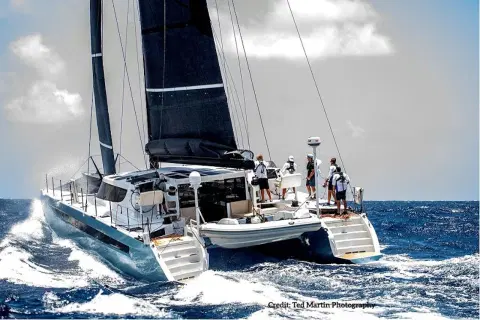
Antigua’s south coast provided a magnificent natural racecourse. The easterly trade winds arrived across open Atlantic water, bringing dependable pressure and an energetic swell that rewarded sound helming, disciplined sail handling and the courage to keep driving when the boat began leaping from one wave into the next.
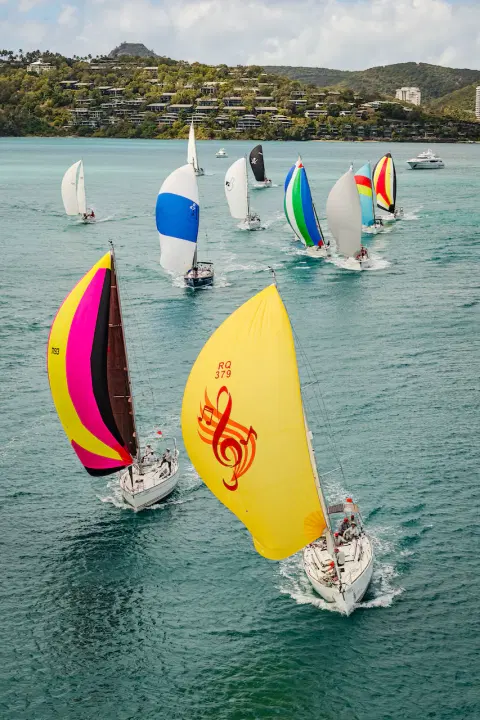
The tactical examination extended far beyond finding the quickest route around a buoy. Headlands disturbed the wind, coastal bays created patches of lighter pressure and long reaching legs encouraged crews to judge how hard they could press without losing control. Powerful yachts carried large asymmetric spinnakers across rolling seas, while smaller boats searched for flatter water and clean air closer to shore.
English Harbour supplied the social heart, with Nelson’s Dockyard giving the regatta one of the most distinguished bases in international sailing. The restored Georgian dockyard, once home to the Royal Navy’s Caribbean operations, connected modern crews with the island’s deeper maritime history while providing a naturally contained gathering place after racing.
The parties became almost as famous as the sailing, although dismissing Antigua Sailing Week as a week of rum and music overlooked the quality of competition. International professionals raced beside local sailors and committed amateurs, often sharing the same dockside tables after spending the afternoon fighting for seconds on the water.
New Events Grow from Antigua’s Success
A successful regatta frequently creates more sailing around it, and Antigua Sailing Week proved particularly fertile. During the early years, classic yachts formed a major part of the fleet, although faster modern racers gradually made competition between very different designs increasingly difficult.
The classic contingent separated in 1988 to establish the Antigua Classic Yacht Regatta, which developed into a celebrated gathering for traditional yachts, restored masterpieces and modern vessels inspired by classical lines. What began as a practical division allowed each event to preserve its identity, while strengthening Antigua’s wider position within the international sailing calendar.
Members of the Antigua Sailing Week race-management community later helped identify the opportunity for a serious offshore race beginning and ending on the island. Working with the Royal Ocean Racing Club, that idea became the RORC Caribbean 600, whose demanding course around 11 islands has attracted some of the fastest offshore yachts and most accomplished sailors in the world.
Antigua Sailing Week also developed its own roll of recognised winners and enduring campaigners. Sir Peter Harrison’s powerful Farr 115 Sojana carried British ambition to the Lord Nelson Trophy, while Ross Applebey’s Scarlet Oyster became a familiar and successful presence within the production-yacht divisions.
Sir Richard Matthews returned repeatedly with yachts bearing the Oystercatcher name, becoming one of the event’s most experienced competitors. His long involvement reflected the loyalty Antigua inspires because many crews who arrive for a single regatta eventually treat the island as a regular conclusion to their Caribbean season.
More recently, El Ocaso secured the Lord Nelson Trophy during the 2025 event, while Roy Disney’s Pyewacket 70 claimed line honours in the accompanying Round Antigua Race following a fast contest with Lee Overlay Partners III. The boats, rating systems and sailcloth have changed enormously since 1968, yet the desire to finish a Caribbean campaign with a memorable result in Antigua remains unchanged.
Evolution Rather Than Abandonment
International yacht racing has become increasingly crowded, expensive and professionally organised. Leading boats must divide their seasons between the Caribbean, Mediterranean, North America and northern Europe, while transatlantic delivery schedules place heavy pressure upon crews and shore teams.
By late April, many dedicated race boats need to be heading towards their summer programmes. Antigua Sailing Week therefore faced the same challenge that has confronted numerous long-established events, because preserving every element of the traditional format risked allowing the regatta to become less relevant to the sailors it hoped to attract.
The response was to separate two distinct experiences. The Antigua Racing Cup was created for performance-focused teams seeking professionally managed course racing, while Antigua Sailing Week moved closer to the destination-based spirit of its earliest years.
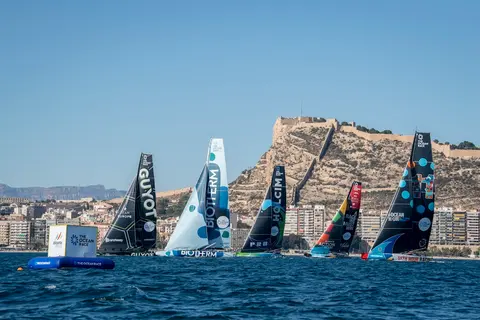
The first Antigua Racing Cup was held in April 2026, delivering nine races for a fleet of grand-prix yachts, performance cruiser-racers and smaller competitive designs. Its 2027 edition will take place from 17 to 21 March, providing an earlier position in the calendar for teams wanting serious competition before moving towards European or North American summer programmes.
Dual CSA and IRC scoring allows suitable monohulls to compare their performance under both rating systems, while course lengths can be adjusted for maxis, offshore multihulls and smaller yachts. Nelson’s Dockyard remains the regatta village, ensuring that professional race management does not remove the warmth and sociability expected from sailing in Antigua.
Antigua Sailing Week follows a month later with a broader invitation. Liveaboard cruisers, charter crews, racing yachts and multihulls can choose between racing and rally participation, while point-to-point legs carry the fleet towards different parts of the island.
The 2026 edition demonstrated how the format could work, sending sailors from English Harbour towards Green Island before later legs explored the waters around Little Jumby and Antigua’s northern coastline. Competitive crews still watched their rivals and corrected times, although the day no longer ended simply by returning to the same berth and preparing to repeat the exercise.
Sailing Around the Island
Destination racing demands a slightly different form of seamanship from short-course competition. Crews must consider changing sea states, coastal wind effects and the practical requirements of reaching another harbour or anchorage, while navigators carry greater responsibility for the wider route.
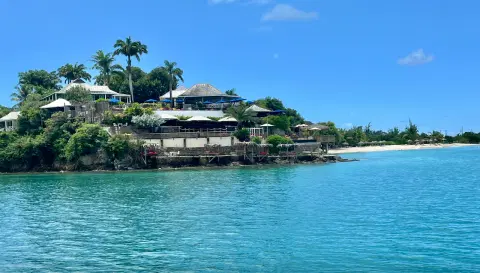
Antigua’s coastline rewards that approach. The Atlantic-facing east coast delivers open water, stronger swell and reefs requiring careful attention, while the western side offers a gentler Caribbean character with sandy beaches and sheltered anchorages.
Spinnaker use remains a choice for individual crews, allowing confident racing teams to pursue speed while less experienced sailors shorten sail and enjoy the passage without turning every manoeuvre into a deck-level emergency. A simplified CSA rating option gives cruising boats access to fair competition without demanding an elaborate grand-prix measurement campaign.
Each arrival creates a natural gathering ashore, where crews can explore another part of Antigua before returning to the water. Beach activities, organised challenges and relaxed social events allow the week to retain its famous hospitality without requiring every evening to become an endurance contest of an entirely different sort.
The entry fee supports professional race management and a shoreside programme that is expected to include a welcome party, daily prizes, post-sailing celebrations, happy-hour drinks and the final prize-giving. The familiar Skippers’ Bag will also return with useful equipment and the occasional item whose practical purpose may only become apparent after the rum has been opened.
Two Regattas, One Sailing Island
The separation between the Antigua Racing Cup and Antigua Sailing Week gives crews a clearer choice. Serious racing sailors can compete in March, when their campaigns remain firmly within the Caribbean season, while cruising crews, charter sailors and mixed teams can enjoy the more exploratory gathering in April.
Ambitious sailors may choose both, using the Racing Cup to sharpen manoeuvres and test performance before returning for a less intensive journey around the island. The two events need not compete because they serve different expectations while sharing the same trade winds, historic dockyard and Antiguan welcome.
Antigua and Barbuda Tourism will present the programme at the Annapolis Sailboat Show from 15 to 18 October 2026, with Antigua Sailing Week represented in the Vacation Basin at tent 32. Sailors planning a Caribbean campaign will be able to discuss entries, charter possibilities and the practicalities of joining the new format.
The Early Bird entry rate of US$12 per foot remains available until 31 October 2026, after which the standard fee will apply. Race documents, preliminary information and the online entry system are available through the official Antigua Sailing Week website.
Nearly sixty years have passed since Peter Deeth, Desmond Nicholson, Howard Hulford and their companions looked across English Harbour and imagined a regatta that might keep visitors on the island for a little longer. Their plan succeeded beyond any reasonable expectation, creating an institution that influenced Caribbean sailing far beyond its own finish lines.
The 2027 Antigua Sailing Week will look different from the regatta that once attracted more than 250 yachts, although survival in sailing has always required an ability to change course when the wind shifts. The fleet will still gather beneath the green hills, the trades will still roll across the south coast and English Harbour will still welcome tired sailors home.
Antigua is no longer asking every visitor to race in precisely the same way. Its invitation is broader and perhaps closer to the original spirit, because the island is offering a reason to sail, explore, remain a little longer and finish the Caribbean season among friends.