September in Cannes has a familiar rhythm once the cinema crowds have gone, because the red carpet gives way to boarding ladders, the Vieux Port fills with polished hulls and the Croisette becomes a mile-long link between two very different collections of boats. The Cannes Yachting Festival will return from 7 to 12 September 2027 with more than another season’s new models to display, since the event will mark fifty years since its foundation in 1977. That anniversary offers an opportunity to look backwards at how boating has changed while confronting a future shaped by electrification, efficiency, new materials, digital systems and owners who increasingly expect luxury to arrive with greater environmental responsibility.
Full details of the 2027 exhibitors, premieres and individual boats have not yet been announced, although the scale of the preceding show provides a substantial indication of what visitors can expect. The 49th edition in September 2026 assembled 680 exhibitors and 700 boats between five and 55 metres, including almost 150 world premieres, while attracting close to 56,000 international visitors across six days. Few boat shows allow so many yachts to be inspected in the water, where proportions, deck access, cockpit layouts and boarding arrangements can be judged more honestly than they can beneath exhibition-hall lighting, and selected sea trials add the useful possibility of discovering whether an attractive design behaves as convincingly beyond the harbour wall.
Cannes began its nautical gathering in 1977, long before touchscreens, lithium battery banks and foiling electric toys became routine subjects of conversation along a marina. Production boating was expanding, European builders were developing new families of cruising yachts and motorboats, while the Mediterranean offered an ideal stage on which machinery could be presented as part of a wider life around the sea. The show became known for opening the international autumn boat-show season and for introducing new models directly to owners, dealers and journalists when shipyards were setting out their plans for the following year. Its growth mirrored the industry, moving from a conventional exhibition towards an event where design studios, equipment companies, brokers, service businesses and technology specialists stand alongside the finished yachts.
The modern festival is divided across two harbours, a structure that requires comfortable shoes and a little planning but gives each part of the market room to establish its own character. The Vieux Port is principally the territory of motor yachts, with the 2026 layout accommodating new boats from around 12 to 50 metres together with engines, equipment, marinas and marine services. The Power Cat Village reflects the continuing rise of motor multihulls, whose beam creates generous accommodation and whose twin slender hulls can offer an alternative approach to efficiency, stability and deck space. Visitors moving through the Vieux Port encounter everything from practical trawler-style cruisers to fast dayboats and large yachts whose interiors resemble carefully edited waterfront apartments.
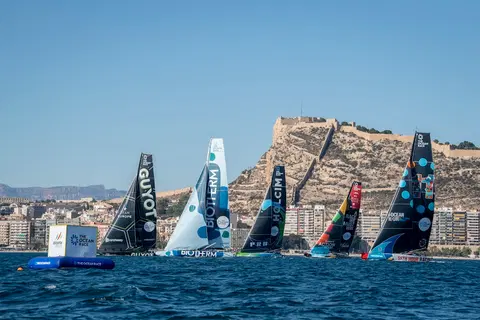
Port Canto provides the contrast, placing new sailing yachts, smaller motor craft, brokerage yachts and water toys into four complementary areas. The 2026 Sailing Area contained 120 new monohulls and multihulls over ten metres, allowing a visitor to move from performance cruisers with narrow entries and deep appendages to spacious catamarans built around family living and long periods at anchor. The Power Boat Marina brought together about 180 rigid and semi-rigid boats up to 13 metres, while the Yacht Brokerage Area displayed 45 pre-owned yachts over 25 metres and the Toys Area covered foils, electric surfboards, submersibles and the growing assortment of machines designed to keep guests occupied after the main yacht has stopped moving.
The fiftieth-anniversary show should be watched most closely for evidence of how builders are responding to the energy problem that now sits beneath almost every serious conversation about future boating. Electric propulsion is well suited to silence, low-speed harbour operation and shorter passages, although range, weight, charging and the energy demands of hotel systems remain difficult on larger cruising yachts. Hybrid installations can reduce generator hours and allow quiet periods at anchor, while solar generation, more efficient hull forms, improved insulation, variable-speed machinery and intelligent power management often deliver less theatrical but more practical gains. Cannes has increasingly placed these developments within its Innovation Route, preventing them from disappearing among the polished saloons and promotional claims that naturally dominate a luxury show.
That route was introduced in 2024 and developed into the Innovation Route Awards in 2025, creating a judged programme for equipment, sustainable products, innovative boats and corporate responsibility. The 2026 edition selected 47 boats, services and initiatives, giving visitors a marked trail across both ports rather than expecting them to discover the most important technology by accident. A 2027 anniversary edition will carry greater credibility if it continues pushing this part of the show beyond fashionable language, because genuine progress must be measured through energy use, repairability, material choices, product life and what happens when equipment or an entire hull eventually reaches the end of service.
Cannes also remains a commercial event where glamour has a practical purpose, since builders use world premieres to gather owners, distributors and international press around new designs before the wider autumn show season begins. The 2026 fleet included projects ranging from the 27-metre Azimut Magellano 27M to the ISA Viper 130 and the Grand Soleil Plus 80 Long Cruise, illustrating how the show can place motor yachts, large sailing boats and new design collaborations within the same waterfront. Those particular launches belong to 2026 rather than the forthcoming edition, and the 2027 model list should not be guessed before shipyards confirm it, although the anniversary is likely to encourage builders to reserve important premieres for Cannes.
Visitors interested in buying rather than admiring will need to look beyond marble, upholstery and the number of sunbeds, because a crowded show rewards disciplined comparison. Machinery access, ventilation, handholds, sea berths, stowage, tender handling and routes through the boat matter far more after several seasons than the first impression created by decorative lighting. Sailing buyers should inspect deck hardware, visibility from the helm and the practicality of reefing or anchoring with a short crew, while motor-yacht owners need to consider fuel use, service access, noise and whether the electrical system can support realistic life aboard without keeping a generator running through every quiet evening.
The two-harbour layout can help that process when it is treated as a working route rather than a social wander. Serious visitors benefit from arranging appointments, grouping comparable boats and leaving time to return to a favourite after the initial excitement has faded, because seven yachts viewed in rapid succession can become one indistinct forest of pale oak and glass. Port Canto and the Vieux Port are connected along the Croisette, and the journey between them forms part of the character of Cannes, although the distance means that a useful day begins with a plan and ends with notes detailed enough to survive the inevitable conversation over dinner.
Fifty years is a considerable achievement for any marine exhibition, particularly one that has survived economic downturns, changing ownership patterns, the interruption of the pandemic and repeated predictions that virtual presentations would make large shows unnecessary. Boats remain physical objects whose scale, movement and workmanship are difficult to understand through a screen, while the marine industry still depends upon conversations between builders, designers, suppliers, dealers and customers who may be scattered across several countries. Cannes brings those people into two harbours at the moment when a new European season begins, turning a beautiful setting into a temporary workshop for the global business of boating.
The 2027 festival will naturally celebrate its past, although nostalgia alone would be a poor use of the anniversary. The strongest tribute to the first show in 1977 would be an event prepared to examine what the next fifty years require, including boats that consume less energy, systems that can be repaired, materials chosen with their whole life in mind and designs that remain desirable after the novelty of launch day has passed. When the pontoons open on 7 September, Cannes will again offer polished yachts against a Mediterranean backdrop, yet the boats worth remembering may be those that combine pleasure with convincing answers to the harder questions now following every owner to sea.