There are easier ways to begin a French boatbuilding tour than nearly missing a connecting flight, although a little uncertainty has always added flavour to a proper maritime journey, especially when the destination is the Vendée coast and the workshops of one of the most recognisable names in recreational boating. My first reassuring sight at Nantes Airport was a group of people gathered beside the luggage collection point wearing boot Düsseldorf shirts and jackets, each carrying the familiar “We Love Water” message across the chest, which made introductions pleasantly straightforward after the hurried journey. Once the cases had appeared and the travelling party assembled, we boarded a coach for La Roche-sur-Yon, where a three-day press tour organised by Tania Vellen, Senior Manager Press and PR at boot Düsseldorf, and Petros Michelidakis, Director of boot Düsseldorf, would take us behind the doors of four very different French boatbuilders.
The first evening provided the wider industry setting, with Petros Michelidakis explaining how boot Düsseldorf was adapting to a changing market while preparing a larger show for 2027, with new halls, additional exhibitors, a significantly expanded diving section and a much-improved indoor water activity area where visitors could try paddleboarding, canoeing and fin swimming rather than simply admiring equipment from dry land. Philip Easthill, Secretary General of European Boating Industry, followed with a detailed look at the European leisure marine sector and its continuing development, giving the factory visits that lay ahead a useful sense of economic scale. Boatbuilding may begin with resin, timber, aluminium, fabric and a designer’s drawings, yet it survives by responding to changing customers, evolving technology and a market that can shift quickly when confidence, interest rates or international events begin disturbing the water.
By 8.45 the following morning, the group had gathered at the hotel reception, and at 9.00 we were aboard the coach for the 45-minute journey to Beneteau’s production facility in Saint-Gilles-Croix-de-Vie, the Atlantic fishing town where the company’s story began more than 140 years ago. The modern factory produces both sailing boats and motorboats, although the industrial buildings sit within a region where Beneteau is more than a badge fitted to the side of a hull, because the company has grown alongside generations of local craftspeople, suppliers and families. Saint-Gilles-Croix-de-Vie remains the spiritual home of the business, even though Groupe Beneteau now operates an international manufacturing network and sells boats through dealers across the world.
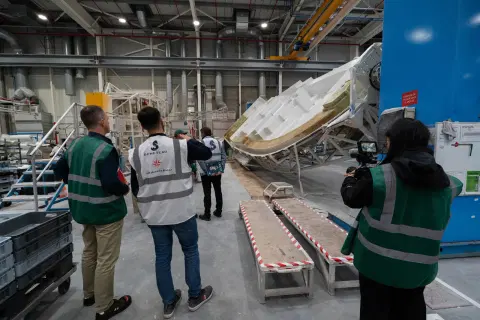
We were welcomed by senior members of the factory team and given an introductory presentation before being divided into groups of approximately ten, issued with steel toe-capped shoes and dressed in bright green high-visibility jackets. Any romantic idea of wandering casually through a boatyard disappeared once the safety equipment was on, although the atmosphere inside was not cold or impersonal, because the production system depended upon people at almost every stage. Machines created consistency and helped manage the scale of output, yet skilled workers still checked surfaces, installed systems, adjusted interior components and dealt with the small variations that appear whenever a complex boat moves from a mould towards the water.
Our tour began where many modern production boats begin, among the moulds and fibreglass materials that create the boat’s essential shape. A finished hull may appear smooth, clean and almost simple from a marina pontoon, although standing beside the moulds reveals how much preparation is required before that familiar white surface can exist. Release agents, gelcoat, carefully positioned layers of reinforcement and controlled resin application must combine correctly, because mistakes made at this stage cannot easily be hidden by polished joinery or attractive upholstery later in the build. Consistency is particularly important for a manufacturer working at Beneteau’s scale, where customers in many countries expect one boat to match the structural standards, finish and performance of another produced months earlier.
Fibreglass changed Beneteau’s fortunes during the 1960s, when the company moved from traditional working craft towards recreational boating under the leadership of the third generation, particularly Annette Roux and her brother André Bénéteau. Annette joined the family yard in 1964 and helped lead its transformation from an artisanal builder of commercial fishing vessels into a producer of leisure boats, while polyester construction provided the material capable of supporting that change. Moulded composite construction made repeatable production possible, reduced the maintenance associated with wooden hulls and opened boat ownership to a much broader public. The transition represented far more than adopting a new material, because it required Beneteau to reconsider what it built, who would buy it and how a family yard could manufacture boats on an industrial scale without losing the practical knowledge accumulated beside the Atlantic. Groupe Beneteau
The company’s origins reach back to 1884, when Benjamin Bénéteau established his boatyard in Croix-de-Vie after training as a naval architect at Rochefort. Fishing boats of the period carried names such as luggers, dundees and smacks, and their performance had a direct commercial purpose, because the boat returning to harbour first could sell its catch while the market was still hungry and the best prices were available. Speed, strength and seaworthiness were therefore not advertising language but working necessities, which helps explain why performance became such a persistent thread within the company’s identity. Benjamin later introduced motor-powered tuna boats during an era when some local fishermen reportedly distrusted engines, although the willingness to adopt unfamiliar technology would eventually become one of the family business’s defining characteristics. BENETEAU
Walking from the moulding area into the assembly operation showed how quickly a bare composite shell becomes crowded with systems that owners may rarely notice until something stops working. Pipes, ducting, electrical cables, pumps, tanks and services were installed with careful attention to routing, support and future accessibility, because a production yacht or motorboat must eventually be maintained far from the factory that built it. Much of this work disappears beneath furniture and interior liners, making the order of assembly essential, since fitting one component too early can obstruct another while a poorly planned cable route can create years of irritation for engineers and owners.
The production line brought a sense of controlled movement rather than hurried activity, with each boat progressing through a sequence of specialised stations where different teams completed defined sections of the build. Industrial boatbuilding at this level requires the choreography of a theatre production, although the scenery weighs several tonnes and arrives with plumbing, engines and electrical systems attached. Parts must reach the correct station at the proper time, workers need accurate instructions for different models and specifications, while quality checks must identify problems before the next layer of construction makes them harder to reach.
Cabin installation was one of the most revealing stages because this is where the boat began acquiring the character that customers recognise at a show or during a test sail. Joinery sections, bulkheads, seating, galley components and accommodation modules were brought together inside a hull that had previously looked more like an engineering structure than a future home. Small alignments mattered everywhere, from the way locker doors met their frames to the manner in which panels followed the curves of the hull, because a millimetre ignored repeatedly can become an obvious imperfection by the time a cabin is complete.
Beneteau’s claim to fame rests partly upon its ability to combine this industrial repeatability with boats that retain distinct identities. The First range established an enduring connection with performance sailing, giving club racers and fast-cruising owners boats that could compete seriously without abandoning practical accommodation, while Oceanis became one of the most familiar names in modern cruising. Figaro yachts created another influential chapter through demanding offshore one-design racing, where generations of French sailors developed the seamanship, tactical independence and endurance required for the highest levels of solo competition. On the motorboat side, ranges including Antares, Flyer, Gran Turismo and Swift Trawler expanded Beneteau’s reach into family cruising, sportier day boating and economical long-distance passagemaking.
Oceanis became particularly significant because it helped define the expectations of the modern production cruising yacht, combining manageable sail handling, useful interior volume and a range of layouts suitable for private owners or charter fleets. The boats were not intended to be rare objects hidden away for occasional use, because they were designed to cross channels, carry families on summer holidays and spend long seasons working from charter bases. That broad usefulness created an enormous international population of Beneteau owners, while the scale of the dealer and service network gave buyers confidence that support would not end when the boat left France.
Our route eventually reached final finishing, where the accumulated work of moulders, electricians, plumbers, engineers, joiners and assembly teams faced close inspection. Beneteau’s indoor test pool was one of the most memorable parts of the factory, because a boat that looked complete was not automatically considered ready to leave. Systems could be commissioned, fittings examined and water-related checks conducted within a controlled environment, allowing faults to be discovered before the boat was wrapped and transported to a dealer or customer. The process carried a simple message that applies equally to a modest family cruiser and an expensive yacht, because the person taking delivery is entitled to expect the drains, pumps, engines, electrics and fittings to work from the beginning.
Once the inspections had been completed and the boat checked again, it was shrink-wrapped for transport to its fortunate new owner. Seeing a complete boat covered and prepared for departure created a curious contrast with the exposed moulds and raw materials encountered earlier, because everything visible during the tour had now disappeared beneath a protective white covering. Somewhere beyond the factory, that same boat would eventually be unwrapped, commissioned and launched, with its owner perhaps giving little thought to the hundreds of individual tasks completed before the keys changed hands.
Production numbers are not consistently published for the Beneteau brand alone, partly because Groupe Beneteau now contains several brands and manufactures different categories of sailing and motorboats across an international network. The more useful measure of scale is the wider group, which generated revenue of €849 million in 2025, employed more than 6,200 people and operated 15 production sites, principally across France, Poland, Italy, Portugal and Tunisia. Its independent distribution networks reach more than 1,200 sales locations, while the family holding company BERI 21 continues to own approximately 54 percent of the listed group, maintaining a meaningful connection between a global industrial business and the descendants of its founder. press.beneteau-group.com
Groupe Beneteau has been listed on the Paris stock market since 14 March 1984, when expansion and international ambitions required access to greater financial resources. Its shares trade on Euronext Paris under the mnemonic BEN and carry the ISIN code FR0000035164, although the continuing majority position of the family holding company distinguishes Beneteau from a corporation whose ownership has become completely detached from its origins. The stock-market listing introduced public reporting, outside shareholders and the financial scrutiny expected of a quoted company, while family control helped preserve a longer view of products, factories and employment. Groupe Beneteau
The current financial picture deserves context because the recreational marine industry has been adjusting after the exceptional demand experienced during and immediately after the pandemic. Groupe Beneteau’s 2025 revenue of €849 million was below the €1 billion reported for 2024, reflecting slower markets, dealer stock adjustments and strategic changes that included the discontinuation of certain American brands. Encouraging signs appeared during the first half of 2026, when sales increased by 12 percent and income from ordinary operations returned to approximately break-even, representing an improvement of more than €20 million. Net income was affected by around €30 million of non-recurring expenses, principally connected with impairments relating to discontinued American brands, while management continued to expect sales and margins to recover during 2026. Groupe Beneteau
This is not a story of a company standing still, because Groupe Beneteau has been simplifying its portfolio, renewing models and concentrating investment around brands and product categories where it believes it can outperform the market. Eighteen recently introduced models received a strong response according to the group’s financial communications, providing a useful indication that product development continued even while market conditions became less accommodating. Boatbuilding has always been cyclical, with demand affected by confidence, finance costs, exchange rates and geopolitical events, so the more revealing question is whether a manufacturer retains the industrial capacity, dealer network, brand strength and product pipeline required for the next change in tide.
Beneteau possesses those foundations in unusual depth, supported by a name known well beyond France and a product history stretching from working fishing boats to offshore racers, family cruisers, trawler-inspired motorboats and increasingly sophisticated yachts. Its position also carries responsibility, because a manufacturer operating at this scale can influence construction methods, supplier standards, employment and the environmental direction of recreational boating. Greater use of lower-impact materials, improved resin processes, recyclable components, efficient propulsion and boats designed for longer service lives will become increasingly important as the marine industry attempts to reconcile growth with the health of the waters upon which it depends.
The factory visit ended with the welcome gift of a Beneteau baseball cap before we returned to the coach and travelled to the company’s nearby headquarters for lunch. The cap was a cheerful souvenir, although the lasting impression came from the sequence we had just followed, beginning with moulds and fibreglass before moving through services, interiors, finishing, testing and preparation for delivery. Every completed boat represented a long chain of specialists whose work would soon be hidden, leaving only the smooth hull, fitted cabin and the anticipation familiar to anyone preparing to take ownership of a new boat.
Beneteau’s achievement is not simply that it became large, because scale without identity produces little affection among sailors, while heritage without adaptation eventually becomes a museum display. Its more important accomplishment has been carrying an Atlantic boatbuilding tradition into modern production while continuing to create boats that ordinary owners can imagine using. The machinery, planning systems and international financial structure may belong to a global industrial group, yet the underlying idea remains remarkably close to Benjamin Bénéteau’s original purpose, which was to build a boat capable of carrying people safely, efficiently and perhaps slightly faster than the fellow trying to reach harbour first.
Leaving Saint-Gilles-Croix-de-Vie, the factory buildings slipped behind the coach as we headed towards Les Sables-d’Olonne and the much smaller J Composites operation, where a different philosophy of production awaited us. Beneteau had provided the scale against which the other yards would inevitably be measured, although the tour also showed that scale does not remove the human element from boatbuilding. Somewhere inside every Beneteau, behind the immaculate moulding and carefully fitted furniture, remain the hands of the people who routed the cables, joined the pipes, aligned the cabins and checked the boat in the pool before allowing it to begin a new life on the water.