The journey began with the sort of airport sprint that gives a travelling journalist an unwelcome appreciation of racing against the clock, because a nearly missed connection left little time for calm reflection before Nantes appeared beneath the aircraft. At baggage reclaim, the boot Düsseldorf team was easy to identify in matching shirts and jackets carrying the familiar “We love water” message, and after introductions among a travelling party of around forty international journalists, the cases were loaded and the coach turned south towards La Roche-sur-Yon. What followed over four busy days was not simply a procession through factories, because it became a revealing passage through the industrial, sporting and cultural landscape that has made western France one of the most important boatbuilding regions in the world.
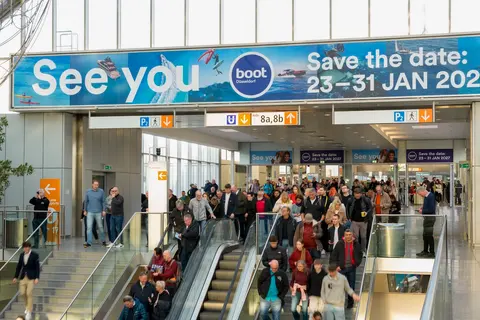
The tour had been organised ahead of boot Düsseldorf 2027, which will run from 23 to 31 January across the Messe Düsseldorf exhibition complex. That evening, boot director Petros Michelidakis set out how the show is adapting to a market that has become more demanding, more technically diverse and increasingly conscious of its environmental responsibilities. The 2027 edition is expected to occupy 15 halls across 210,000 square metres, with exhibitors representing 68 nations, while diving gains a larger dedicated presence and Hall 12 becomes a more ambitious action centre with an extended indoor pool, canoe channel and practical areas for stand-up paddleboarding, foiling and other watersports.
Philip Easthill, Secretary General of European Boating Industry, followed with a broader view of a sector that extends far beyond the polished yachts seen at major shows. European recreational boating encompasses about 32,000 companies and directly employs more than 280,000 people, linking builders, engine manufacturers, equipment specialists, marinas, charter operators and service businesses. Those figures gave useful scale to the factories waiting along our route, because every hull leaving a mould supports a far wider network of designers, laminators, electricians, engineers, transport firms, dealers and harbours.
Bénéteau and the Scale of Modern Production
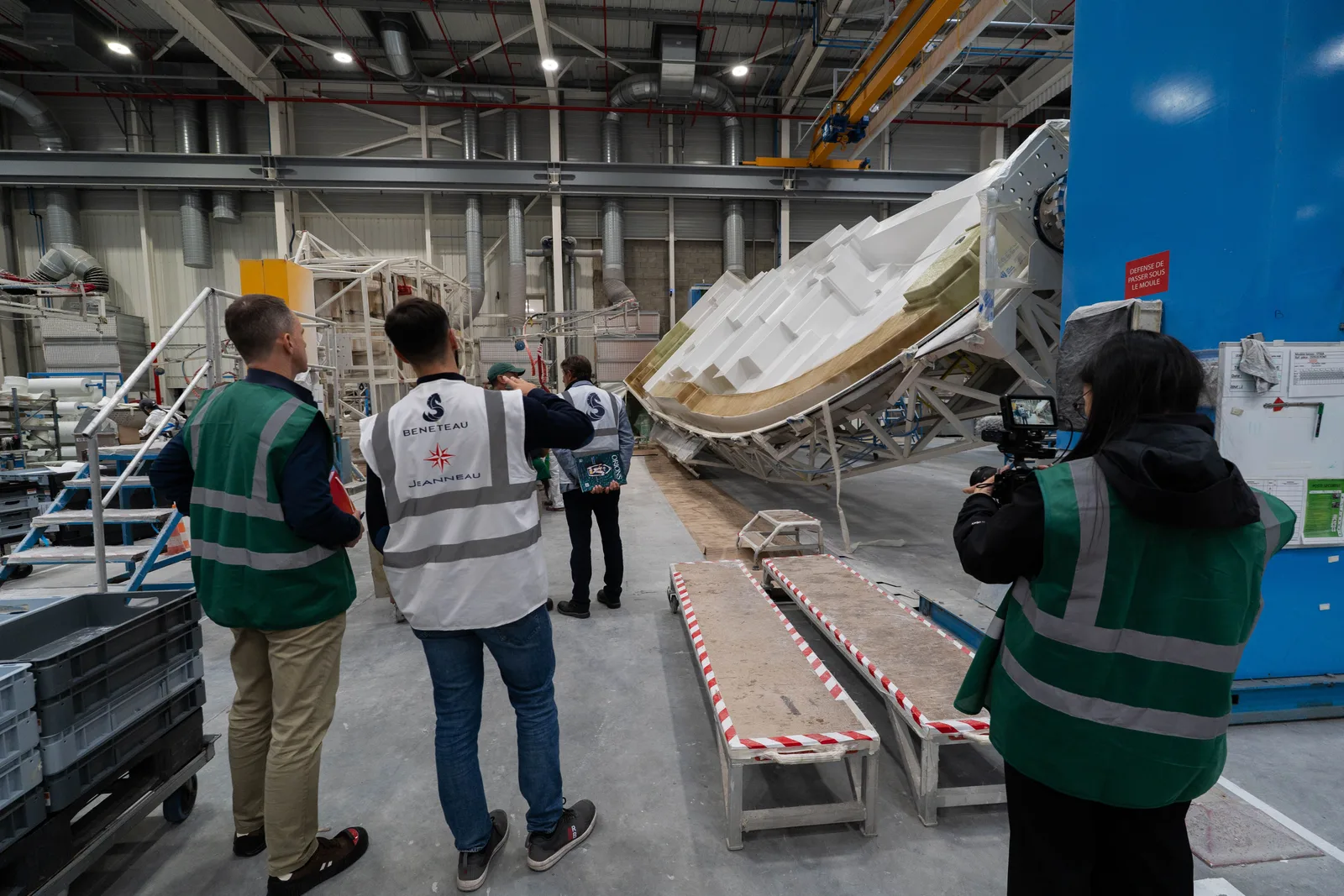
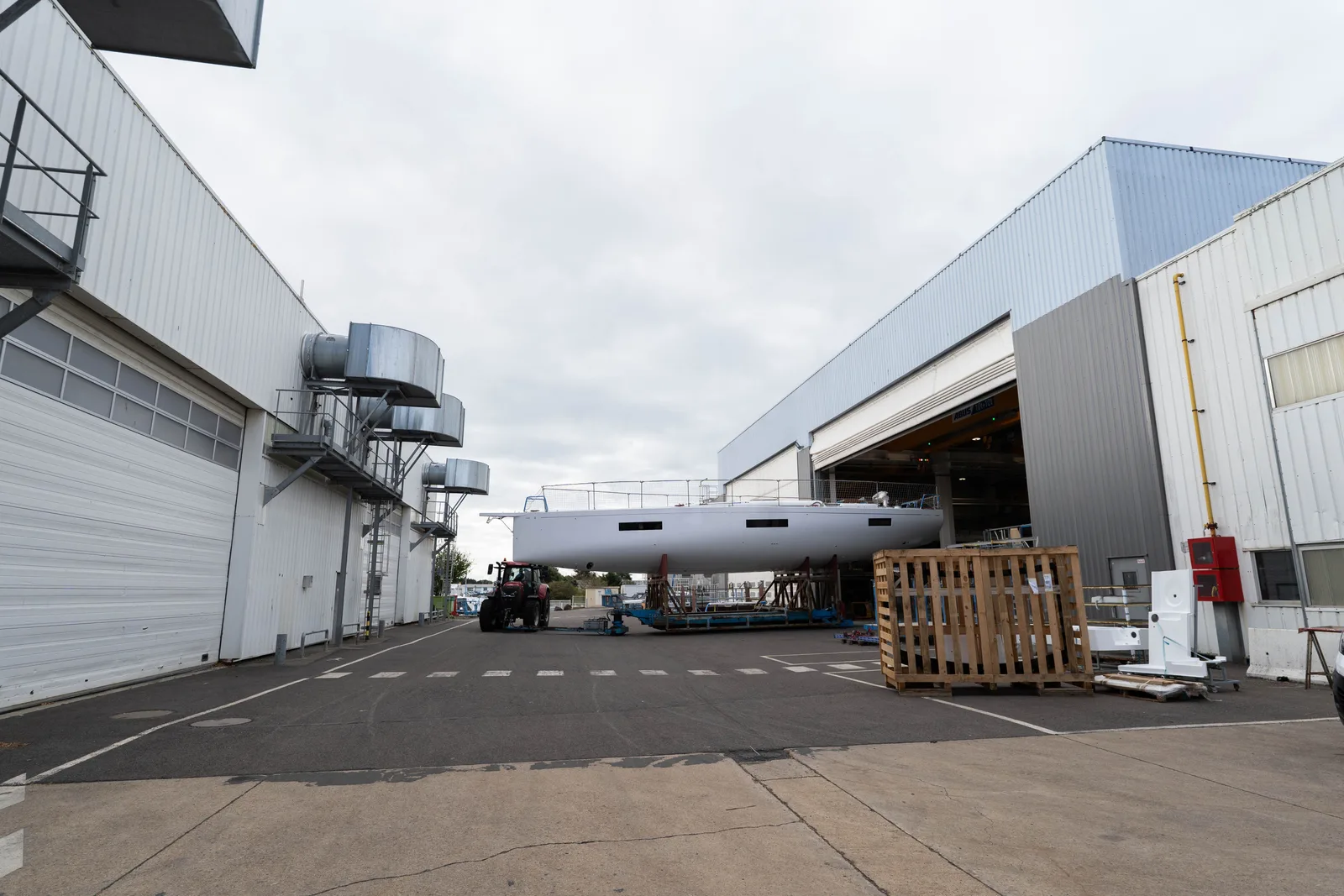
The first morning began at Bénéteau’s Saint-Gilles-Croix-de-Vie production facility, where steel-toe shoes and bright green high-visibility jackets replaced the usual press-room clothing. The tour started among moulds and fibreglass, where layers of material, resin and carefully controlled processes gradually create the structural shell of a boat, before following the production line through plumbing, ducting, electrical installation, interior modules, cabin joinery and final finishing. Completed boats entered an indoor testing pool, where systems and watertight integrity were checked before each vessel was wrapped for transport to its dealer or fortunate new owner.
Scale was the immediate impression, although the deeper story began only a short distance away in 1884, when Benjamin Bénéteau established his boatyard at Croix-de-Vie to build sailing craft for local fishermen. Speed already mattered because the first boats returning to harbour secured the best prices for their catch, while Benjamin’s determination to introduce engine power in 1909 met fierce local suspicion before proving the future had arrived. His son André revived the yard in 1928, and the family moved decisively into recreational boating during the 1960s as fibreglass allowed durable boats to be produced for a far wider audience.
That heritage now spans sailing ranges such as the Oceanis cruising family and First performance yachts, alongside motorboat names including Antares, Gran Turismo and Swift Trawler. The attraction of the factory visit lay in seeing how a company of such size still depends upon hundreds of small decisions that eventually disappear behind finished panels. A pipe routed badly, a cable hidden beyond sensible reach or a poorly fitted window can become an owner’s lasting frustration, so the repeated inspections and final pool test were as significant as the gleaming hull emerging at the end. Lunch at Bénéteau’s head office offered a welcome pause, as well as time to realise how much work had passed before us in a single morning.
J Composites and "Boats for True Sailors"
The afternoon coach carried us to Les Sables-d’Olonne and a very different atmosphere at J Composites, where managing director Didier Le Moal guided us through a yard producing roughly 200 boats each year. The scale was more intimate than Bénéteau, with around fifty employees and an annual turnover described during the visit as approximately eleven million euros, yet there was no sense that the company wanted to become an industrial giant. Le Moal’s message was direct, because J boats are built for true sailors, and his own racing experience gives that claim more substance than a marketing line.
J/Boats began in the United States in 1977 after Rod Johnstone designed and built the first J/24, creating a family business whose combination of easily driven hulls, manageable sail plans and genuine racecourse performance spread around the world. The French chapter opened when Didier Le Moal met Jeff Johnstone during the 1994 World Sailing Games in La Rochelle and founded J Composites that December to build J yachts under licence in Europe. The early J/92 and J/80 established the partnership, while more than 2,200 boats have since passed through the French operation.
Current models explain why the yard occupies an interesting position between racing and cruising. The J/70 remains one of the world’s leading sportsboat classes, the J/99 is aimed towards offshore and short-handed competition, and the J/40 and J/45 blend fast passage-making with interiors intended for owners who do not believe comfort should require a slow boat. The yard’s claim that J boats account for around 20 per cent of the Rolex Fastnet Race fleet illustrates the loyalty created by that formula, because the Fastnet exposes weakness with unusual efficiency. Here the production tour felt less like watching a conveyor and more like entering a workshop where the people building the boats understood exactly how they would be pressed when the breeze rose.
4CAD Éole Racing and a Vendée Globe Ambition
A short move took us from production sailing yachts into the sharper world of IMOCA racing at the headquarters of 4CAD Éole Racing. Benjamin Dutreux emerged as one of the revelations of the 2020 Vendée Globe when he finished ninth in an older straight-daggerboard boat, then reinforced his reputation with tenth place in the 2024 edition. His campaign has now entered a more ambitious phase through 4CAD Group’s backing of a latest-generation IMOCA designed by Antoine Koch and being developed in collaboration with Yoann Richomme’s Paprec programme.
The team had commissioned its own new boat for the first time, which gave the headquarters the particular energy of a project becoming real one component at a time. A full-carbon mast measuring approximately 26 metres had arrived and was displayed with understandable pride, its apparent simplicity concealing the engineering required to carry immense compression and rig loads through the Southern Ocean. The target is the 2028 Vendée Globe, the solo, non-stop and unassisted circumnavigation that has started and finished at Les Sables-d’Olonne since Philippe Jeantot created the race in 1989. Seeing that mast only a walk from the harbour made the campaign feel less like an abstract sporting promise and more like a machine steadily assembling around one sailor’s ambition.
Our route afterwards followed the marina towards a rooftop restaurant, with cameras repeatedly raised as the light moved across the forest of masts. Les Sables-d’Olonne carries offshore racing in its bloodstream, and the evening walk connected the clean computer models of the design office with the harbour through which Dutreux must eventually depart alone. Dinner above the waterfront ended a long day before the coach returned us to the hotel, where an early night became essential preparation for another 08:00 departure.
Fountaine Pajot and the Architecture of Space
The following morning brought a drive towards Aigrefeuille-d’Aunis and Le Thou, where Fountaine Pajot’s senior leadership welcomed the group into the world of production cruising catamarans. The company was created in 1976 by Jean-François Fountaine, Yves Pajot, Daniel Givon and Rémi Tristan, sailors whose early racing and boatbuilding interests developed into series-built cruising multihulls from 1983. Fountaine Pajot later became a listed company and has grown into one of the defining names of the modern catamaran market, where buyers expect private cabins, broad social spaces and easily managed sailing performance within the same platform.
Much of the tour concentrated upon what remains invisible once a hull is painted and fitted out. End-grain balsa is divided into small blocks held together on a flexible scrim, allowing the core to conform to curved moulds before resin infusion seals it between fibreglass skins. The resulting sandwich structure combines stiffness with relatively low weight, while the segmented core can help contain water migration if local damage occurs. Completed boats undergo a prolonged water test lasting around two hours, with spray directed across windows, hatches, deck fittings and joints to reveal leaks before the yacht reaches its owner.
Another building housed large computer-controlled cutting machines working through timber and sheet materials with layouts calculated to reduce waste. Extraction systems removed dust at source, leaving the air unexpectedly clear for a facility containing so many saws and routers. Managers explained that the site was operating at roughly half of its potential capacity, preserving room to increase output when demand requires it. The range now runs from accessible family cruising cats to the Aura 51, Samana 59 and the flagship Thíra 80, while the newer FP51 points towards the company’s next design generation.
Dufour and the La Rochelle Tradition
From the catamaran factories we travelled to Port des Minimes in La Rochelle to visit Dufour Yachts, another company whose history is inseparable from the arrival of fibreglass production. Engineer and racing sailor Michel Dufour founded the yard in 1964 after recognising the possibilities of polyester construction, beginning with the trailerable Sylphe before the Arpège established an international reputation for combining cruising accommodation with satisfying sailing performance. That balance remains central to a current range extending broadly from 35 to 55 feet.
The factory revealed another interpretation of series production, with hulls moulded before openings for windows and access points were cut and finished, while interior systems were arranged for both private buyers and charter fleets including Sunsail. Customer experience had influenced the routing of electrical services towards the centre of the boat, improving access when maintenance became necessary. Such a change lacks the drama of a new hull shape, although any owner who has attempted to trace a fault behind sealed furniture will understand why sensible service access can matter more than a fashionable feature.
Dufour remains primarily associated with monohulls, including models such as the Dufour 37, Dufour 41, Dufour 44, Dufour 48 and flagship Dufour 54, although its place within the wider Fountaine Pajot Group links the brand with multihull expertise and a shared industrial network. The visit showed how a historic marque can retain its own sailing character while benefiting from production knowledge gathered across a larger group.
Where the Factory Meets the Water
The final formal stop brought us to the marina at La Rochelle, where completed Fountaine Pajot catamarans and Dufour yachts undergo their last commissioning work and sea trials before delivery. Boats seen earlier as mouldings, cable runs and carefully cut panels now floated as complete yachts, their proportions finally understood against pontoons, masts and open water. The most commanding presence was a Thíra 80 that had completed its final sea trial and stood ready for handover, a vast sailing catamaran whose living spaces belong to the world of luxury yachting while its construction still begins with the same disciplined control of fibres, resin, core material and weight.
A gala dinner closed the formal programme, giving the journalists, organisers and boatbuilders a chance to exchange impressions without safety shoes, coach timetables or the constant noise of extraction systems. Four days had shown several versions of French boatbuilding, from Bénéteau’s industrial reach to J Composites’ deliberately controlled output, from Fountaine Pajot’s command of multihull volume to Dufour’s long-established cruising identity, while Éole Racing provided a glimpse of the uncompromising development required for a solo race around the world.
The tour also explained why boot Düsseldorf remains important. A major indoor show does more than place polished boats beneath exhibition lights, because it gathers the manufacturers, suppliers, distributors, sailors and curious newcomers who sustain the entire industry. When the doors open in January 2027, visitors will see finished products presented at their most seductive, although I will remember the hidden balsa blocks, carefully labelled cables, carbon mast, testing pools and skilled hands that made those displays possible. Detailed reports on each company will follow, yet the first lesson from France was already clear: every new boat carries a history, and every apparently seamless hull contains the work of many people whose names seldom appear on its transom.