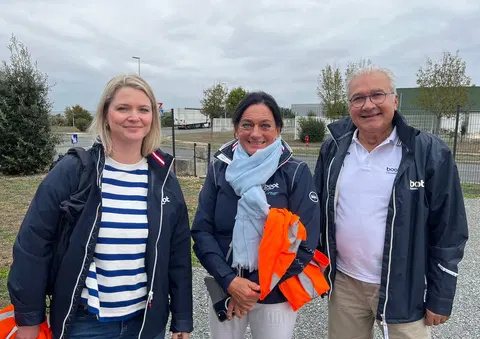
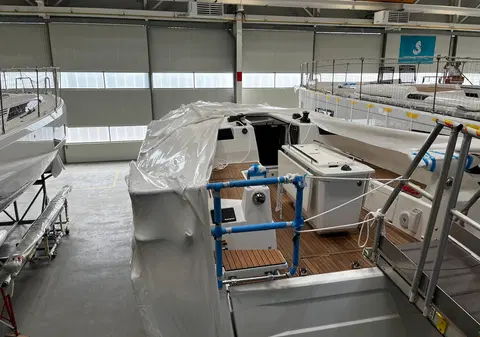
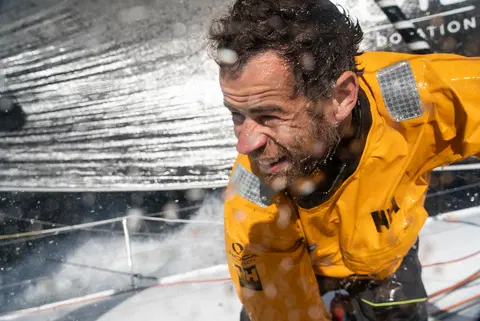
There is something slightly strange about walking through a factory knowing that the anonymous pieces of timber, glass fibre and balsa passing through enormous computer-controlled machines will eventually emerge at the other end as yachts capable of crossing oceans, because when the finished boat is sitting in a marina with cushions arranged, sails bent on and the coffee machine humming below, it is very easy to forget just how much engineering, cutting, laminating, joining and testing happened long before anybody stepped aboard with a glass in their hand. Following the boot Düsseldorf press tour, Old Sea Dogs was invited to see that process for ourselves at Fountaine Pajot’s home in western France, beginning at Aigrefeuille-d’Aunis and continuing through the group’s specialised production operation at Le Thou, before finishing at the marina where completed catamarans are tested on the water before delivery to dealers and owners.
Aigrefeuille is more than simply another production site because this is the historic headquarters of a company whose story began in 1976, when Jean-François Fountaine, Yves Pajot, Daniel Givon and Rémi Tristan created what would become Fountaine Pajot, initially building racing dinghies rather than luxury cruising catamarans. The new Aigrefeuille site followed in 1978 as demand grew for boats including the 505, 420 and 470, and competition remained very much part of the company’s early character, with Fountaine Pajot becoming involved in IOR Half Tonners that went on to world championship success and victories in the Solitaire du Figaro, before producing larger open racing multihulls including the Royale trimaran and Charente Maritime catamaran in 1981. That racing background still matters because lightweight construction, stiffness and the ability to make a boat strong without simply adding more material are not marketing ideas invented for modern cruising catamarans, they are lessons the company began learning when performance on the racecourse mattered above almost everything else.
By 1983 the direction was changing, although the performance thinking remained, with the Louisiana 37 marking Fountaine Pajot’s move into production cruising catamarans and beginning a development path that would eventually include boats such as the Maldive 32, Fidji 39, Venezia 42, Bahia 46 and Marquise 53. The Taïti 75 followed in the 1990s and helped open the day-charter market, while increasingly sophisticated composite construction became central to the way the company worked, with infusion adopted for the Lavezzi 40 in 2002 and later vacuum-moulding processes expanding through the range. The company joined the stock market in 2007, listing on what was then Alternext Paris and is now Euronext Growth Paris under the symbol ALFPC, giving a family-rooted French boatbuilder access to the capital needed to industrialise production and continue renewing its ranges. The group later brought Dufour into its activities in 2018, adding monohull sailing yachts to an operation already known internationally for sailing and power catamarans.
That history was given rather more substance when we arrived at the factory, where we were welcomed by senior management before starting a tour that quickly moved beyond polished presentation and into the practical business of making large composite structures. Fountaine Pajot now employs hundreds of people across its production operations, with the core sailing-catamaran range built at Aigrefeuille, larger flagship models produced close to the water at Port Neuf in La Rochelle and specialist digital cutting carried out at Le Thou. The scale is industrial, although much of the work still depends upon skilled people doing jobs where accuracy matters at every stage, because a cruising catamaran may contain thousands of individual components and the quality of the finished yacht eventually depends upon all of them arriving in the correct place and fitting together as intended.
One of the more interesting parts of the visit was seeing how balsa is used within the composite structure, because from outside a finished hull the word fibreglass suggests a solid laminate when the reality is far more sophisticated. We were shown sheets of balsa cut into small individual blocks and held together on a flexible gauze or scrim, allowing the material to follow the curves of the mould rather than behaving like a rigid wooden sheet, which becomes particularly important when forming the complex shapes found throughout a modern catamaran. Glass reinforcement, the balsa core and resin then become part of an infused sandwich structure, giving stiffness without the weight that would result from simply building an enormously thick solid laminate, while the small-block construction and resin boundaries around the core also help limit the ability of damage in one area to migrate unchecked through a much larger section. Fountaine Pajot has used glass, balsa and polyester sandwich structures with infusion techniques across its catamarans for many years, making this far more than an experimental construction method.
Watching the process explains why composite construction has become such an important part of the modern cruising multihull, because weight on a catamaran affects almost everything, from sailing performance and acceleration to payload and fuel consumption under power, yet nobody wants lightweight construction at the expense of strength. Infusion allows resin to be drawn through the prepared reinforcement under vacuum, controlling the relationship between fibre and resin much more accurately than older hand-lamination methods, while sandwich cores create a stiff structure without requiring an excessive amount of material. Fountaine Pajot itself traces much of its industrial development to advances in injection and infusion, technologies that allowed the yard to make larger structures with increasingly repeatable quality, and standing beside the moulds brings home just how far the industry has travelled from the relatively simple fibreglass boats of the 1970s.
Quality control becomes considerably less theoretical once the main pieces have been assembled, and one stage that particularly caught our attention involved the completed boats being subjected to an extended water test before they are allowed to move farther through the process. We watched boats being taken to a dedicated area where they spend around two hours being sprayed heavily with water, effectively creating the sort of persistent soaking that windows, hatches, deck fittings and joints might experience during foul weather at sea, while teams inspect inside for the smallest sign that water has found a route where it does not belong. It is hardly the glamorous part of catamaran building, although anyone who has owned a boat will understand that stopping rain and seawater entering the accommodation is considerably more important after the first winter afloat than many of the features that attract attention at a boat show.
The next stage of our visit took us to Le Thou, where the atmosphere changes again because this is where enormous computer-controlled cutting machines turn raw sheets and panels into precisely shaped components destined for boats elsewhere in the group. Officially, the facility handles digital cutting of fabrics and foams used in composite hull and deck construction as well as joinery panels destined for floors and bulkheads, although seeing the operation makes those words sound rather understated because the machines occupy a considerable amount of space and work with the sort of repeatability that would be difficult to achieve manually.
What impressed me was not simply the size of the machinery, it was the attention paid to getting as much useful material as possible from each panel, with cutting patterns arranged by computer to minimise the amount left behind once the required pieces have been removed. Waste on an occasional boat might appear insignificant, yet when production is repeated across hundreds of large composite and timber-intensive structures the difference between an efficient cutting plan and a careless one becomes enormous, both financially and environmentally. The same thinking was visible in the dust extraction, because an industrial building containing that many timber-cutting machines might reasonably be expected to disappear into a permanent cloud of sawdust, yet the air remained remarkably clean as extraction systems removed waste at source almost as soon as the cutting tools created it.
There was another detail at Le Thou that may prove important to the company’s future, because we were told that the facility was operating at only around half its available capacity, meaning there is already considerable room to increase output without immediately having to recreate the entire production system somewhere else. That spare capacity is easy to overlook when standing beside machinery that already appears to be working on an industrial scale, yet it gives Fountaine Pajot an interesting amount of flexibility should demand rise again, because increasing boat production is not simply a matter of hiring more people on an assembly line when every floor, bulkhead, composite insert and furniture panel has to arrive in sequence.
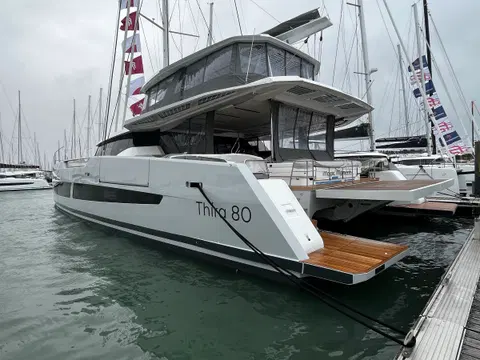
That scale is increasingly relevant when looking at where Fountaine Pajot now sits within the market, because the modern range stretches from comparatively accessible cruising catamarans towards genuine yacht territory, with the Thira 80 providing the most dramatic expression of how far the company has travelled since those early dinghies and Half Tonners. At just under 24 metres, the 80 was too large for conventional road transport from Aigrefeuille, which is why Fountaine Pajot’s larger flagship catamarans are built at Port Neuf in La Rochelle where they can be launched directly, and the boat brings superyacht-style spaces, a substantial flybridge, huge forward and aft living areas and serious passagemaking ambitions to a platform that still carries the basic DNA of the company’s smaller sailing catamarans. Fountaine Pajot’s own designers have spoken of average passage speeds around eight to nine knots in appropriate conditions, while the sail plan and enormous deck area make the Thira very clearly something beyond an enlarged family cruiser.
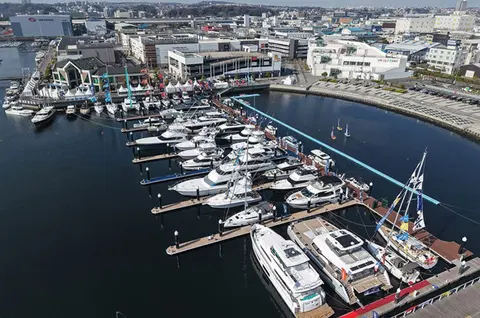
Seeing the boats on the water at the end of the tour was therefore the right way to finish, because a factory can teach you how something is built while a marina reminds you why anybody wanted to build it in the first place. Completed boats are tested before being handed onwards to dealers and owners, and lined up afloat they looked considerably different from the bare structures, moulds and precisely cut pieces we had been examining only a few hours earlier, with the Thira 80 inevitably dominating the view because an 80-foot sailing catamaran has a presence that is difficult to ignore even when surrounded by other substantial yachts.
There should have been rather more time to enjoy that part of the visit, although western France had other ideas and the sky suddenly opened with enough enthusiasm to remind a collection of marine journalists that waterproof jackets remain useful even when nobody is actually going sailing. The planned marina visit became considerably shorter as everybody made a fairly rapid retreat towards the coach, leaving the boats to deal with the rain rather more elegantly than we did, although Fountaine Pajot did manage one final gesture before we departed by presenting each of us with a substantial book telling the story of the company.
It is the sort of book that will probably spend much of its life on the coffee table at Old Sea Dogs, which seems appropriate because the company it describes has travelled a surprisingly long way from a handful of racing sailors building dinghies in 1976. Fifty years later Fountaine Pajot has built thousands of boats, operates internationally, remains publicly listed on Euronext Growth Paris and produces sailing catamarans that range from practical family cruisers to an 80-foot flagship that would have been difficult to imagine when the first 505s were leaving Aigrefeuille.
The most revealing part of the day, however, was not the company history or even the size of the Thira 80, because what stayed with me was the journey from apparently insignificant details to the finished yacht, with small balsa blocks flexing around a mould, computer software finding one more component in a sheet of timber, extraction systems swallowing sawdust before it can fill the air and water being deliberately fired at a new boat for two hours in the hope of finding a leak before its future owner ever has the chance. Boatbuilding on this scale is industrial, although good boats still emerge from getting thousands of small things right, and somewhere between the Aigrefeuille factory and the rain-soaked marina it became obvious that Fountaine Pajot has spent fifty years learning exactly that.