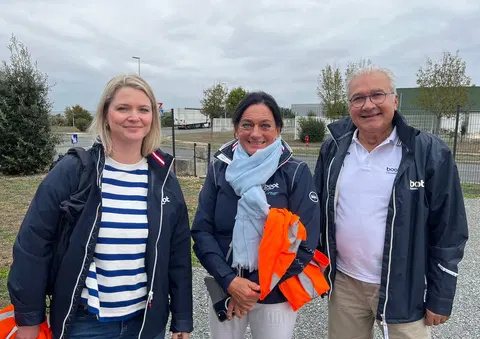
The road towards Fountaine Pajot led through the flat countryside of western France to Aigrefeuille-d’Aunis and Le Thou, where some of the world’s most recognisable cruising catamarans begin life far from any tropical anchorage. I visited the company during the boot Düsseldorf media tour last month, joining a group of marine journalists invited into the production facilities before travelling onwards to Port des Minimes in La Rochelle, where completed boats were undergoing their final checks upon the water.
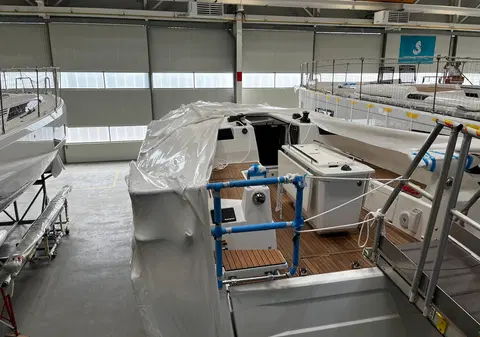
Catamarans displayed at international boat shows often appear almost impossibly clean and complete, with pale upholstery, carefully arranged cabins and broad decks intended to suggest a life of sunshine, warm anchorages and unhurried passage-making. The factory offered a very different view, revealing the thousands of individual operations hidden behind that polished surface, while composite structures, timber panels, electrical systems, plumbing, engines, furniture and deck equipment gradually came together around a production process designed to repeat complex work without losing control of quality.
The welcome from Fountaine Pajot’s senior management carried the confidence of a company celebrating its fiftieth anniversary while continuing to invest in new models and additional manufacturing capacity. The group is also unusual among French leisure-boat builders because its shares are publicly traded, placing its financial performance, strategic decisions and changing market conditions under a brighter light than privately owned competitors usually experience.
Fountaine Pajot was admitted to Alternext Paris, now known as Euronext Growth Paris, on 27 June 2007, with trading beginning on 3 July at an offer price of €30 per share. The shares trade under the symbol ALFPC with the ISIN code FR0010485268. The flotation brought new capital into the business and supported the industrialisation and renewal of its ranges, marking the point when an already successful boatbuilder began preparing for a larger international future.
The story began much earlier, during an era when production cruising catamarans remained a comparatively small part of mainstream sailing. Fountaine Pajot was established in 1976 by Jean-François Fountaine, Yves Pajot, Daniel Givon and Rémi Tristan, four men connected through sailing, competition and the desire to produce lightweight boats. Their early work centred upon dinghies and racing prototypes, including the 505, 470 and 420 classes, while experience with composite construction and International Offshore Rule racing boats gradually created the knowledge required for more ambitious designs.
Competition was deeply woven into the character of the young company, with its founders bringing lessons from Olympic sailing, international regattas and offshore racing into the factory. Lightweight construction, stiffness and efficient hull forms were not marketing concepts invented later, because they were practical requirements learned from boats where unnecessary weight or weak structures immediately appeared in the results.
The company launched its first range of cruising catamarans in 1983, entering a market still viewed with suspicion by many traditional monohull sailors. Earlier multihulls were frequently criticised for poor accommodation, limited carrying capacity or unconventional handling, although their speed and shallow draught had already demonstrated considerable potential. Fountaine Pajot helped move the production catamaran towards mainstream cruising by combining two hulls with practical living spaces, dependable construction and layouts suited to family ownership and charter use.
The appeal was straightforward once sailors experienced it. A cruising catamaran could offer a level platform at anchor, broad interior space, shallow draught and the privacy created by separating accommodation between two hulls. Twin engines provided close-quarters manoeuvrability, while the saloon and cockpit could be connected across one level rather than divided by a steep companionway. These qualities eventually transformed the global charter market and persuaded growing numbers of private owners that long-distance cruising did not need to involve living at an angle.
Fountaine Pajot was among the builders that industrialised those advantages, using series production to create catamarans in meaningful numbers while continuously refining construction methods. The company adopted resin infusion for the hulls and bridgedeck structure of the Lavezzi 40 in 2002, replacing more labour-intensive methods with a controlled process in which resin is drawn through reinforcement under vacuum.
The Mahé 36 later became the first model in the range to be produced entirely using vacuum techniques, with infused hulls and a deck created through the company’s RTM Eco process. These developments reduced unnecessary resin, improved consistency and created lighter structures without surrendering the strength required for offshore service.
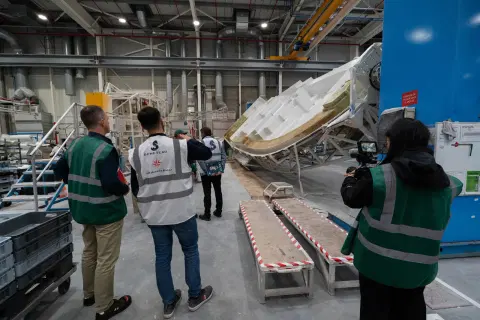
The composite area was one of the most revealing parts of our tour. Large moulds defined the shapes that would eventually become hulls and deck structures, while layers of reinforcement and core material were positioned before the infusion process began. The scale of the components made it clear that building a production catamaran involves more than repeating conventional monohull techniques twice, because the hulls must be connected through a bridgedeck capable of carrying rig loads, machinery, accommodation and the twisting forces generated when each side meets a different wave.
Balsa core was used within selected composite structures, supplied in small blocks held together by a flexible backing material that allowed the sheet to follow compound curves. Once positioned and infused within the laminate, the core became sealed between layers of glass fibre and resin, creating a stiff sandwich structure without the weight of a solid laminate of equivalent thickness. The individual blocks also limit the distance moisture can travel if local damage penetrates the outer skin, provided the repair is identified and completed correctly.
Balsa sometimes attracts suspicion among owners who remember older boats where poorly sealed deck fittings allowed water into the core, although the material remains valuable when engineered and installed properly. Its stiffness-to-weight ratio, bond strength and compressive performance explain why it continues to appear within sophisticated composite structures, while modern infusion processes give builders much tighter control over resin distribution and laminate quality.
Production moved from large composite pieces towards the hidden systems that determine whether a boat remains pleasant to own after the novelty of delivery has passed. Plumbing, electrical cables, ventilation ducting and mechanical services were installed before furniture and cabin modules restricted access, requiring each stage to follow a carefully planned sequence. The work may disappear behind panels, although it is precisely this unseen routing that determines how easily pumps, cables and connections can be inspected or repaired years later.
Furniture production at Le Thou revealed another side of the operation, with large computer-controlled machines cutting timber panels while software arranged components across each sheet to minimise unused material. The cutting area contained the machinery expected within a substantial industrial joinery facility, although the air remained unexpectedly clear because dust was extracted immediately from the tools and removed from the building.
Efficient nesting across each panel reduces cost as well as waste, while repeatable computer cutting allows replacement pieces to be produced accurately and ensures matching boats leave the line with consistent components. Skilled joiners remain essential because machines can cut the parts without completing the fitting, finishing and adjustment required inside a hull where small tolerances quickly accumulate.
The facility was operating at approximately half its potential capacity during our visit, leaving considerable room to increase production when demand strengthens. That reserve reflects the changing position of the international boat market, which has been returning towards more normal trading conditions after the exceptional demand experienced during and immediately after the pandemic.
The company’s recent financial figures demonstrate both the scale of the business and the effect of that changing market. Group revenue for the year ending 31 August 2026 reached €291.3 million, representing a reduction of 9.9 per cent from €323.2 million during the previous financial year. Revenue during the second half fell by a more moderate 7.1 per cent, which the company regarded as an early indication that demand was beginning to stabilise.
The latest full-year revenue remained considerably above the €276.8 million reported for 2022 to 2023, although the comparison with the exceptional €351.3 million achieved in 2023 to 2024 illustrates how rapidly the leisure marine market expanded before normalising. The first half of 2025 to 2026 produced revenue of €136.3 million and a group net profit of €5.2 million, compared with €156.2 million and €15.3 million during the corresponding period a year earlier. Full results for the complete 2025 to 2026 financial year had not yet been published when this article was prepared, making it important not to treat the annual revenue announcement as a complete assessment of profitability or cash generation.
Those figures describe a company facing a slower market rather than one standing still, with management using the transition to renew a substantial part of the model range. The FP41 and FP44 supported sales during the latest financial year, while the FP48, FP51 and FP55 form part of a new generation intended to carry the brand through its next stage of development. Larger sailing catamarans remain represented by established models and the flagship range, culminating in the Thíra 80.
Public ownership makes this investment cycle especially interesting because Fountaine Pajot must balance long-term product development against the shorter-term expectations attached to a listed company. Designing a new catamaran, creating moulds, reorganising production and building dealer confidence require substantial capital before customer deliveries begin generating revenue. The stock-market listing provides access to investors and greater financial visibility, although it also requires the company to report openly when revenue, margins or demand weaken.
Fountaine Pajot’s public status should not be confused with the main Euronext Paris regulated market occupied by many of France’s largest corporations. Euronext Growth is designed for small and medium-sized businesses seeking capital-market access with a framework proportionate to their scale. The distinction remains important, although the practical consequence for readers is straightforward: Fountaine Pajot is a publicly quoted French boatbuilder whose financial announcements, shareholder information and significant strategic decisions can be followed through formal market disclosures.
The group has grown beyond its original catamaran business, most notably through its combination with Dufour Yachts in 2018. The move brought one of France’s best-known monohull builders into the Fountaine Pajot Group, creating an organisation capable of serving sailors who prefer conventional yachts alongside those attracted by multihulls and motor catamarans.
Approximately 1,300 people now work across the combined Fountaine Pajot and Dufour organisation, representing around 40 different trades. The wider group operates production centres around the La Rochelle region and at Gujan-Mestras, with Aigrefeuille responsible for the core Fountaine Pajot range, Port Neuf in La Rochelle producing the largest flagship catamarans, Gujan-Mestras building motor yachts and Périgny remaining the historic home of Dufour. Fountaine Pajot states that more than 4,000 boats have been launched during its history, establishing a global fleet spread across charter bases, private marinas and cruising grounds around the world. Catamarans & Motor Yachts
A production catamaran company cannot be understood solely through the number of boats leaving its factories, because the fleet must remain supported after delivery. Fountaine Pajot operates through an international network covering approximately 80 countries, requiring distributors and service partners capable of handling commissioning, warranty work and technical support far from western France. This global structure also provides information from owners and charter operators whose boats accumulate thousands of hours in real service, creating feedback that can influence access panels, electrical routes, interior materials and future layouts.
The final stages of production include testing designed to find problems before a distributor or customer takes control. Completed boats are placed in a test pool and subjected to sustained water spraying for around two hours, allowing teams to inspect hatches, windows, deck fittings and seals for leaks. Systems are checked again before the catamarans are prepared for transport or moved towards the water for commissioning.
No production process can remove every fault from a complex yacht containing engines, pumps, electronics, plumbing, glazing, rigging and hundreds of fittings, although systematic testing can prevent small manufacturing errors becoming expensive customer problems. The discipline involved is less glamorous than a new model launch, yet it has far greater influence upon the owner who discovers a dry cabin after the first night of heavy weather.
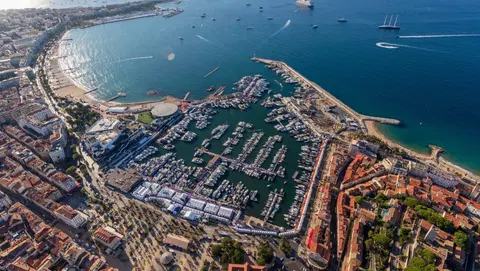
Our tour eventually reached Port des Minimes in La Rochelle, where examples from Fountaine Pajot and Dufour were afloat for commissioning and final inspection. Seeing the finished catamarans upon the water completed the journey from raw materials and open hulls towards functioning cruising yachts, while also revealing how dramatically scale changes once a large multihull leaves the factory.
The most striking boat was a Thíra 80 that had completed its final sea trial and was being prepared for its owner. At nearly 24 metres, the flagship sits in territory once occupied almost exclusively by custom yards, professional crews and one-off construction. Its immense beam creates living spaces more closely associated with a waterfront apartment, although the yacht must still carry a rig, cross open water and behave predictably when conditions deteriorate.
Fountaine Pajot has promoted the Thíra 80 as a combination of luxury and genuine seakeeping ability, later demonstrating the model in 35-knot Mediterranean winds and pronounced swell. Such boats attract owners who expect private-yacht finishes, crew accommodation and extensive customisation while retaining the stability, space and shallow draught associated with a cruising catamaran.
The Thíra 80 also reveals how far the production catamaran has travelled since Fountaine Pajot introduced its early cruising range in 1983. A sector once associated mainly with practical charter boats now extends from family cruisers around 40 feet to sophisticated flagships offering private terraces, large suites and professional service areas. This growth has brought valuable investment into multihull design, although it has also increased weight, complexity and energy demand, creating a constant tension between sailing performance and luxury expectations.
Fountaine Pajot’s ODSea Lab programme is intended to address part of that challenge through collaboration on lower-carbon cruising, onboard energy generation and hybrid propulsion. The company has stated an ambition to move towards carbon-neutral cruising and develop hybrid options across the range by 2030, while continuing to reduce factory energy consumption and recover a greater proportion of production waste.
Solar generation offers particular potential aboard catamarans because the broad coachroof and hardtop provide substantial surface area without requiring separate structures. Hybrid propulsion may allow silent manoeuvring and reduced engine use, although the weight, cost, battery capacity and real-world charging demands must be approached honestly. Large cruising catamarans consume significant energy through refrigeration, air conditioning, navigation systems, watermakers and domestic equipment, meaning worthwhile sustainability requires more than fitting an electric motor and adding a green badge.
The strongest impression from the factory was therefore not of a company relying upon fashionable promises, but of an industrial boatbuilder attempting to control thousands of practical decisions. Efficient panel cutting, enclosed dust extraction, infusion, carefully sequenced assembly and extended water testing may lack the romance of a sunset anchorage, although these processes determine the weight, durability and reliability of every completed catamaran.
Fountaine Pajot reaches its fiftieth anniversary in a market less forgiving than the extraordinary years that followed the pandemic, with revenue below recent peaks and customers taking longer to make major purchasing decisions. Its advantages remain substantial: a globally recognised brand, an extensive range, more than 4,000 boats already launched, international distribution and production capacity capable of supporting renewed growth.
Its stock-market listing adds another dimension because success is measured not only in boats delivered, but through revenue, margins, investment and shareholder confidence. The 2007 flotation helped finance industrial development, while the company’s present challenge is using the same discipline to navigate a normalising market without sacrificing the innovation required for its next generation of catamarans.
Walking through Aigrefeuille-d’Aunis and Le Thou made it impossible to view the finished boats simply as lifestyle products. Each catamaran represented composite specialists positioning core material, engineers planning systems, machine operators reducing waste, joiners fitting furniture and inspectors searching for the leak that an owner should never need to discover.
The broad decks and bright saloons may sell the dream, although the less visible factory work makes that dream capable of crossing an ocean. Fountaine Pajot began with racing sailors searching for lightness and speed, developed into one of the pioneers of production cruising catamarans and now enters its second half-century balancing industrial scale, public-market responsibility and the changing expectations of modern sailors. The company’s future will depend upon how successfully it preserves that connection between efficient production and boats people genuinely want to take to sea.