Meeting the people behind boot Düsseldorf offered a rare opportunity to understand how the world’s largest indoor yacht and watersports exhibition is planned, developed and continually reshaped around an international marine industry that never stands still. During a three-day press tour of leading French boatbuilders organised by Tania Vellen, Senior Manager Press and PR, I met boot Düsseldorf Director Petros Michelidakis and members of the team responsible for transforming a German exhibition centre into an extraordinary temporary maritime city every January.
The opening presentation provided an early look at the ambitions for boot Düsseldorf 2027, with Michelidakis explaining how the show would respond to changing visitor interests, commercial pressures and new areas of growth across the watersports sector. Larger activity zones, a greatly expanded indoor pool, stronger provision for diving, new exhibitors and a revised arrangement of the halls would all form part of the next edition, while Philip Easthill, Secretary General of the European Boating Industry, examined the wider position of recreational boating within the European economy.
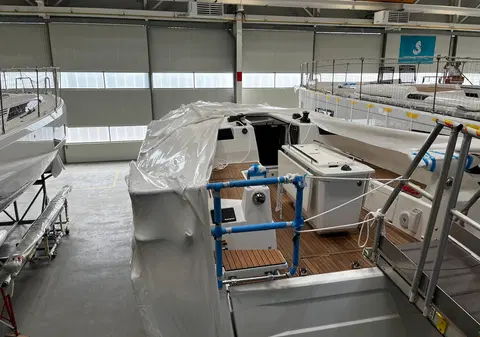
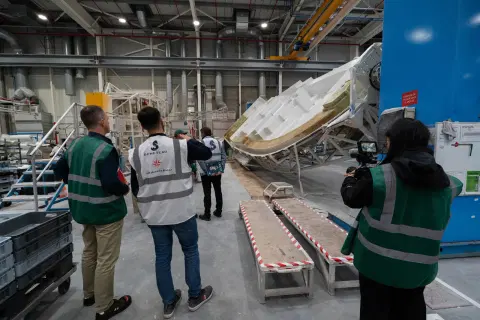
The following days took us through the production facilities of Beneteau, J Composites, Fountaine Pajot and Dufour, where raw materials, composite moulds, computer-controlled cutting machines and skilled boatbuilders gradually produced the yachts that would later appear beneath exhibition lighting. Seeing that process alongside the boot Düsseldorf team underlined the close relationship between the show and the manufacturers it serves, because the organisers are not merely selling space inside an exhibition centre. They spend the year visiting boatyards, speaking with builders, studying consumer behaviour and understanding the pressures facing an industry that depends upon investment, confidence and a continuing desire to spend time on the water.
Petros Michelidakis has directed boot Düsseldorf since 2016, although his journey towards the bridge was shaped by an international career extending well beyond boats and exhibitions. Born in Greece and raised partly in Germany, he began his professional life as a sales manager for a German freight-forwarding company before entering international trade promotion. In 1991 he took responsibility for an Athens office covering Greece, Cyprus, Türkiye and markets across the Middle East, later moving to Milan in 2007 to oversee work involving Italy and Malta. Between 2011 and 2015 he represented Messe Düsseldorf in Greece and Cyprus, gaining the detailed knowledge of international markets and commercial relationships required to persuade businesses from many countries to invest in a major exhibition.
His appointment brought that experience together with a lifelong interest in sailing and watersports, giving boot Düsseldorf a director who understood that a successful international show must satisfy several very different audiences. Manufacturers need serious buyers and dependable exposure, dealers need sales leads, designers need a place to reveal new ideas, while ordinary visitors want inspiration, entertainment and the opportunity to step aboard boats previously seen only in photographs. Sailors arrive carrying technical questions, families arrive with holiday plans, divers search for equipment and destinations, while younger visitors may simply want their first opportunity to try sailing, surfing, paddling or diving.
The enormous scale of the modern event makes its origins seem almost improbable. Boot Düsseldorf opened for the first time in November 1969 on Fischerstraße, when trade fair manager Kurt Schoop persuaded experienced boating journalist Horst Schlichting to help establish a major inland boat exhibition. Only 116 exhibitors from seven countries attended, yet 34,000 visitors passed through the doors during its six-day run, confirming that enthusiasm for boating extended far beyond traditional coastal communities.
Placing boats inside an exhibition hall was still unusual enough to attract considerable attention, while Düsseldorf discovered that its position beside the Rhine could connect the marine industry with millions of potential customers living across Germany and neighbouring European countries. The show had no harbour full of display boats and no Mediterranean sunshine to help create an atmosphere, yet it possessed something equally valuable, namely a central location, excellent transport links and a vast population within relatively easy travelling distance.
Expansion came almost immediately, with 183 companies from 25 countries attending the following year and the exhibition area doubling. The show moved to Düsseldorf’s modern northern exhibition centre in 1972, adopted its now familiar January position and expanded to nine days covering two weekends. That edition welcomed 307 exhibitors from 41 countries, occupied more than 50,000 square metres and attracted 85,751 visitors, while a large indoor pool allowed children and beginners to experience sailing under cover.
The decision to let visitors participate rather than merely observe became one of boot Düsseldorf’s defining characteristics, surviving through successive generations of sailing pools, diving towers, canoe channels and indoor surfing arenas. A visitor could look at boats, speak with the people who built them and then experience some form of watersport without leaving the building, creating an exhibition that felt less like a conventional trade fair and more like a compressed version of the entire maritime world.
Bringing increasingly large boats into an inland exhibition centre demanded an operation closer to a working shipyard than an ordinary show. Yachts travelled along the Rhine before being lifted ashore and moved towards the halls, with the enormous orange crane known as Big Willi becoming part of boot Düsseldorf folklore from 1980. The 84-tonne machine could lift yachts weighing as much as 100 tonnes, allowing builders to display vessels that earlier organisers could scarcely have imagined fitting inside an exhibition hall.
Larger yachts became an important part of the spectacle, although boot retained its broader appeal by continuing to include dinghies, family cruisers, engines, chandlery, diving equipment, canoeing, fishing and accessible watersports. The ability to place an ocean-going yacht near a beginner’s sailing pool became one of the show’s unusual strengths, reminding visitors that almost every experienced boat owner once began with a much smaller and simpler encounter with the water.
By 1987 boot Düsseldorf had become capable of attracting 100,000 visitors on a single Saturday, while Olympic champions, pioneering divers, celebrated sailors, international surfers and royal guests turned its halls into a gathering place for the wider watersports community. The 1990s brought further expansion, including a record 1,607 exhibitors in 1996 and the introduction of a dedicated superyacht hall the following year.
Luxury yachts moved into Hall 6 in 2001, where vessels longer than 30 metres demonstrated how far the exhibition had travelled from the relatively modest boats displayed during its earliest editions. Every hall at the Düsseldorf exhibition centre was occupied for the first time in 2003, although extreme water levels on the Rhine reminded organisers that transporting yachts inland remained vulnerable to the forces of nature. High water disrupted deliveries in 2003, while unusually low water created a different challenge the following year, when specialist vessels and pontoons helped the largest yachts reach the exhibition centre.
The show continued expanding beyond the traditional boat market, introducing areas dedicated to canoeing, fishing, maritime tourism, beginners and specialist equipment. The Classic Forum arrived in 2007, placing restored wooden craft and traditional seamanship beside modern production yachts, while the show adopted its “360° watersports” philosophy in 2010. That approach recognised that participation could begin with a paddleboard, a dive course or a charter holiday just as naturally as it could begin with buying a yacht.
Michelidakis inherited that substantial legacy when he became director in 2016, while the marine industry around the show was already being transformed by digital sales, environmental expectations, new propulsion systems and changing attitudes towards ownership. Charter businesses, shared access, houseboats and equipment-led activities gained prominence beside conventional ownership, while builders responded to growing demand for electric propulsion, efficient hulls, improved onboard energy management and construction methods carrying a reduced environmental burden.
The pandemic interrupted the familiar annual rhythm when boot Düsseldorf 2021 was cancelled during worldwide restrictions, removing an event manufacturers and dealers had long treated as the opening bell for the European boating season. Its eventual return demonstrated why a physical exhibition still mattered, because boats remain tactile objects whose qualities cannot be understood completely through a digital presentation. Buyers want to descend companionways, examine engine access, test seating positions, inspect joinery and imagine how a family might live aboard during an uncomfortable passage, while builders gain immediate insight into how customers respond to new layouts and equipment.
The commercial importance of the exhibition has become even more apparent during the present economic cycle. The German water-sports industry’s 2026 Economic Barometer described a market that had stabilised at a lower level after the exceptional fluctuations of recent years, with more than 60 per cent of surveyed companies reporting a weaker position than the previous year and fewer than 10 per cent recording an improvement. That does not amount to an industry in crisis, although it reveals a market shaped by caution, elevated operating costs, financing pressures and customers taking longer to make substantial purchasing decisions.
New boat sales have been particularly exposed to that caution, with smaller motorboats under pressure and the medium-sized sailing market losing some of its earlier momentum. Larger boats have proved more resilient because their customers are generally less affected by financing costs and economic uncertainty, while the used-boat market has remained an important stabilising influence through greater availability and more approachable prices.
Service and maintenance businesses have displayed greater resilience, accompanied by charter operators, training centres, marinas, surveyors and watersports schools whose income depends less heavily upon a single major purchasing decision. Canoeing, kayaking and nature-based activities have also remained comparatively steady, suggesting that the desire to spend time on the water remains strong even when customers postpone buying an expensive boat.
The economic report identified an important change in the way buyers approach boat shows, because customers faced with a significant purchase are researching more thoroughly and comparing a wider selection before committing themselves. Visiting several manufacturers individually could require hundreds of miles of travel between dealers, yards and showrooms, whereas boot Düsseldorf allows competing boats, equipment and ownership options to be examined in one place. This gives the exhibition renewed importance in a cautious market, since the ability to compare products directly may become more valuable as decisions take longer and customers demand stronger evidence before signing a contract.
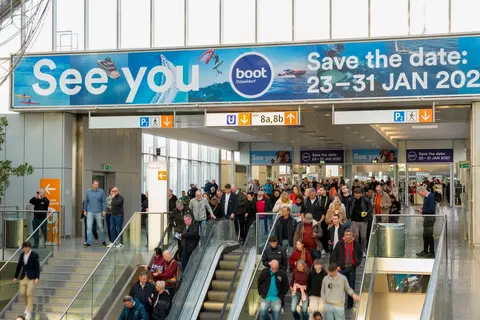
Boot Düsseldorf 2026 attracted 198,988 visitors and 1,391 exhibitors from 69 countries, while the organisers reported strong visitor quality and meaningful commercial activity despite the wider headwinds. The 2027 edition will attempt to build upon that foundation when it opens from 23 to 31 January, becoming the 58th boot Düsseldorf and welcoming visitors daily between 10:00 and 18:00. Nearly 1,500 manufacturers, retailers and destinations from around 70 countries are expected across fifteen exhibition halls, accompanied by more than 1,000 boats and yachts and a projected attendance exceeding 200,000 visitors.
The scale will once again stretch from compact tenders and sailing dinghies to offshore cruising yachts, production catamarans, high-performance motorboats and superyachts. The preliminary exhibitor list confirms the return of internationally recognised names across boatbuilding, electronics, equipment and propulsion, including Beneteau, Jeanneau, Lagoon, J Composites, Hallberg-Rassy, Azimut, Ferretti, Princess, Sunseeker, Garmin, Raymarine, Mercury and Volvo Penta. The list remained preliminary when issued, although its breadth already demonstrated the commercial pull Düsseldorf continues to exert across the industry.
The 2027 show will look noticeably different because Hall 9 is being modernised and will remain unavailable until boot Düsseldorf 2029. RIBs, inflatable boats, tenders and dinghies previously displayed there will move into Hall 17, forming the beginning of a redesigned Motorboat Walk continuing through Halls 1, 3 and 4. Superboats will occupy Hall 5, superyachts will return to Hall 6, while designers, brokers and specialist advisers will be positioned in Hall 7a.
A wide protected walkway through the Hall 9 construction area will maintain access between the northern entrance and the eastern halls, preventing the temporary closure from splitting the exhibition into disconnected sections. The revised structure has also been designed to provide more consistent long-term orientation, suggesting that the changes represent more than a temporary response to building work.
Sailing will remain concentrated in Halls 15 and 16, where most of the global players in the sailing-boat industry are expected to present production cruisers, performance yachts, multihulls and smaller craft. The Sailing Centre will provide a programme centred upon international regattas, cruising, offshore adventure and talks from prominent sailors, giving visitors an opportunity to hear the stories behind the boats and the people who take them beyond familiar waters.
Equipment, engines, refit products, clothing, deck hardware and marine accessories will fill Halls 10 and 11, accompanied by the Classic Forum in Hall 11. These halls often reveal the future direction of boating more clearly than the completed yachts, because battery systems, navigation electronics, propulsion technology, charging equipment, digital switching, sails and new construction materials show how the next generation of boats will function.
Electric and hybrid propulsion will continue attracting attention, although experienced owners will look beyond attractive claims towards the practical questions of range, charging time, battery weight, service support and the availability of replacement components. The blue innovation dock in Hall 10 will provide a forum where shipyards, technology businesses, investors, researchers and political representatives can examine those issues, connecting environmental ambition with the commercial and regulatory realities of modern boatbuilding.
The motorboat and luxury-yacht sections will arrive during a more considered period for the premium market. Sales figures for the first half of 2026 suggested that the superyacht sector had cooled from the exceptional conditions of earlier years, although the picture was more complicated than a simple collapse in demand. Within the popular 24-to-30-metre market, 150 used yachts changed hands during the first half of 2026, compared with 162 during the equivalent period in 2025, while vessels of that size still represented approximately 40 per cent of all projects in the global new-build order book.
Yachts were remaining available for longer and undergoing more price revisions, giving well-prepared buyers greater choice and an improved negotiating position. When asking prices were reduced, the median difference between the original and final asking prices reached 21.1 per cent during the first half of 2026, compared with 19.1 per cent in 2025 and 14.6 per cent in 2023. Individual reductions had not grown substantially, although yachts were being reduced more frequently as their time on the market lengthened.
New construction above 30 metres displayed a similar preference for certainty, with 61 of the 89 projects sold during the first half of 2026 already under construction and only 28 representing entirely new orders. Buyers appeared increasingly attracted to known delivery schedules and projects they could inspect rather than committing themselves to a long wait for a yacht beginning from a blank sheet.
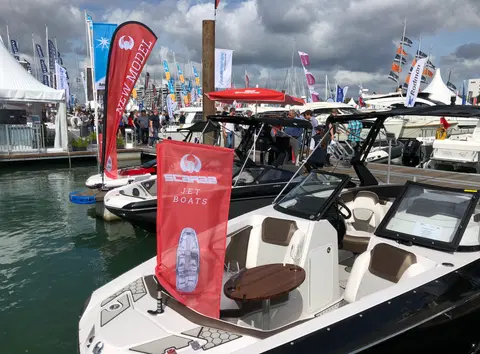
Hall 6 will give visitors an opportunity to compare offerings from major builders, while Hall 7a will place brokers and advisers nearby for discussions about ownership, purchase structures and the used-yacht market. Hall 5 has meanwhile developed into a significant destination for high-quality dayboats, runabouts, weekenders and exclusive tenders, reflecting a younger group of buyers who may want the finish and performance associated with luxury yachting without the financial and operational commitment of a much larger vessel.
A major new professional initiative will arrive on 28 January with the first Superyacht Thursday, organised by the Deutsche Yachten working group and boot Düsseldorf. The invitation-based programme will begin before the exhibition opens with a breakfast for approximately 100 industry guests, followed by English-language presentations and panel discussions focused upon refit, one of the most important areas of the modern superyacht economy.
Refit has become increasingly significant as the global fleet grows older, environmental requirements develop and owners seek to add new propulsion, navigation, energy and communications technology without commissioning an entirely new yacht. Peter Hürzeler of Ocean Independence, yacht designer Katharina Raczek and Tim Schommer of Noorden Jones are among the confirmed speakers, while the afternoon programme will continue with member meetings and professional networking in Hall 7a.
The initiative is intended to attract shipyards, owners’ representatives, designers, suppliers and service businesses that may not currently exhibit at the show, strengthening boot Düsseldorf’s position as a working international marketplace rather than a display intended solely for the public. Personal relationships remain particularly important within the superyacht industry, where projects carry high financial value, long delivery periods and an exceptional dependence upon trust between owners, representatives, designers and yards.
One of the most visible transformations will take place in Hall 12, where surfing and paddling will be brought together for the first time. A 65-metre pool will host demonstrations, visitor sessions and four international competitions, accompanied by a new two-level skimboard course, a Surf Academy, an indoor canoe channel and a high-rope adventure course.
The canoe route will circle an artificial island rather than requiring participants to turn at each end, creating a continuous course where paddlers are less likely to obstruct one another. Beginners will receive more opportunities to try pump foiling, wakeboarding, stand-up paddling, windsurfing and skimboarding, while the new Train with a Pro programme will place experienced participants into small-group sessions with leading athletes who can provide direct technical guidance.
The opening weekend is scheduled to include the SFT Indoor Pump Foil World Cup and the World Skimboard Masters, while wakeboarding and windsurfing will take over during the second weekend for the Pooltastic Wakeboard Masters and the FPT Indoor Tow-In Freestyle. E-foiling will receive a stronger presence around the Pool Stage, reflecting another fast-growing area where electronic technology and traditional board sports are beginning to overlap.
The Surf Festival Camp will also return to the exhibition’s P1 parking area, where visitors with campervans can stay close to the grounds for €25 per night plus city tax, with showers, water, electricity and shuttle transport available. This practical addition gives the surfing and paddling community a gathering place extending beyond exhibition hours, strengthening the sense that Hall 12 is intended to become a temporary watersports festival rather than a conventional product display.
Diving will be brought together beneath one roof in Hall 13, which was already fully booked months before the exhibition opened. Equipment manufacturers, specialist retailers, training organisations, tour operators and international diving destinations will share the hall with demonstration pools, a diving tower, stage presentations and sessions designed for both newcomers and experienced divers.
The range of destinations will stretch from accessible European waters to distant tropical reefs, including the Mediterranean, the Canary Islands, Madeira, Egypt, Mauritius, the Maldives, Thailand, Indonesia, the Philippines, the Caribbean and the Pacific. For visitors planning a diving holiday, Hall 13 will provide the unusual advantage of comparing destinations, operators, equipment and training during the same visit, while experienced divers can explore new technology without losing sight of the environments that make the activity worthwhile.
The boot Dive Award, introduced in 2023, will return with support from Bauer Kompressoren and recognise achievement across five categories covering Personality, Destination, Innovation, Product and Climate. Three nominees will be selected within each category, followed by public voting and the judgement of an international media jury, while each winner will receive €3,000 and the opportunity to present their work at the show.
The awards connect commercial diving with environmental responsibility, equipment development, travel and public communication, acknowledging that the future of the sector depends upon healthy oceans as much as improved technology. The 2026 winners included Antonio Cressi in the Personality category, actor and environmental campaigner Hannes Jaenicke for Climate, the Garmin Descent S1 in Product, Divevolk’s underwater smartphone data transmitter for Innovation and French Polynesia as Destination.
Hall 14 will provide a change of pace through Destination & Boat Life, combining charter operators, houseboat companies, international marinas, tourism authorities and organisations serving people who want to experience life on or beside the water without purchasing a vessel. This section reflects one of the clearest changes in modern boating, because access has become almost as important as ownership. A family may charter a yacht for one week, rent a houseboat for an inland holiday or join a training programme without accepting the fixed costs of maintaining a boat throughout the year.
Water Pixel World and Love Your Ocean will connect photography, storytelling, education and conservation, while the ocean tribute Award will continue boot Düsseldorf’s support for practical marine protection. The award creates an international stage for projects addressing ocean health, pollution, research and sustainable use, ensuring that the exhibition does not discuss future boats without also considering the future of the waters upon which they depend.
Visitors planning their journey can choose from several ticket options, including a two-day boot.club ticket priced at €21, with reduced admission of €16 for pupils and students. Standard online admission costs €23 for one day, while children up to and including the age of 12 enter without charge. Trade visitors can purchase a €28 single-day ticket or a €44 two-day ticket, gain entry from 09:30 and use dedicated business lounges, while a weekday afternoon ticket provides a lower-cost option for visitors from the Rhine and Ruhr region.
The slogan for 2027 is “All water sports. One Community,” which neatly describes the difficult balance boot Düsseldorf has spent nearly six decades refining. Few exhibitions can place serious superyacht negotiations, family cruising boats, diving destinations, classic craft, racing boards, marine conservation and a child’s first sailing experience within the same event without becoming hopelessly fragmented. The revised hall plan attempts to preserve that breadth while giving each community a recognisable home.
Petros Michelidakis described the forthcoming exhibition as a show adapting to its market while preserving the character that made Düsseldorf an important international meeting place. His approach appears grounded in direct contact with manufacturers, dealers, charter businesses, equipment suppliers and the journalists who report upon them. The French press tour demonstrated that relationship in practical form, taking the organising team into production facilities where boats are laminated, assembled, wired, tested and prepared for delivery.
Those visits also changed the way the completed displays in Düsseldorf should be viewed, because every polished yacht represents thousands of individual decisions and many months of skilled work. Composite structures, hidden pipework, electrical systems, furniture modules, machinery and deck equipment must all be completed before a boat reaches the exhibition floor, where visitors may judge the finished result within a few minutes. Boot Düsseldorf provides the stage upon which those efforts meet the public, while the conversations surrounding each boat help shape the models that will appear in future years.
When the doors open on 23 January 2027, visitors will discover polished hulls, towering rigs, foiling boards, diving pools and immense motor yachts arranged with the confidence of a permanent maritime city, although almost everything will have been transported into place for only nine days. That temporary quality remains part of the attraction, because boot Düsseldorf appears during the depths of a northern European winter carrying the promise of another season on the water.
The original exhibition in 1969 proved that the maritime world could be brought inland, while the 2027 edition will reveal how far that ambitious idea has travelled. Fifty-eight editions later, the boats may be larger, the technology more complex and the commercial pressures considerably greater, yet the essential purpose remains familiar: bringing people together around the water, allowing them to compare possibilities and sending them home with another voyage beginning to take shape.