The doors opened in Pensacola on 19 October 2026 with the usual gathering of officials, athletes, technicians and invited guests, yet the most important arrival needed no speech, because sitting inside the American Magic High Performance Center was an F50 catamaran whose presence signalled a profound change in the way SailGP prepares its sailors. Until now, teams competing in the world’s fastest international sailing championship have travelled from one spectacular city to another, unpacking boats, studying unfamiliar water and squeezing precious training into the narrow window before racing began, often with weather, logistics and technical schedules deciding how much useful practice could actually be completed. Pensacola has altered that rhythm by becoming SailGP’s first long-term, year-round training base, providing a permanent home where athletes can learn, established crews can refine their communication and new combinations can make mistakes without a championship point hanging upon every manoeuvre. ussailgpteam.com
The opening completed a plan announced in January 2026, when SailGP and American Magic confirmed that the newly established Pensacola centre would become a North American training hub under an agreement running until the end of 2031. The partnership brings together two organisations shaped by foiling technology and elite competition, although their histories have followed different courses. American Magic was formed in 2017 to challenge for the America’s Cup, drawing upon one of sailing’s oldest international ambitions while seeking to build a modern American performance programme around advanced design, engineering and athlete development. SailGP was launched the following year by Larry Ellison and Sir Russell Coutts, with its first racing taking place in Sydney in February 2019, when six national teams began competing in identical F50 catamarans derived from the foiling technology developed for the America’s Cup. sailgp.com
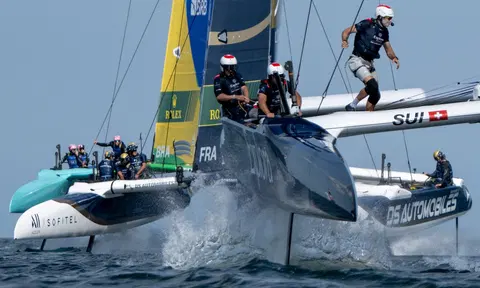
Those early SailGP regattas established the championship’s central promise, with national teams racing at close quarters aboard boats fast enough to transform a small tactical error into an immediate and highly visible loss. The opening season visited Sydney, San Francisco, New York, Cowes and Marseille, introducing spectators to a form of racing where boats rose onto hydrofoils, accelerated with startling force and crossed traditional sailing boundaries between athletic competition, engineering and spectacle. Dylan Fletcher supplied one of the defining early moments when the British F50 exceeded 50 knots during training before the 2019 Cowes event, reaching 50.22 knots on the Solent and demonstrating how quickly the new platform was expanding the accepted limits of inshore racing. The achievement also revealed something less glamorous yet equally important, because such speed was reached during training, where a crew could concentrate upon technique, communication and control without the compression of a live race start. sailgp.com
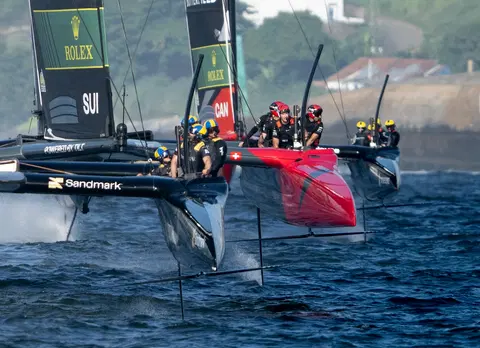
SailGP grew from those six original teams into a championship containing 13 national crews during its sixth season, while the F50 evolved into a machine capable of exceeding 100 kilometres per hour and travelling several times faster than the wind. Three wing configurations, interchangeable foils and a sophisticated control system allow the boats to race across a broad range of conditions, although that adaptability creates an enormous learning burden for the athletes. A flight controller must hold the catamaran at an efficient height above the water, the driver must judge closing speeds that leave almost no time for hesitation, grinders must supply hydraulic power, while tacticians and strategists must interpret an entire racecourse that appears to shrink as boat speed rises. Every movement is interconnected, which means a poorly timed turn, delayed call or momentary loss of flight can surrender several boat lengths before the crew has fully understood what went wrong. SailGP
Pensacola therefore matters because it gives teams something that even the most advanced technology cannot replace, namely repeated hours on the water. Emirates GBR driver Dylan Fletcher was among the first athletes to experience the new facility, describing the opportunity to refine communication, test ideas and develop established playbooks away from racing as a major advance. His presence carried a certain historical neatness, since the sailor who first drove an F50 beyond 50 knots in 2019 was now helping to open the facility intended to prepare the next generation for even greater performance. Six teams had already booked training time soon after the opening, with the league’s dedicated training F50 unpacked, assembled, tested and prepared for use before crews arrived. Pensacola Local Today
The geography is equally persuasive, because Pensacola Bay offers a large, comparatively protected expanse of water with reliable sailing conditions, ready access from the Port of Pensacola and enough room for foiling boats to stretch their legs without being sent directly into open-ocean punishment. Conditions will never remain identical, which is precisely why the water should prove valuable, since crews need to practise transitions between displacement sailing, partial flight and stable foiling while learning how the platform reacts as pressure, sea state and wind angle change. Flat water can expose tiny errors in foil control, stronger breeze allows teams to sharpen their high-speed manoeuvres, while lighter days offer the opportunity to practise the delicate take-off sequences that often determine whether an F50 escapes from the start or becomes trapped behind disturbed air.
The technical centre ashore is just as significant as the sailing area outside it, since high-performance campaigns are sustained by engineers, boatbuilders, data analysts, shore crews, safety specialists and medical personnel whose work rarely attracts the same attention as a dramatic mark rounding. Centralising those skills removes the need for every team to recreate an expensive private training operation, while allowing multiple crews to use shared services and consistent safety procedures. SailGP will manage the schedule to provide equal access, with teams paying for the particular days they use rather than carrying the fixed cost of maintaining separate permanent facilities. The first ten training days sit outside the annual US$10 million team operating cap, creating an incentive to use the centre for genuine athlete development rather than allowing financial caution to leave the boats ashore. ussailgpteam.com
That arrangement will be watched carefully because equality of equipment has always formed an essential part of SailGP’s appeal. Every national team competes with the same fundamental F50 platform, while technical information gathered across the fleet contributes to development managed at championship level. A permanent training centre could have threatened that balance if access depended upon private influence or individual team wealth, yet central scheduling and a common operating structure are intended to prevent Pensacola becoming the preserve of the strongest programmes. Competitive fairness will still depend upon how intelligently each team uses its allocated time, because equal days do not guarantee equal improvement, while the crews arriving with clear objectives, disciplined debriefing and strong coaching are likely to extract the greatest value.
Roster depth may become the centre’s most important long-term contribution, since an F50 cannot be treated like an ordinary racing dinghy or keelboat when a new sailor joins the crew. The platform’s acceleration, loaded systems and unforgiving closing speeds require controlled introduction, while the limited practice available during traditional event weeks has made it difficult to give inexperienced athletes meaningful time without compromising race preparation. Pensacola can provide a safer progression from simulator work and shore-based systems training into measured sessions on the water, allowing women, younger athletes and sailors transferring from Olympic classes, offshore racing or the America’s Cup to understand the boat before being asked to perform under grandstand pressure.
American Magic also gains a powerful foundation for its wider ambitions, because the Pensacola High Performance Center was created as more than a temporary America’s Cup base. Its programme encompasses elite competition, Olympic pathways, youth development and women’s sailing, giving the building a purpose that can continue between major campaigns. SailGP’s presence brings international teams, technicians and intellectual exchange into that environment, while Pensacola receives visitors, specialist employment and a visible connection with one of the fastest-growing championships in sailing. Mayor D.C. Reeves described the opening as proof that the bay had moved beyond being a well-kept secret, and the sight of an F50 leaving the dock will make that argument far more effectively than any promotional slogan.
SailGP has built its identity around short races, famous waterfronts and immediate drama, yet the standard seen by spectators is created during the quieter hours when crews repeat manoeuvres, engineers examine data and sailors discuss a failed turn until every movement has been understood. Pensacola gives those unseen hours a permanent address, shifting the championship from a travelling series with occasional practice into a more complete performance ecosystem capable of operating throughout the year. The boats will still race in iconic cities, national rivalries will still be settled metres from crowded shorelines and the decisive moments will still arrive at extraordinary speed, although the preparation behind those moments will now be deeper, more methodical and less dependent upon the restricted days preceding a regatta.
The first F50 to arrive in Florida represented only one boat inside a new building, yet maritime history is often made through apparently modest beginnings. SailGP’s inaugural event in Sydney started with six teams and an idea that foiling catamarans could support a global championship, while the Pensacola base begins with a shared boat, a stretch of dependable water and the belief that better preparation will produce closer racing. Years from now, the facility may be remembered less for its opening ceremony than for the sailors who learned their craft there, the crews who found the missing fraction of control and the young athlete who first stepped aboard an F50 on Pensacola Bay before eventually lifting a championship trophy.