Ocean races are often decided by decisions that appear almost insignificant when they are made, perhaps a gybe delayed by an hour, a course held for several miles longer than the surrounding fleet or a narrow tongue of pressure trusted when every weather model offers a slightly different answer. Corentin Horeau’s extraordinary breakaway in the 2026 Route du Rhum began with precisely such a choice, as the MACSF skipper continued west on a direct course while the leading boats around him turned north in search of what appeared to be the narrowest and safest crossing of a stationary Atlantic front.
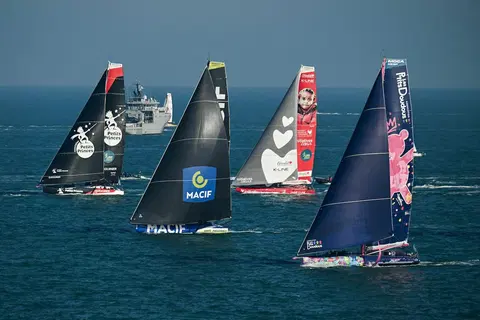
The 37-year-old Frenchman entered the transition behind early leaders Sam Goodchild aboard MACIF Santé Prévoyance and Italy’s Ambrogio Beccaria on Allagrande Mapei, both of whom had demonstrated impressive speed during the opening passage from Saint-Malo. Their short gybe towards the north appeared logical, positioning them closer to a theoretically narrower section of the front where they hoped to minimise the time spent in weak and unstable wind, although the atmosphere refused to follow the neat lines generated by the routing software.
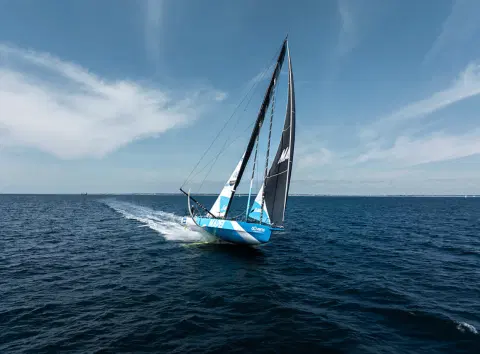
Horeau continued straight towards the weather barrier, approaching from farther south and trusting the pressure visible ahead rather than making the additional manoeuvre. MACSF found just enough wind to keep moving through the transition before the passage closed behind, leaving Horeau accelerating south in a strengthening northerly while Goodchild, Beccaria and several other leading contenders remained trapped in light air. A small deficit became a lead, the lead became a breakaway and MACSF was soon more than 150 nautical miles ahead of a fleet that had previously been separated by only small margins.
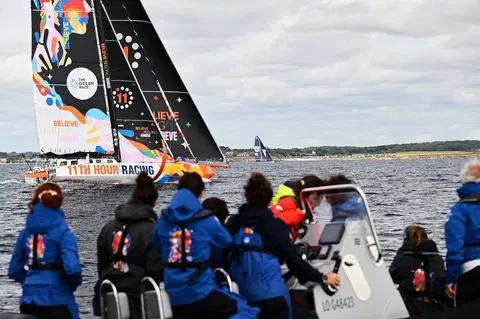
By Wednesday morning, Horeau had become the only IMOCA skipper to escape the front cleanly, sustaining speeds above 20 knots while the boats behind struggled to reach double figures. Boris Herrmann had climbed into second aboard Malizia 4, with Italian-American skipper Francesca Clapcich close behind on 11th Hour Racing, although both remained on the wrong side of an expanding gap. Later position reports placed Horeau more than 200 miles ahead, an astonishing advantage created not by weeks of gradual separation, but by one weather transition north of the Azores.
Thomas Ruyant watched the move unfold from ashore with the authority of a sailor who understands both the race and the boat involved. Ruyant won the IMOCA class in the 2022 Route du Rhum aboard LinkedOut, completing the Saint-Malo to Pointe-à-Pitre course in a record 11 days, 17 hours, 36 minutes and 25 seconds. His victory came after he overtook long-time leader Charlie Dalin during another difficult Atlantic transition, making him particularly well qualified to recognise the value of Horeau’s timing and the danger of becoming trapped on the wrong side of a moving weather gate.
Ruyant described Horeau’s race as masterly, praising the quality of his routing and the discipline required to hold a direct line without being tempted into unnecessary tactical detours. The observation carried an additional layer of meaning because MACSF is the former Paprec Arkéa, the IMOCA Ruyant sailed to second place in the 2024 to 2025 Vendée Globe. Horeau later joined the Paprec Arkéa programme as Ruyant’s co-skipper, gaining intimate knowledge of the boat before taking command when MACSF acquired the campaign.
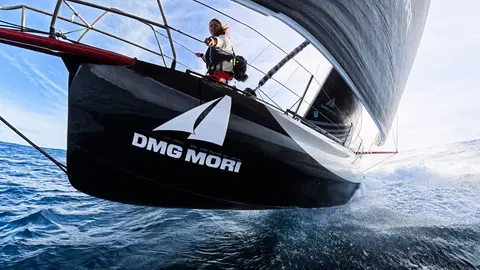
That familiarity matters when sailing an IMOCA alone at more than 20 knots, because the skipper must understand far more than the theoretical fastest route. Each angle changes the loads upon the foils, rig and sails, while every manoeuvre costs energy and creates another opportunity for equipment failure. A routing programme may recommend a series of gybes through a narrow band of pressure, although the sailor must judge whether the predicted gain justifies leaving the cockpit, moving sails, adjusting ballast and forcing an already tired body through another violent sequence on deck.
Horeau’s background was built in the Figaro class, where close one-design racing punishes small navigational errors and rewards sailors capable of combining weather analysis with relentless concentration. He won the 2023 Solitaire du Figaro after years of competing near the front of one of offshore sailing’s most demanding development circuits, establishing a reputation for determination, precise routing and the ability to maintain speed while racing alone. His move into IMOCA began alongside Benjamin Dutreux during the 2023 Transat Jacques Vabre, followed by a season working with Ruyant before taking over the boat now racing as MACSF.
The present Route du Rhum has therefore become Horeau’s opportunity to show that his Figaro instincts can survive the immense speed and physical punishment of a foiling 60-footer. His route across the front reflected the classic Figaro willingness to protect a simple strategic idea rather than chase every short-term movement among nearby rivals. Goodchild and Beccaria attempted to optimise the crossing by finding its narrowest point, while Horeau concentrated upon remaining connected with enough wind to preserve forward motion.
The distinction appears simple when viewed afterwards on a tracker, although the decision would have felt considerably less certain at sea. Weather fronts are not solid barriers with clearly marked openings, since they move, weaken and reform while the boats approach them. Satellite information, barometric pressure, cloud structure, sea state and the behaviour of nearby competitors all influence the final judgement, while forecasts received several hours earlier may already be wrong by the time a skipper reaches the critical area.
Horeau’s advantage remains substantial rather than secure, because the Atlantic ahead presents another sequence of complicated weather systems. MACSF must negotiate a narrow corridor of wind through repeated gybes before crossing a ridge of high pressure and reconnecting with a developing low. The approaching depression could deliver stronger downwind conditions and exceptional speed, although its associated sea state may become increasingly difficult, particularly for the slower boats reaching it later.
Ruyant believes record-breaking conditions may emerge once the leaders connect with the stronger breeze, creating another phase in which foil control, sail selection and structural preservation become as important as routing. Horeau’s lead gives him room to manage risk, although a skipper leading an ocean race must decide whether to protect the boat or continue pressing while rivals behind encounter different wind. Reducing speed too much could allow Herrmann, Clapcich or Élodie Bonafous to close the gap, while pushing without restraint could turn a commanding position into a damaged foil, broken sail or exhausted skipper.
The 13th Route du Rhum has already delivered a heavy toll among the 22 IMOCA starters. Violette Dorange’s Initiatives-Cœur collided with Romain Pilliard’s vintage trimaran Use It Again shortly after the Cap Fréhel gate, damaging the IMOCA’s starboard foil, structure and hull before Dorange diverted towards the French coast. Her team continued working towards a possible restart, although the repairs required in Lorient left her far behind the fleet.
Armel Tripon retired aboard Les P’tits Doudous after suffering rudder damage, ending an ambitious campaign built around an innovative IMOCA incorporating recycled carbon fibre and medical-grade titanium. Jérémie Beyou withdrew for medical reasons while lying second, bringing a painful conclusion to his final race with Charal and ending his fifth attempt to win the Route du Rhum. The decision carried particular sadness after a decade-long Charal programme, although offshore racing leaves little room for sentiment when a skipper’s health makes continued competition unsafe.
Those retirements have reduced the active IMOCA fleet to 20 boats and demonstrated why a large lead cannot be treated as a guarantee. Every remaining skipper must pass through the same developing low-pressure system, while those towards the rear may encounter stronger wind and more difficult seas as the depression deepens and wraps around itself. The leaders have found a route through the first major obstacle, although the trailing boats and Class40 fleet may have little choice except to cross the next system under considerably harsher conditions.
Another contest is unfolding among the older daggerboard IMOCAs, whose skippers race without the sustained foiling speeds available to the latest generation. Nicolas d’Estais aboard Café Joyeux led that group, followed by Pierre-Louis Attwell on Resilient and Sébastien Marsset aboard Foussier. Their race remains strategically important because the absence of large foils changes the balance between outright speed, reliability and sea-state performance, particularly when a powerful depression produces conditions that may favour simpler boats.
The Route du Rhum has encouraged such races within races since its creation in 1978, when Canadian Mike Birch’s small trimaran Olympus Photo defeated Michel Malinovsky’s much larger monohull Kriter V by only 98 seconds. The race’s open character allowed radically different boats to cross the Atlantic together, creating a four-yearly gathering where professional campaigns, experimental designs and determined private sailors could share the same start line.
Florence Arthaud’s victory in 1990 established one of the great landmarks in offshore racing, while Laurent Bourgnon’s consecutive wins in 1994 and 1998 confirmed the increasing dominance of large multihulls. The IMOCA class developed its own history through sailors including Ellen MacArthur, François Gabart, Paul Meilhat and Thomas Ruyant, each confronting a course that appears straightforward on the chart yet repeatedly turns upon weather transitions, mechanical survival and the treacherous final passage around Guadeloupe.
The theoretical route covers approximately 3,540 nautical miles from Saint-Malo to Pointe-à-Pitre, although the winning track is rarely direct. Most editions encourage skippers to dive south in search of the established trade winds, accepting extra distance for more dependable pressure and warmer conditions. The 2026 race has produced an atypical northern pattern, with low-pressure systems developing unusually far south and creating a strategic contest unlike the familiar trade-wind sprint.
Horeau now occupies the position every skipper wants and fears, alone at the front with an advantage large enough to inspire dreams while remaining vulnerable to every weather system ahead. His pursuers may benefit from observing his progress through the next ridge, while MACSF must make each decision without the reassurance provided by another boat nearby. The tracker shows a commanding lead, although Horeau sees only an empty horizon, an unsettled forecast and another 2,000 miles of Atlantic water before Guadeloupe.
Ruyant had intended to follow the race casually while continuing his search for a commercial partner capable of supporting a competitive 2028 Vendée Globe campaign. The unfolding tactical drama quickly destroyed that plan, leaving the defending IMOCA champion absorbed by the tracker and running his own weather routes from ashore. His fascination reflects the quality of Horeau’s performance, since experienced sailors recognise how rarely an ocean race produces a move that is both strategically simple and overwhelmingly decisive.
One boat sailed straight while its closest rivals turned north, allowing MACSF to catch the final breath passing through a closing front. The decision may ultimately become the defining moment of the 2026 Route du Rhum, although the Atlantic has not finished setting questions for Corentin Horeau. His masterly escape created the lead, while the coming days will reveal whether he can protect the boat, cross the next systems and carry that advantage through the uncertain shadow of Guadeloupe.