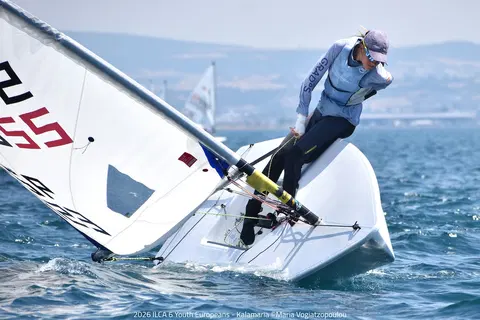
There are championship mornings when the mathematics appear simple, the leading sailors know precisely whom they must beat, the coaches have already worked through every possible points calculation, and the shore seems strangely calm, yet nothing remains simple once the fleet reaches open water and the first warning signal breaks the silence. That was the atmosphere hanging over Bodrum on 16 October as the final day of the 2026 ILCA Under-21 European Championships began, with Ginevra Caracciolo of Italy defending a narrow advantage in the ILCA 6 fleet and Spain’s Karol Krupski Teterycz attempting to complete a week of disciplined sailing in the physically demanding ILCA 7. Six days of racing had brought 184 sailors from 39 countries to this historic Turkish harbour, where the clear water, surrounding hills and restless autumn breeze created a beautiful setting for a championship that demanded far more than speed alone. eurilca.org
The final afternoon arrived with approximately ten knots across the course, enough to reward clean boat handling while leaving plenty of room for tactical gains and painful losses, particularly when the wind began shifting across a tightly packed fleet. Racing started at 13:15 with the women’s ILCA 6 fleet, followed by the ILCA 7 Gold and Silver divisions, although general recalls and course adjustments soon consumed valuable minutes. Pressure increased to between 12 and 15 knots before the women began their third and final race of the day at around 15:30, completing a ten-race championship series, while the men’s Gold fleet was denied the same total when two general recalls prevented another start before the 16:00 time limit. Those recalls were more than delays in the programme, since every premature movement towards the line revealed the nervous energy of young sailors who understood that one clean start could bring a European title, while one black flag or trapped lane could undo an entire week.
Caracciolo carried the additional burden of arriving in Bodrum as the reigning ILCA 6 Under-21 European champion, having won the 2025 title in Split after a full twelve-race series. Her position at the head of the fleet therefore came with expectation as well as opportunity, while Italian teammate Maria Vittoria Arseni remained close enough to turn the final race into a direct contest between two sailors who knew one another’s habits, strengths and preferred tactical moves. Caracciolo had spoken modestly before the championship, suggesting that another medal would be a bonus, although her preparation and determination told a rather different story, because defending a European title in a strict one-design class requires an appetite for detail that cannot be disguised. Every sheet movement, hiking angle, shift and mark rounding matters when the boats are fundamentally equal, leaving the sailor exposed without the shelter of design advantages, expensive development programmes or superior equipment.
The decisive moment came on the final downwind leg, where Arseni attacked and attempted to place her teammate under the kind of pressure that can make a championship leader sail cautiously, defend the wrong side or surrender the faster route towards the finish. Caracciolo refused to allow the emotion of the occasion to take command, keeping her thinking clear and her boat ahead when the contest became most intense. Her final score of 53 points gave her a six-point victory over Arseni, while the Czech Republic’s Linda Dokoupilova secured bronze with 76 points. The numbers recorded the outcome neatly, although they could not fully describe the balance, judgement and emotional control needed to protect a championship lead while another accomplished sailor attacked from close astern.
Krupski Teterycz faced a different final-day battle in the ILCA 7 fleet, beginning with an advantage of roughly eight or nine points and knowing that Antonio Pascali of Italy remained close enough to punish an error. The Spanish sailor admitted feeling nervous during the opening race, which was hardly surprising in a class where the full rig places enormous physical demands upon sailors while still requiring the light touch, tactical awareness and precise steering expected from any elite dinghy racer. He managed those competing pressures with maturity, making sound decisions as the breeze shifted and the fleet searched for clear lanes, eventually completing the championship on 44 points, eleven ahead of Pascali, while Slovenia’s Luka Zabukovec claimed bronze with 71 points.
His victory was built upon the less visible side of international sailing, including the long training hours shared with teammates, the guidance of coach Rui Silveira, support from the Spanish federation and the encouragement of a family that continued believing through the difficult periods that accompany any serious campaign. Krupski Teterycz was already looking beyond Bodrum towards a training camp in Santander and the World Championship in Australia in January, with one final season remaining in the Under-21 category. Such ambition explains why this European championship matters far beyond a single medal ceremony, since it provides a bridge between youth competition and senior international racing, placing emerging sailors into deep fleets where starting discipline, physical endurance and tactical consistency are tested repeatedly.
Türkiye also had reason to celebrate through Kutsal Güneş Kurnaz, who finished seventh overall and secured the ILCA 7 Under-19 European title with 74 points, ahead of Italy’s Alessandro Cirinei and Spain’s Sergio García. His result offered the host nation something more enduring than the pleasure of staging a successful championship, because a home sailor performing near the front of an international fleet gives younger club members a visible pathway to follow. Bodrum has long been associated with boats, seafaring and the timber gulets that still form part of the region’s maritime identity, yet this championship showed another side of its sailing character, where modern one-design dinghies and highly trained young athletes could compete within sight of a coastline shaped by centuries of Mediterranean voyaging.
The ILCA itself carries one of sailing’s most influential histories, having emerged from the Laser design created by Bruce Kirby around the beginning of the 1970s before growing into a vast international class and an Olympic discipline. Its enduring appeal rests upon a brutally honest idea, because the boat is simple enough to understand quickly yet difficult enough to spend a lifetime mastering, with strict one-design principles placing the emphasis on the sailor. The Laser name transitioned to ILCA for international class competition, while the familiar rigs became known as the ILCA 6 and ILCA 7, although the essential challenge remained unchanged: arrive at the start prepared, protect clear air, recognise the first decisive shift, keep the boat moving through disturbed water and avoid the unnecessary mistake that becomes expensive in a fleet filled with talent.
European Under-21 competition has repeatedly revealed sailors capable of progressing towards the senior ranks, while recent championships demonstrate how demanding the pathway has become. Shai Kakon won the women’s European crown in 2022, with Paul Hameeteman taking the men’s title, while the 2024 championship in Majorca produced victories for Lilly May Niezabitowska and Enrico Tanferna, whose one-point success over Ole Schweckendiek illustrated how narrow the margin can become. Caracciolo then claimed the 2025 ILCA 6 title in Split as Erik Norlén won the men’s championship, establishing the Italian as the sailor everyone would watch when the fleet assembled in Bodrum. Earlier editions under the Laser name carried the same intensity, including the 2017 championship in Douarnenez where Ireland’s Aoife Hopkins finished with five consecutive race victories. EurILCA
Bodrum added two more names to that history, although the greater significance may only become clear when these sailors move deeper into senior international competition. Caracciolo left Türkiye having defended her title through intelligence and composure, while Krupski Teterycz departed with proof that his training programme could withstand the pressure of a European final day. Kurnaz carried home a title for Türkiye, Arseni and Pascali demonstrated the growing depth of Italian ILCA sailing, while every sailor further down the results gained experience that no training session can reproduce. The medals were decided beneath an autumn sun, yet the real legacy of the championship will travel onwards through the winter, carried into training camps, selection trials and future regattas by young sailors who discovered in Bodrum exactly how close triumph can feel, and how hard it remains to reach.