There are few cities where the Atlantic feels quite so close to everyday life as it does in Porto, where the Douro reaches the sea beneath a broad western sky and generations have looked beyond the river mouth towards distant coasts. That maritime instinct will acquire a powerful new expression from 2028, when The Ocean Race establishes its global headquarters in the Portuguese city and begins a partnership designed to last until 2040. The agreement is far more ambitious than the familiar arrangement in which a race visits a port, fills the waterfront for a week and then vanishes over the horizon, because Porto is intended to become a permanent home for the organisation, an Atlantic base for teams and marine businesses, and a public centre for ocean science, education and culture.
The programme begins with a special racing event in Porto during 2028, followed by the starts of three editions of The Ocean Race Round the World in 2030, 2034 and 2038. Portugal is also expected to stage at least six further international events connected with The Ocean Race Europe during the partnership, while summits, educational projects and ocean literacy programmes will bring scientists, sailors, policymakers and young people into the same conversation. An historic waterfront building beside the beach and Porto City Park is planned as the operational headquarters, while a separate museum will celebrate the race, its boats and its sailors alongside Portugal’s own maritime heritage. That physical presence matters because it gives the race a recognisable home between editions, rather than leaving its identity dependent upon the next start line and the next fleet of boats.
Porto is a logical Atlantic choice, not merely an attractive backdrop, because the city faces the weather system that shapes so much European offshore sailing. Crews leaving northern Europe for the trades often pass the Portuguese coast after negotiating the Bay of Biscay and Cape Finisterre, while those returning from the south must read a shoreline influenced by the Azores High, the Portuguese trade winds and the powerful interaction between land and sea. Matosinhos and Porto already featured as a fly-by destination during The Ocean Race Europe 2025, and Lisbon welcomed the round-the-world fleet in 2011 to 2012, 2014 to 2015 and 2017 to 2018, which means Portugal’s relationship with the event has developed through experience rather than appearing overnight. The new agreement takes that connection much further by attempting to build an offshore racing industry around the city, attracting teams, technical specialists, designers, suppliers and young Portuguese sailors who may previously have needed to look elsewhere for a route into the professional sport.
The Ocean Race itself began in a very different age, when seventeen yachts left Portsmouth on 8 September 1973 for the first Whitbread Round the World Race. Those boats were varied, heavy and comparatively basic by modern standards, yet the challenge was enormous as 324 sailors faced long Southern Ocean passages with limited weather information, few comforts and none of the constant shore communication that now surrounds an offshore campaign. Ramón Carlin’s Swan 65 Sayula II won that inaugural race on corrected time, creating one of sailing’s most enduring stories as a Mexican businessman and his crew conquered a contest many established professionals believed lay beyond them. The race soon became a proving ground for ocean sailors, navigators and designers, with Cornelis van Rietschoten winning aboard Flyer in 1977 to 1978 before returning with Flyer II four years later, while Peter Blake’s Steinlager 2 completed a celebrated clean sweep of every leg in 1989 to 1990.
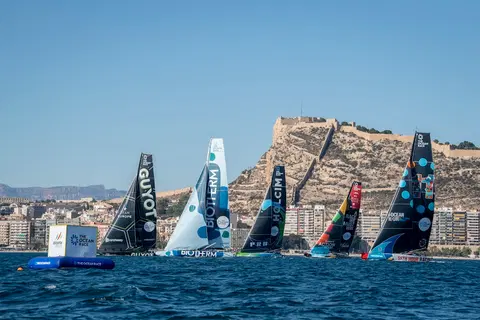
Successive generations changed the race without weakening its essential demand for teamwork. Paul Cayard led EF Language to victory in 1997 to 1998, illbruck won in 2001 to 2002, Franck Cammas and Groupama triumphed in 2011 to 2012, and Charles Caudrelier’s Dongfeng Racing Team secured the 2017 to 2018 title after one of the closest editions the event had known. The 2022 to 2023 race brought foiling IMOCAs into the round-the-world contest, placing crews aboard highly powerful yachts that could sustain remarkable speeds while subjecting people and machinery to relentless punishment. Charlie Enright’s 11th Hour Racing Team eventually claimed the overall title after a campaign filled with tactical pressure, repairs and a collision in the final leg, a reminder that modern data, foils and satellite communications have altered the tools without removing the uncertainty that has always defined the race.
Tactical decisions begin long before a crew reaches the Southern Ocean, because the opening miles from an Iberian port can shape the entire first leg. Teams must judge coastal breeze, sea state and traffic while deciding how quickly to escape local weather and reach the larger Atlantic systems, and those calculations will make future starts from Porto particularly compelling. An Atlantic departure removes the Mediterranean exit that crews leaving Alicante must negotiate, yet it replaces that problem with the exposed Portuguese coast, the possibility of heavy autumn or winter swell and an immediate need to position the boat for the weather developing farther west. Every sail change carries a cost, every unnecessary manoeuvre consumes energy, and every early tactical split can become magnified once the fleet enters open water, which is why a start line beside Porto will offer much more than a picturesque farewell.
Before that new era begins, the fifteenth edition of The Ocean Race will start from Alicante on 17 January 2027, preserving the Spanish city’s important role as the departure port for a sixth consecutive edition. The opening leg to Auckland is planned to cover more than 14,000 nautical miles, the longest opening stage in the race’s history, taking crews from the Mediterranean into the Atlantic, around Cape Horn and across the Southern Ocean towards New Zealand. Alicante therefore remains central to the immediate story, while discussions continue over its longer relationship with the race, although Porto now provides the clear Atlantic direction beyond 2027. This is best understood as a carefully staged transition rather than an abrupt change of harbour, with one established home carrying the fleet into its next circumnavigation before Portugal begins hosting the organisation’s wider ambitions.
Those ambitions reach beyond trophies and finishing times through the Racing for the Ocean programme, which uses the boats, sailors and global audience to support scientific research, education and advocacy for ocean health. Racing yachts have carried instruments into remote waters that conventional research vessels seldom visit, collecting information about temperature, carbon dioxide, salinity and microplastics while the crews continue racing, and the planned Porto headquarters should give that work a visible public centre. The Ocean Race Summit Porto on 19 November 2026 will provide an early test of the relationship by bringing together international voices concerned with the future of the sea, while the proposed museum and education programme can translate an often distant environmental argument into something families and young sailors can see and understand.
A headquarters does not guarantee a flourishing offshore industry, and the success of the partnership will depend upon investment, access, local participation and the willingness to turn grand announcements into working facilities that remain active between races. Porto nevertheless offers the right ingredients, including an Atlantic shoreline, a strong tourism economy, universities, maritime knowledge and a country whose history has always been tied to voyages beyond the horizon. When the fleet gathers there for the first round-the-world start in 2030, the spectacle will naturally belong to the foiling yachts, the crowded harbour and the sailors preparing to leave home for months, although the deeper measure of success will be found ashore in the teams, apprentices, scientists and schoolchildren who have made the race part of their own maritime world. The Ocean Race has spent more than half a century circling the planet, yet its next lasting achievement may come from finally placing deeper roots beside the Atlantic.