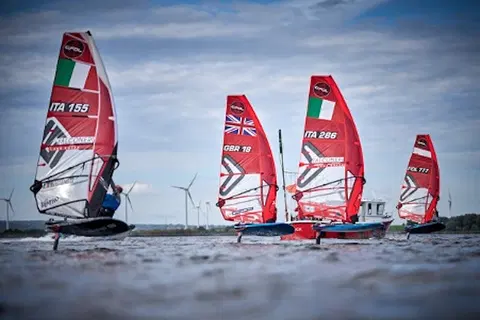
Early morning arrived over València with the pale Mediterranean light spreading across the harbour, race officials watching an untroubled sea and sailors searching the water for the faintest dark line that might announce enough breeze for one final contest. Nothing useful arrived, leaving the Nacra 17 fleet ashore and a championship poised on the narrowest of margins, with Argentina’s Mateo Majdalani and Eugenia Bosco holding 27 points while Sweden’s Emil Järudd and Hanna Jonsson waited only one point behind. No final duel would follow, no last charge towards the windward mark would separate the leading crews, and no sudden tactical mistake would disturb the standings, because the complete absence of wind forced the race committee to abandon the eleventh scheduled race and confirm Majdalani and Bosco as winners of the inaugural Nacra València Cup. Nacra17.org
Their victory had effectively been forged during Friday’s four-race programme, when the organisers responded to the unpromising final-day forecast by adding another race to the original schedule. That decision proved inspired, allowing the international fleet to complete ten meaningful races before the Mediterranean turned silent. Majdalani and Bosco entered the penultimate day needing to recover ground from Järudd and Jonsson, whose consistency had carried them into the provisional lead, yet the Argentinians responded with finishes of third, first, first and third. Two consecutive victories in races eight and nine transformed the championship, placing them back at the head of the standings precisely when the remaining opportunities were disappearing.
Friday’s conditions suited the Argentine crew, who possess the balance of aggression and control required to keep a fully foiling Nacra 17 moving cleanly through its manoeuvres. Their final scorecard revealed the depth of that performance, with three race victories across the series, two second places and enough solid finishes to absorb an eighth as their discard. Järudd and Jonsson had been equally dangerous, winning two races and remaining close throughout, although fifth-place finishes in the last two contests allowed their rivals to turn a deficit into a one-point advantage. When Saturday failed to produce another start, those two fifth places became the final entries in a championship decided not through one dramatic collapse, but through the gradual accumulation of small differences between two highly accomplished teams.
Majdalani and Bosco arrived in València carrying considerably more than the status of ordinary regatta favourites, having won Nacra 17 silver for Argentina at the Paris 2024 Olympic Games. Their partnership began in 2017, although the road towards Olympic recognition demanded patience because they initially competed for national selection against Santiago Lange and Cecilia Carranza, the celebrated Argentine pairing who won gold at Rio 2016. Majdalani had already worked with Lange and Carranza as a coach during that successful Rio campaign, placing him in the unusual position of having to move from supporting an idol to challenging him for the right to represent Argentina. Bosco brought her own multihull and skiff experience, having sailed from childhood before racing the 29er with her brother Santiago, while their combined programme eventually delivered Pan American gold in Santiago in 2023 and Olympic silver the following year. Argentina.gob.ar
That history mattered in València because the Nacra 17 punishes any weakness in the relationship between helm and crew. Majdalani and Bosco have accumulated years of shared reference points, allowing one sailor to recognise changes in pressure, boat attitude or tactical intention without requiring a lengthy conversation. At foiling speeds there is no time for debate, since the crew must control power and balance while the helm manages direction, flight and the positioning of the boat against its rivals. Every tack risks dropping the hulls back into the water, every gybe demands precise movement across the trampoline, while a small error in pitch can produce a violent touchdown that costs several places before the boat accelerates again.
Their Swedish challengers were hardly short of experience, with Järudd having competed at both Tokyo 2020 and Paris 2024, while Jonsson made her Olympic debut alongside him in Marseille during the Paris Games. They finished tenth at Paris 2024 and arrived in València as reigning European champions, giving the fleet a contest between crews already accustomed to the pressure of Olympic racing. Järudd and Jonsson sailed with impressive consistency across the opening stages, recording a victory on the second day and rarely allowing the Argentinians to move beyond reach, yet the championship ultimately turned upon a handful of positions during Friday’s final races. Sveriges Olympiska Kommitté
New Zealand’s Micah Wilkinson and Kate Stewart completed the podium with 51 points, finishing well clear of much of the fleet while remaining separated from the extraordinary one-point struggle at the front. Their penultimate day contained almost every emotion available in fleet racing, beginning with a victory before a fifteenth place placed their podium position in danger, followed by third and twelfth. The fifteenth was discarded, allowing the New Zealanders to protect third place by five points from Sweden’s Ida Svensson and Marcus Dackhammar, whose final fourth-place finish ensured the bronze-medal contest remained open until the wind removed the possibility of further racing.
The final results also revealed the international strength of the gathering, with Türkiye’s Sinem Kurtbay and Alican Kaynar finishing fifth, Austria occupying sixth and seventh, the United States taking eighth, France ninth and Australia tenth. Catalan siblings Dani and Nora García de la Casa led the Spanish challenge from Club Nàutic El Masnou, finishing eleventh with 87 points and missing the top ten by a single point behind Ruben and Rita Booth. Their Friday score of tenth, thirteenth, thirteenth and sixth kept the possibility of a top-ten finish alive, although the windless final day denied them the opportunity to make one last attack. Nacra17.org
The 2026 Nacra València Cup marked the first appearance of the Olympic Nacra 17 class in the city, bringing 24 teams from 17 countries to waters already deeply connected with international sailing. Real Club Náutico de Valencia, founded in 1903, has staged national championships, world championships and major offshore events across more than a century, while the city’s modern sailing identity was transformed when València hosted the 32nd America’s Cup in 2007 and the following edition in 2010. The arrival of the Nacra fleet therefore continued a long relationship with advanced racing technology, placing a new generation of Olympic foilers on waters once occupied by some of the most sophisticated America’s Cup yachts ever built. rcnauticovalencia.com
The Nacra 17 possesses its own important place in Olympic history, having been selected by World Sailing in May 2012 for the mixed multihull event at Rio 2016. Its introduction created the first compulsory mixed-gender discipline within the Olympic sailing programme, demanding that male and female athletes share responsibility aboard one of the fastest and most physically demanding boats in the Games. The original design used curved daggerboards to create lift, although the class took a dramatic step after Rio by adopting Z foils and developing into a fully foiling catamaran for the Tokyo cycle. Further refinements strengthened the platform, improved its control systems and eventually allowed crews to foil more consistently upwind as well as downwind. Nacra17.org
Such development changed the tactical character of Nacra 17 racing because the fastest route around the course no longer depended simply upon wind shifts and clear air. Crews must now judge when to protect stable flight, when to accept a slower manoeuvre to reach stronger pressure and whether a tactical engagement is worth the risk of falling from the foils. Apparent wind moves rapidly forward as the boat accelerates, narrowing the angles and making layline judgement particularly difficult, while disturbed air from another boat can destroy the power required to remain airborne. Starts are especially unforgiving because the fleet reaches the line quickly, compressing time and distance until a poorly judged approach can leave a crew buried beneath several rivals with no clear escape.
The championship in València provided an excellent illustration of that tension between outright speed and consistent scoring. Wilkinson and Stewart won a race yet also carried a fifteenth, while the leading Argentinians and Swedes built their title challenges by limiting the damage whenever victory was unavailable. Majdalani and Bosco never finished worse than eighth before the discard was applied, while Järudd and Jonsson remained inside the top five in nine of the ten completed races apart from their discarded tenth. That discipline separated the leading pair from the remainder of the fleet and ensured that a single point, rather than a spectacular final-day reversal, decided the trophy.
No sailor wants a championship settled while waiting ashore, particularly when only one point separates first from second, although Majdalani and Bosco had already completed the work required to win. Their Friday performance forced the series back into Argentine hands, while the race committee’s decision to complete four races preserved a substantial ten-race contest despite Saturday’s calm. València’s first Nacra 17 Cup ended without the anticipated final flourish, yet the silence carried its own lesson, because sailing remains a sport governed by nature even when carbon foils, Olympic athletes and advanced engineering have pushed the boats towards astonishing speed. The wind had given the fleet three demanding days, then withheld the last, leaving Argentina’s silver medallists with a title earned through speed, partnership and the quiet discipline of finishing every race that mattered.