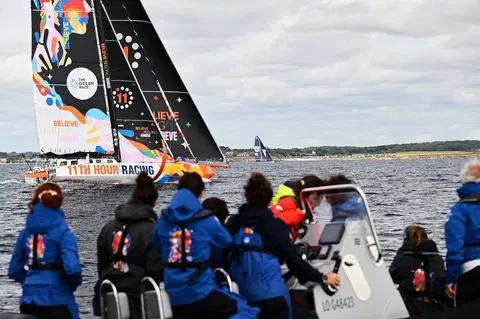
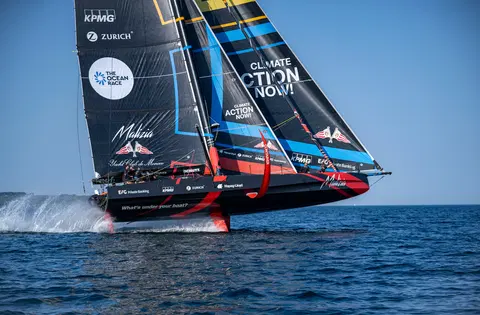
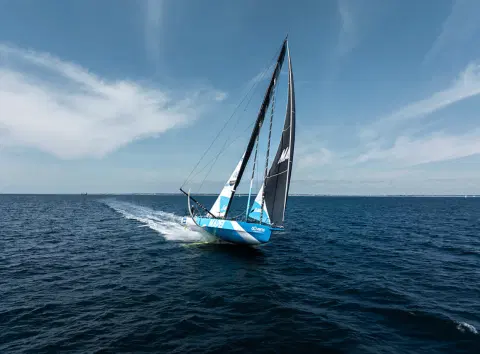
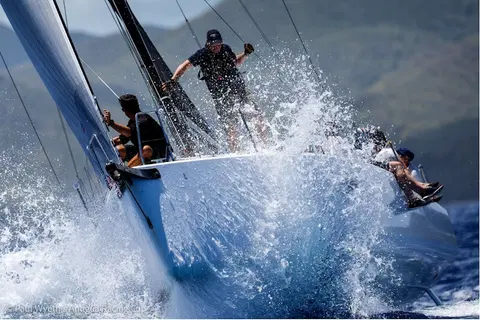
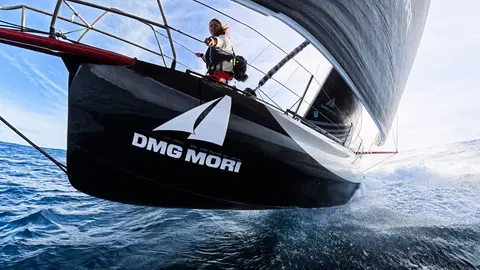
The great stone ramparts of Saint-Malo had barely begun to fade astern before the 22 IMOCA skippers discovered that the 2026 Route du Rhum would offer little time for reflection, sleep or a gentle return to the rhythms of solo ocean racing. What began beneath clear skies and a manageable northeasterly breeze soon developed into a relentless westward charge, with the fleet accelerating beyond the English Channel, passing the Isles of Scilly and driving towards the open Atlantic at speeds that placed skippers, sails and carbon structures under continuous pressure.
The 13th Route du Rhum started at 13:02 on Sunday, 1 November, sending 115 solo sailors from six classes across the same 3.2-mile line off Saint-Malo. The only compulsory mark before Guadeloupe was the Cap Fréhel gate, positioned approximately 16 nautical miles west of the start, where the enormous fleet compressed before beginning the long Atlantic passage towards Pointe-à-Pitre. Light northeasterly conditions had provided a comparatively gentle opening spectacle for the crowds gathered along the Breton coast, although the breeze strengthened during the first night and rapidly transformed the race into the high-speed contest anticipated by Yoann Richomme.
Richomme had studied the developing weather pattern before the start with the understandable frustration of a sailor who knew his former boat would have been exceptionally well suited to the conditions. The Paprec skipper, runner-up in the 2024 to 2025 Vendée Globe, is waiting for the launch of his next IMOCA and therefore watched this Route du Rhum from ashore, although his experience gave his forecast considerable authority. He has already won the race twice in Class40, taking consecutive victories in 2018 and 2022, and he immediately recognised that the position of the Atlantic high pressure would force the IMOCA fleet towards an unusually northerly course.
Most editions of the Route du Rhum encourage skippers to search south for warmer weather and dependable trade winds, even when that route adds considerable distance to the direct line. The northern Atlantic can deliver stronger wind and a shorter passage, although it can also produce violent depressions, steep seas and the sort of conditions capable of breaking a boat before the skipper has properly settled into the race. This year the southern option offered too many areas of weak or absent wind, leaving the quickest route climbing towards Ireland before turning west and passing north of the Azores.
Richomme expected the fleet to sail towards the Fastnet Rock, or slightly west of it, before gybing onto a long port layline aimed towards the northern side of the Azores. That forecast quickly began taking shape on the water, with the leading boats accelerating through the opening night before committing to their western charge. The attraction was obvious, because a powerful modern IMOCA could remain on one fast downwind angle for hundreds of miles, turning the Atlantic into a runway where the best foilers might threaten existing 24-hour solo monohull records.
Such speed carries its own danger, since an IMOCA travelling above 20 knots is never a peaceful place. The hull slams into uneven water, foils transmit immense loads into the structure and every loose object becomes a potential missile, while the skipper must eat, sleep, navigate and make tactical decisions inside a carbon drum beaten continuously by the sea. The boat may be sailing downwind, although the apparent wind generated by its own speed loads the rig and sails with considerable force, leaving little margin when a squall arrives or the bow buries into the back of the next wave.
The early Tuesday position report placed Corentin Horeau at the front aboard MACSF, followed by Ambrogio Beccaria on Allagrande Mapei, Sam Goodchild aboard Macif Santé Prévoyance and Jérémie Beyou on Charal. Horeau’s position carried an intriguing connection with Richomme’s analysis, because MACSF is the former Arkea Paprec, the powerful downwind IMOCA Richomme sailed to second place in the Vendée Globe. The boat Richomme believed could prosper in this Route du Rhum was doing precisely that under a new skipper, averaging more than 22 knots across the preceding 24 hours as the leaders drove west.
Beccaria had led during the first full day after an aggressive start, showing the confidence that has made him one of Italy’s most exciting offshore sailors. Stronger wind arrived more quickly than expected during the opening night, forcing him to reconsider a planned sail change when the manoeuvre began looking more dangerous than useful. Goodchild executed the change Beccaria had considered, demonstrating how small differences in confidence, timing and sail selection can create miles between evenly matched boats.
Beyou remained firmly within the leading group aboard Charal, the boat Richomme identified as his favourite before the start. Years of development have turned Charal into an exceptionally refined downwind machine, capable of sustaining averages that were unimaginable when the IMOCA class first became part of the Route du Rhum story. Élodie Bonafous, Francesca Clapcich, Boris Herrmann and Sébastien Simon were also positioned within the faster group, ensuring the opening Atlantic passage remained a genuine contest rather than a procession behind one runaway leader.
The race had already supplied a sobering reminder of the risks created when very different boats share crowded water. Violette Dorange’s IMOCA Initiatives-Cœur collided with Romain Pilliard’s 79-foot trimaran Use It Again after the Cap Fréhel mark, damaging Dorange’s starboard foil, opening a leak and affecting the structure of her boat. Both skippers escaped injury, although Dorange was forced towards the coast for repairs, leaving her team with the difficult task of making the IMOCA safe enough to continue towards Guadeloupe.
That collision illustrated why Richomme considered the opening rhythm so demanding. A skipper cannot simply set the autopilot, choose the fastest angle and disappear below to sleep, particularly when other classes are nearby and boats are travelling at dramatically different speeds. Radar, AIS, visual checks, sail changes, weather analysis and the ordinary maintenance of life aboard must all be handled by one person, often while the boat is leaping through darkness with spray covering the deck.
The weather routing creates another layer of difficulty because the fastest theoretical line is constantly moving. Forecast models change, fronts weaken or strengthen and the position of a transition can shift by enough miles to reward one group while trapping another. A skipper attempting detailed analysis inside a violently moving IMOCA must study several models, decide how much confidence to place in each one and then judge whether the boat can survive the sailing angle required by the computer’s preferred route.
The first major complication is expected near the Azores, where the leaders are likely to encounter a slow-moving or stationary front. The fast passage from the Fastnet region may therefore end abruptly as the breeze becomes less stable, compressing the leading boats before the next weather system pulls them apart again. A skipper arriving first could sail into weakening pressure and watch rivals close rapidly from behind, while a boat approaching from a slightly different latitude might retain stronger wind and cross the transition with considerably less delay.
The second half of the race should remain largely downwind, although the approach to Guadeloupe has never rewarded complacency. The fleet must round the island before reaching the finish at Pointe-à-Pitre, passing through an area where high volcanic land can distort the wind and create enormous patches of calm. Boats arriving within sight of one another can find completely different conditions, with one skipper carrying breeze along the coast while another stops beneath the island’s wind shadow.
Richomme even identified the possibility of westerly wind creating an upwind finish, an unusual conclusion after thousands of miles of downwind racing. Such a scenario would place renewed emphasis upon sail condition and remaining energy, because a skipper who has pushed hardest across the Atlantic might arrive with a damaged inventory, depleted batteries or too little sleep to handle the final tactical contest cleanly.
The Route du Rhum has always rewarded boldness, beginning with an inaugural edition in 1978 that changed ocean racing forever. Canadian Mike Birch arrived aboard the little yellow trimaran Olympus Photo and defeated Michel Malinovsky’s much larger monohull Kriter V by only 98 seconds after more than 3,500 miles of Atlantic racing. Birch’s victory demonstrated the potential of ocean-going multihulls and immediately established the Route du Rhum as a contest where unconventional boats and determined sailors could defeat far larger and more heavily funded campaigns.
The race returns every four years between Saint-Malo and Pointe-à-Pitre, preserving a rare mixture of professional excellence and private ambition. Ultims, Ocean Fifty trimarans, IMOCAs, Class40s and vintage boats cross the same ocean, linking the most advanced offshore technology with machines carrying the history of earlier generations. Florence Arthaud’s celebrated outright victory in 1990 remains one of the defining moments in French sailing, while Laurent Bourgnon’s consecutive successes in 1994 and 1998 strengthened the race’s reputation as one of the ultimate tests of solo multihull sailing.
The IMOCA class has supplied its own collection of memorable victories. Ellen MacArthur won the category in 2002 after finishing second in the Vendée Globe, François Gabart established a new benchmark in 2014, while Paul Meilhat claimed the 2018 title after Alex Thomson’s extraordinary challenge ended with a collision against the northern coast of Guadeloupe and a subsequent penalty. Thomas Ruyant won in 2022 aboard LinkedOut, completing the course in 11 days, 17 hours, 36 minutes and 25 seconds, breaking Gabart’s IMOCA record by more than eleven hours.
The 2026 fleet is now travelling at a pace capable of challenging that record, although outright speed alone will not decide the race. The leaders must cross the front near the Azores, preserve their sails and foils, negotiate the trade-wind passage and survive the final approach around Guadeloupe before any comparison with Ruyant’s time becomes meaningful. A spectacular opening average can disappear through one poor gybe, a damaged sail or several hours trapped in a windless transition.
Richomme’s prediction of a fierce northern charge has already proved accurate, while the exact outcome remains hidden somewhere beyond the Azores. Horeau, Beccaria, Goodchild and Beyou have displayed the speed required to lead, yet the Route du Rhum has spent nearly half a century punishing certainty. Its winners are rarely determined by the sailor who is fastest for one night, because the Atlantic rewards those capable of sustaining speed without allowing ambition to consume the boat carrying them.
The 22 IMOCA skippers are presently balanced on that narrow line, flying west through a noisy world of spray, carbon and incomplete sleep. Record numbers may appear on the instruments, while every skipper understands that Pointe-à-Pitre remains thousands of miles away. The northern route has opened the door to a historic passage, although the oldest rule in offshore racing still applies: reaching extraordinary speed matters far less than knowing how long the boat can safely hold it.