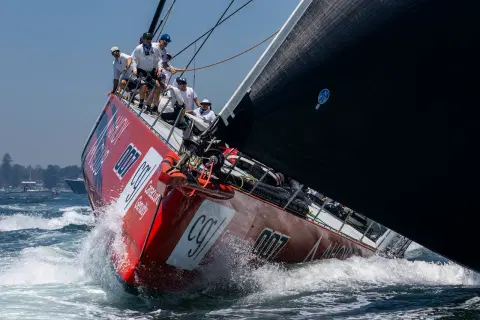
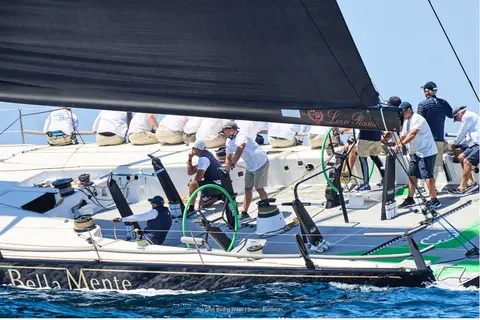
Sydney Harbour offered little assistance when Anthony Bell brought Tribeca LOYAL towards the starting line for her first competitive appearance under a new name, new ownership and one of Australian offshore racing’s most familiar campaign banners. The water lay frustratingly quiet beneath the 100-foot maxi, smaller yachts slipped into the available breeze and the most powerful monohull in the fleet appeared temporarily imprisoned by her enormous sail plan and considerable wetted surface, although everything changed when the afternoon sea breeze began reaching down the New South Wales coastline. Once the pressure arrived, the former Comanche accelerated, stretched her long legs and turned the 83-nautical-mile Bird Island Race into an emphatic demonstration of speed.
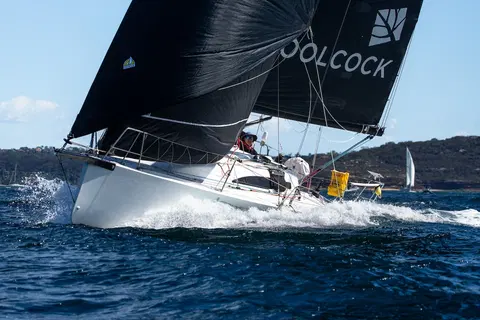
The fourth round of the 2026/27 Audi Centre Sydney Blue Water Pointscore began on Saturday, 14 November, following a 50-minute postponement while the race committee waited for enough wind to establish itself across Sydney Harbour. When the fleet finally started at 10:50 in a light northeasterly of around eight knots, Karl Kwok’s Fast 40 Beau Ideal, Sean Langman’s GP42 Back 2 Black, Rob Appleyard’s Moneypenny and Anthony and David Johnston’s 72-foot URM Group were among the early leaders, while Tribeca LOYAL struggled to convert her vast sail area into useful forward speed.
Light conditions can humble even the fastest maxi because a 100-foot hull requires enough pressure to overcome its drag before the design begins producing the remarkable speeds for which it was created. Smaller boats can accelerate earlier, tack through confined water with less energy and take advantage of narrow bands of breeze that may not extend across the towering rig of a supermaxi. URM Group escaped through Sydney Heads first, followed by Moneypenny, while Bell’s larger yacht remained dependent upon the wind strengthening beyond the harbour.
The fleet initially moved east after clearing North Head in search of pressure, with URM Group making the first decisive turn north towards the Central Coast. Several leading handicap contenders found useful wind closer inshore and temporarily sailed beneath Tribeca LOYAL, giving the opening stage the appearance of a genuine contest rather than a predictable procession led by the largest yacht. That picture lasted for approximately one hour and 50 minutes, until the sea breeze strengthened between Mona Vale and Newport and the enormous red machine finally began working as her designers intended. bwps.cycaracing.com
Once powered up, Tribeca LOYAL overhauled URM Group and Moneypenny, established control of the race and was never headed again. Bell’s crew recorded a maximum speed of approximately 25.5 knots in winds that reached around 18 knots, revealing the extraordinary ability of a modern supermaxi to sail considerably faster than the breeze pushing it. The yacht crossed the Sydney Harbour finish line at 17:12:42, completing the course in six hours, 22 minutes and 42 seconds to claim line honours on her first race day as Tribeca LOYAL.
The elapsed time did not threaten the Bird Island benchmark set by the same yacht during the previous edition, when she raced as Master Lock Comanche and completed the course in five hours, 43 minutes and 52 seconds. Conditions determine every offshore record, and the calm opening phase of the 2026 race removed any realistic opportunity for Bell’s crew to challenge that performance, although the significance of the result lay in the way a newly assembled campaign responded when the breeze finally arrived.
Bell described the yacht as sharp and praised the teamwork after eight consecutive days of training, a period designed to introduce crew members to the boat, establish manoeuvring routines and identify the configuration changes required before the Rolex Sydney Hobart Yacht Race. A 100-foot maxi cannot be raced effectively by assembling talented sailors on the dock and expecting instinct to solve every problem, because sail changes require precise choreography, equipment loads are enormous and mistakes can damage both the yacht and the people handling her.
The Bird Island Race provided an ideal first competitive examination because its course combines restricted harbour sailing with an open-water passage north towards Bird Island, approximately three nautical miles northeast of Norah Head, before returning to Sydney. At 83 nautical miles, it is the shortest race within the Blue Water Pointscore, although the combination of a crowded start, coastal weather, tactical positioning and repeated changes in sail selection makes it a valuable test for crews preparing for longer offshore challenges.
The Blue Water Pointscore has occupied an important place in Australian ocean racing since the Cruising Yacht Club of Australia introduced the series in 1958, when Graham Newland’s Siandra became its first champion. Its races provide a graduated examination of navigation, boat preparation, crew organisation and heavy-weather ability, building towards the Sydney Hobart at the end of December. The Bird Island contest sits naturally within that progression, offering enough distance for mistakes to become expensive without requiring crews to remain offshore for several days. Live Sail Die
For Bell, the victory represented a return to the level of sailing that had already brought him two Sydney Hobart line-honours triumphs. His first came aboard Investec LOYAL in 2011, when the yacht defeated Wild Oats XI by only three minutes and eight seconds after a memorable struggle towards the River Derwent finish. Five years later, Bell and sailing master Tom Slingsby returned aboard Perpetual LOYAL and completed the 628-nautical-mile course in one day, 13 hours, 31 minutes and 20 seconds, breaking the previous race record by almost five hours. rolexsydneyhobart.com
That 2016 record did not survive for long, because the yacht now named Tribeca LOYAL lowered it dramatically the following year. Designed by VPLP and Guillaume Verdier and originally commissioned by Jim Clark and Kristy Hinze-Clark, Comanche was created to become one of the fastest offshore monohulls ever built, with immense beam, enormous stability and a hull shape optimised for reaching at exceptional speed. Racing as LDV Comanche in 2017, she completed the Sydney Hobart in one day, nine hours, 15 minutes and 24 seconds, a record that still stands.
The yacht has since accumulated five Sydney Hobart line-honours victories under several owners and names, winning in 2015, 2017, 2019, 2022 and 2025. That history makes Bell’s acquisition particularly significant, because he has not merely purchased a competitive 100-footer, he has taken control of the current race record holder and one of the most successful maxis in modern Sydney Hobart history. Sails magazine
Comanche was designed to produce her best performance when sailing fast at reaching angles, using her considerable form stability and powerful rig to carry enormous sails without relying upon the type of canting keel arrangement found aboard several rivals. Her broad stern and aggressive hull form allow the yacht to accelerate rapidly once sufficient pressure arrives, although the slow opening to the Bird Island Race demonstrated the other side of that equation, because immense performance potential offers little advantage when the wind refuses to cooperate.
Tom Slingsby will serve as sailing master for the 2026 Sydney Hobart campaign, renewing the partnership that helped Bell secure line honours in 2016. Slingsby’s career includes an Olympic gold medal, an America’s Cup victory and multiple SailGP championships, while his technical understanding and experience aboard high-performance yachts make him a formidable addition to the campaign. He also knows the former Comanche, having raced aboard the yacht during previous international record attempts.
Bell will be joined by an experienced professional sailing team and a group of high-profile Australian sportspeople continuing the LOYAL campaign’s tradition of using offshore racing to support charitable fundraising. Former Wallabies captain Phil Waugh, rugby league figure Anthony Minichiello and multiple surfing world champion Layne Beachley are expected aboard, with each required to contribute as a functioning crew member rather than travelling south as a passenger.
The LOYAL campaigns have always carried a purpose beyond line honours through their support for the Humpty Dumpty Foundation, which supplies medical equipment to hospitals caring for children across Australia. Bell’s return therefore revives both a sporting project and a fundraising platform, reconnecting the intensity of the Sydney Hobart with a cause that has remained associated with his racing programmes.
Victory in the Bird Island Race did not provide every answer, since the light start offered limited opportunity to test the boat under load and the relatively short course could not reproduce the fatigue, weather transitions and equipment demands of a passage to Tasmania. The crew will study performance data, review manoeuvres and adjust the yacht’s configuration before returning to structured training later in November.
The next major examination will come in the Cabbage Tree Island Race on 4 December, a longer offshore contest that should provide a more representative test of crew routines and night sailing. The SOLAS Big Boat Challenge on 8 December will then bring the leading maxis together on Sydney Harbour, offering spectators their clearest preview of the speed and tactical aggression expected on Boxing Day.
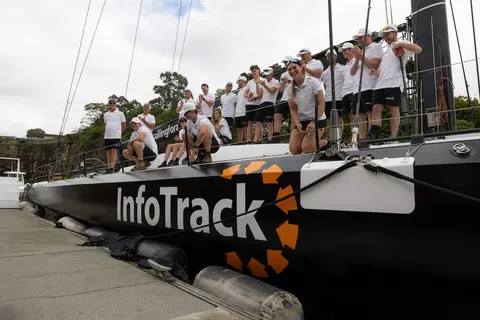
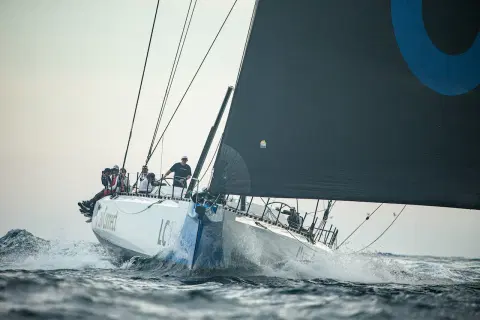
Four 100-footers are preparing to contest Sydney Hobart line honours, with Tribeca LOYAL facing Christian Beck’s InfoTrack, the former Wild Oats XI now racing as Palm Beach XI under Mark Richards, and Grant Wharington’s Wild Thing 100. Each carries a different design philosophy and racing history, creating a contest in which the weather could favour one yacht dramatically before shifting the advantage somewhere else.
InfoTrack, which competed as LawConnect during recent seasons, brings the confidence of consecutive Sydney Hobart victories in 2023 and 2024. Palm Beach XI carries the bloodline of the most successful line-honours yacht in Sydney Hobart history, while Wild Thing 100 possesses a campaign shaped by Wharington’s long experience with powerful offshore maxis. Tribeca LOYAL enters that contest with the current race record, five previous line-honours victories and the unmistakable message delivered during her first race under Bell.
The Bird Island victory was not the Sydney Hobart, and nobody aboard Tribeca LOYAL will confuse a six-hour coastal race with the unpredictable passage through Bass Strait and down Tasmania’s eastern coastline. It was nevertheless the first essential step for a campaign built around one of the fastest monohulls ever created, an experienced owner returning after a decade away and a crew carrying serious expectations.
Sydney Harbour had made Bell and his new yacht wait for the wind, although once it arrived, the old Comanche character emerged quickly. The name on the hull has changed, the crew has been rebuilt and another Sydney Hobart chapter is waiting to be written, yet the wake stretching south across the Bird Island finish carried a familiar warning, because the great red yacht is back and moving fast again.