The Tollgate Islands Race left Sydney Harbour on Friday evening with a respectable easterly breeze, a fleet of 26 yachts and every expectation of a lively 260-nautical-mile contest down the New South Wales coast, although offshore racing has never felt obliged to honour the forecast. By the time the leaders had turned for home, the breeze had softened, shifted and disappeared from inconvenient sections of the course, transforming what had promised to be a fast coastal race into an extended test of patience. Sebastian Bohm’s TP52 Smuggler managed the changing conditions most effectively and secured overall victory under IRC, while Rob Appleyard’s Reichel/Pugh 69 Moneypenny retained her place at the front of the fleet to claim line honours.
The race began at 1700 hours on Friday 16 October in an easterly breeze of approximately 12 to 15 knots, providing enough pressure to carry the fleet away from Sydney Harbour and onto the southbound coastal leg. Back 2 Black, Sean Langman’s GP42, made an assertive beginning and led the early charge, while the larger yachts used their waterline length and sail area to build speed before darkness settled across the coast. Conditions were expected to ease overnight before strengthening again, although the promised recovery failed to arrive with any conviction, leaving crews searching for narrow bands of pressure and working continuously to preserve momentum.
The destination lay at the Tollgate Islands, a group of rocky islets positioned roughly four nautical miles offshore from Batemans Bay, where the yachts would turn before retracing their passage north towards the finish off Sydney. The course looks uncomplicated when reduced to a line on a chart, yet the Australian coastline introduces local wind effects, current, offshore transitions and large tactical decisions over distance from the land. A boat sailing close inshore may find useful local breeze or relief from an adverse current, while another crew farther offshore may discover stronger pressure that more than compensates for the additional distance.
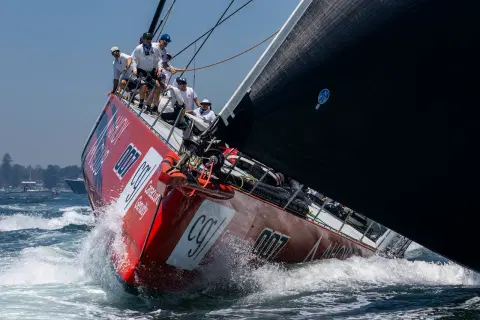
Smuggler’s victory came from maintaining useful speed while much of the fleet became trapped in lighter conditions around the turning mark and during the return through the Illawarra region. The TP52 crossed the finish line second on the water before securing first place on corrected time, earning its first overall victory of the 2026/27 Audi Centre Sydney Blue Water Pointscore. Bohm’s crew arrived with the pedigree of having won the 2024/25 series, and the result demonstrated that a TP52 designed for grand-prix racing could remain effective when the contest became a slow and mentally demanding coastal examination rather than a straightforward high-speed passage. Cruising Yacht Club of Australia
Moneypenny remained the fastest yacht around the course, finishing at 2020 hours on Saturday after one day, three hours, 20 minutes and 15 seconds of racing. Appleyard’s 69-footer claimed a second consecutive line-honours victory for the season, although her elapsed time showed how completely the lighter conditions had removed any prospect of threatening the race record. Moneypenny still performed strongly under handicap and finished second overall on IRC, with Back 2 Black taking third after its energetic opening and continued pressure throughout the race.
The official Tollgate Islands Race record belongs to Andoo Comanche, although it is considerably faster than the original record quoted before the 2026 start. The 100-foot maxi completed the inaugural 2022 race in 20 hours, 16 minutes and 49 seconds, then returned in 2023 to cover the course in 17 hours, 31 minutes and 30 seconds, averaging 14.7 knots. That remarkable performance sliced nearly three hours from its previous time and established a benchmark that would require a powerful yacht, favourable pressure and a clean passage in both directions. Cruising Yacht Club of Australia
Corrected-time history has shown that outright speed does not always decide this race, even though the largest yachts dominated the two editions preceding 2026. Moneypenny won overall in 2025 ahead of the 72-foot URM Group and the 38-foot Bacchanal, while the 2024 race produced a large-yacht procession led by the 100-foot Comanche, followed by Whisper, Smuggler and URM Group. The result from 2023 told a different story when the double-handed Kraken III defeated Andoo Comanche on IRC, with Jules Hall’s J/99 Disko Trooper taking third after racing with sailors from the Cruising Yacht Club of Australia’s Youth Sailing Academy. bwps.cycaracing.com
Smuggler’s success in 2026 therefore continued the recent strength of the larger yachts, although the small and medium-sized competitors remained central to the wider pointscore. Before the start, the top nine boats in the overall IRC standings were all between 32 and 45 feet, with Disko Trooper leading after finishing second and first in the opening two races. Back 2 Black sat five points behind, while Ariel, Minerva, Ambition, Supernova and Kanreki had used consistent handicap performances to remain ahead of the TP52s.
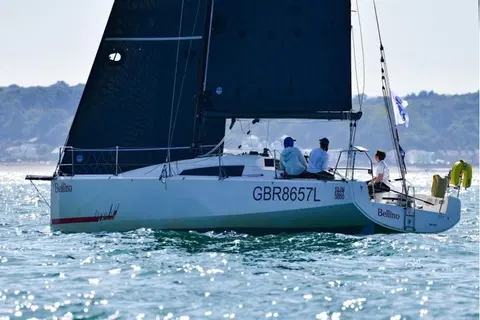
Jules Hall’s Disko Trooper endured one of the least convenient starts in the fleet after being individually recalled, leaving the J/99 as the final yacht out of Sydney Harbour. A poor beginning can become especially expensive for a double-handed crew because only two sailors are available to resolve the mistake, reset the boat and begin the long process of recovering lost ground. Hall and his crewmate responded with considerable persistence, working through the changing breeze to finish sixth overall while winning both IRC Double-Handed and IRC Division 2.
The result strengthened Disko Trooper’s position as one of the defining boats of the 2026/27 Blue Water Pointscore. The J/99 had already won the first two double-handed IRC divisions and arrived at the Tollgate Islands Race leading the overall series, while another J/99, Chris O’Neill’s Blue Planet, had been applying pressure across the double-handed categories. Their contest showed how effectively a well-designed 33-foot yacht can compete over coastal and offshore courses when good preparation, accurate routing and disciplined sail handling compensate for a limited crew.
Double-handed racing changes the rhythm of an offshore passage because every manoeuvre, navigation decision, sail change and period of rest must be shared between two people. A fully crewed TP52 may have specialists concentrating upon different jobs, while a double-handed sailor can move rapidly from trimming sails to steering, navigation and preparing something resembling dinner. Light weather creates its own exhaustion because the boat requires constant attention, yet opportunities to rest often disappear when a small change in wind strength can decide whether the yacht escapes a calm patch or remains motionless for another hour.
The smaller yachts had prospered in the opening races because the weather allowed them to remain connected with the leaders on corrected time. Tollgate presented a different pattern as the largest boats reached key sections before the pressure deteriorated further, while many slower competitors spent much of Sunday working north towards Sydney. Seven yachts eventually retired, with Magic withdrawing because of crew illness, Wot’s Next suffering mainsheet damage, and Atraxia, Inner Circle, MWF Kayle, Ragtime and Toucan ending their races because of time constraints.
Retirement in such conditions does not automatically indicate poor seamanship or insufficient determination, because amateur crews must balance competition against work, family and the practical limits of remaining at sea beyond the expected finishing window. A fading breeze can extend a race by many hours, consuming food, sleep and the time crews allowed for returning to ordinary life. The decision to stop racing may be disappointing, although continuing without adequate time or resources merely to collect a finishing result can become a poorer decision.
Smuggler also claimed the PHS result ahead of Moneypenny and Caol Ila, giving Bohm’s crew a notable double across the principal handicap systems. Disko Trooper won the Corinthian IRC category ahead of Michael Rowe and Ben Martin’s Cookson 12 Kanreki and Alex Seja and Felicity Nelson’s Sydney 36 Supernova. Kanreki took the Wild Rose IRC division from Vixen Racing and Ragtime, while Verite defeated Jupiter and Disko Trooper under Double-Handed PHS. Cruising Yacht Club of Australia
The Tollgate Islands Race occupies an important position within the Blue Water Pointscore because its 260 nautical miles are long enough to expose weaknesses without creating the same logistical and psychological commitment as the Rolex Sydney Hobart. Crews must sail overnight, manage watch systems, interpret a changing coastal forecast and maintain equipment through an extended race, making it a valuable examination before Boxing Day. The southbound and northbound legs can produce very different conditions, ensuring that a boat well suited to the opening passage may have to defend its position through an entirely different return.
The event was introduced in 2022 and is consequently a young race compared with many Australian offshore fixtures, although it quickly developed a distinct tactical character. Its route takes the fleet far enough south to encounter meaningful weather changes while keeping the turning mark close to the mainland, creating a race that can reward powerful offshore yachts, smaller handicap specialists or double-handed crews depending upon the timing of the breeze. Four completed editions have already produced victories for a 100-foot maxi, a double-handed entry, a 69-foot racer and a TP52, demonstrating that the course refuses to favour a single type of yacht indefinitely.
For Smuggler, the victory provided valuable momentum before an expected gathering of highly competitive TP52s in the Rolex Sydney Hobart fleet. The TP52 began life as a box-rule grand-prix class, although older examples have become formidable offshore handicap racers after careful modification. Their combination of speed, manageable size and experienced crews makes them particularly effective under IRC, especially when the weather allows them to maintain momentum without giving the largest maxis an overwhelming elapsed-time advantage.
Moneypenny’s performance offered a different lesson, because line honours required the 69-footer to keep moving through conditions capable of reducing any apparent speed advantage. Large yachts carry taller rigs and greater sail area, helping them find pressure above the water and convert light breeze into useful pace, although their rating reflects that potential. Winning on the water and winning after corrected time are separate disciplines, which is why offshore racing can celebrate the first yacht home while awarding the major handicap prize elsewhere.
The pointscore tightened after three races, with Disko Trooper retaining a narrow advantage over Back 2 Black as the fleet moved towards the shorter Bird Island Race on 14 November. Smuggler’s victory brought the defending champion firmly back into the campaign, while the continued performances of the 30 and 40-foot yachts ensured that the series remained far from a contest reserved for the fastest boats. Every point gained before the Rolex Sydney Hobart could become important, particularly when the offshore classic applies its own mixture of weather, attrition and scoring pressure.
The 2026 Tollgate Islands Race ultimately belonged to the crews who accepted that the forecast had stopped being useful and began racing the conditions directly in front of them. Smuggler preserved enough speed to turn a long, frustrating passage into an overall victory, Moneypenny crossed the line first, and Disko Trooper recovered from the back of the fleet to reinforce its reputation as one of Australia’s most effective double-handed offshore yachts. The breeze may have faded, although the race never became uneventful, because offshore sailing often reveals its most interesting qualities after speed has disappeared and patience becomes the most valuable sail aboard.