There are yacht races that depend upon raw speed, others where the weather becomes the principal opponent, and a small number where geography itself seems determined to join the contest, which is why the Regata dei Tre Golfi has spent more than seven decades earning a reputation as one of the Mediterranean’s most beautiful and deceptively difficult offshore races. In May 2027 the waters around Naples, Sorrento, Capri, Ponza and Li Galli will again fill with racing yachts as Tre Golfi Sailing Week returns for a programme stretching from 5 to 20 May, bringing together the ORC Mediterranean Championship, the 72nd Regata dei Tre Golfi and the IMA Maxi European Championship in a fortnight where polished superyachts, highly developed offshore racers and ambitious Corinthian crews will share the same extraordinary stretch of Italian coastline.
The centrepiece remains the Regata dei Tre Golfi itself, first held in 1954 and now preparing for its 72nd edition, a longevity that places it firmly among the established classics of European offshore sailing. The race will start from Naples on Friday 14 May and cover approximately 150 nautical miles on a course taking the fleet towards Ponza and Li Galli before returning towards Naples, although describing it simply by distance rather misses the point, because the race is defined by what happens between those marks rather than how far apart they happen to be. The Gulf of Naples can offer clean sea breezes and glorious reaching conditions, yet it can just as easily produce glassy patches beneath the coast, shifting night winds, sudden acceleration around headlands and frustrating transitions where one boat continues moving while another scarcely a mile away seems to have dropped its anchor.
That unpredictability has always been part of the attraction, because the Tre Golfi is not simply a drag race through warm Mediterranean water, and the fastest yacht rarely enjoys the luxury of sailing one obvious route from start to finish. The volcanic geography around the Gulf creates local effects that reward crews willing to watch the shoreline, study the clouds and understand that an evening breeze draining from the land may matter as much as the wider forecast, while the approach to islands such as Capri, Ponza and Li Galli can turn apparently comfortable leads into uncomfortable tactical decisions. A boat that sails an extra mile may find more pressure, a yacht that hugs the coast may escape adverse current, and crews who have spent the daylight hours enjoying spectacular scenery can discover that the same cliffs and islands become considerably less decorative when the breeze disappears after dark.
The history of the event is filled with boats representing different generations of offshore racing, and recent editions demonstrate just how varied that contest remains. Peter Dubens’ North Star won the Maxi division on corrected time in both 2022 and 2023, while Sir Peter Ogden’s Jethou took line honours in 2023 and established a then-record time of 15 hours, 30 minutes and one second. Furio Benussi’s Arca SGR claimed line honours in 2024, although the corrected-time honours went to Giuseppe Puttini’s remarkable Swan 65 Shirlaf, a reminder that an older yacht sailed intelligently can still defeat far newer and faster machinery once the handicap system has done its work. Galateia then raised the outright standard dramatically in 2025, the Wallycento completing the course in 13 hours, 19 minutes and 42 seconds, before returning in 2026 to underline the performance with another Maxi victory.
That mixture of outright speed and corrected-time racing is precisely what gives the Tre Golfi its character, because the fleet can contain enormous Maxis carrying sail areas measured in hundreds of square metres alongside smaller ORC boats whose crews know that their real race is against the clock rather than the stern disappearing over the horizon. Modern Maxi yachts can cover extraordinary distances when conditions align, particularly with carbon structures, highly developed sail inventories and professional crews capable of keeping the boats close to maximum performance through the night, yet the handicap systems ensure that simply being first to the finish is only one part of the story. A slower yacht arriving hours later can still have sailed the better race, especially when the crew has avoided unnecessary manoeuvres, protected the boat through difficult transitions and extracted speed from conditions that did not particularly suit their design.
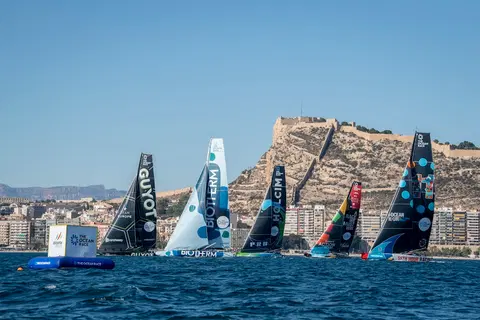
The 2027 programme will begin with the ORC Mediterranean Championship in Sorrento, where up to five windward-leeward races will be held from 6 to 8 May before the fleet turns towards the longer offshore challenge of the Tre Golfi. That combination is a severe test of crews because short-course racing demands precision almost from the first gun, with starts, mark roundings, sail changes and small tactical errors immediately punished, while the offshore element requires a very different mindset involving weather strategy, watch systems, navigation and the ability to keep the yacht moving efficiently through an entire night. A crew capable of producing flawless manoeuvres around a two-mile windward-leeward course can still lose heavily offshore through one poor routing decision, while experienced ocean sailors can discover that a bad start or slow tack on the inshore course leaves no time to recover.
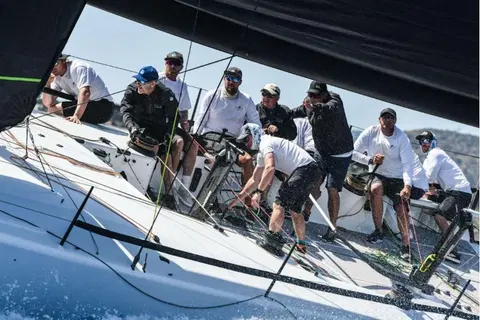
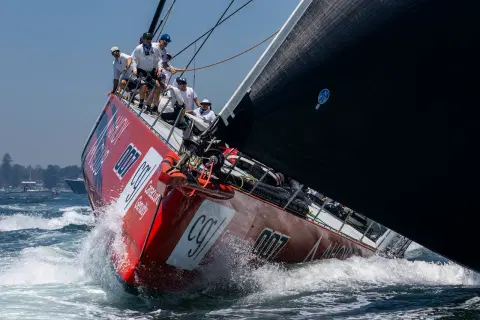
The Maxis will face their own demanding programme through the IMA Maxi European Championship, which has become an increasingly important feature of Tre Golfi Sailing Week since its introduction in 2022. The championship opens with the 72nd Regata dei Tre Golfi before moving to Sorrento for up to six windward-leeward and coastal races between 17 and 20 May, creating a competition that rewards something more complete than offshore horsepower alone. These are yachts that can be spectacular simply standing still at the dock, yet once racing begins their size makes the manoeuvres more complicated rather than less so, with enormous sails, powerful loads and large professional crews working through tacks and gybes where timing has to be exact because mistakes become expensive very quickly.
Sorrento and Capri provide a setting that would be difficult to design deliberately, with steep cliffs, blue water and one of the world’s most recognisable islands forming the backdrop to races where crews have little opportunity to admire any of it. Coastal courses in this area demand constant attention because the breeze can bend around the land, pressure can strengthen or weaken dramatically near the shore and the choice between heading offshore for cleaner air or remaining inside for a favourable shift can decide an entire race. Local knowledge helps, although the strongest international teams arrive with enough meteorological analysis and performance data to make every metre of the course part of a calculated decision, producing a contest where traditional Mediterranean instinct now sits beside sophisticated routing software and detailed weather modelling.
The organisers behind the week also reflect the event’s deep roots in Italian yachting, with the Circolo del Remo e della Vela Italia working alongside the Reale Yacht Club Canottieri Savoia and Yacht Club Italiano, while the Offshore Racing Congress and International Maxi Association oversee the championship elements. That institutional depth matters because events of this scale depend upon far more than starting boats and laying marks, requiring measurement, safety systems, race management, berthing, tracking, media operations and the considerable logistics involved in accommodating large fleets in Naples and Sorrento for nearly two weeks.
Interest in the 2027 edition has already begun well before the first warning signal, with entries open and the first confirmed Maxi appearing on the list, and the new official Tre Golfi Sailing Week website now bringing the various championships, entries and race information together in one place. The early entry of the Maxi 77 Jethou is particularly appropriate given the boat’s association with the event and its record-setting 2023 performance, although the months ahead will determine how deep the international fleet becomes and which of the leading names from recent seasons return to challenge again.
What makes the Tre Golfi enduringly attractive is that the event has managed to grow without losing the race at its centre, because even after more than seventy years, increasingly sophisticated yachts and the arrival of international championships, the essential challenge remains recognisable. Crews will still leave Naples watching the first tactical decisions unfold against the shoreline, they will still spend a night searching for pressure around islands that appear deceptively simple on the chart, and somebody will inevitably discover that the Mediterranean can be at its most difficult precisely when it looks most beautiful.
When the fleet returns in May 2027, the boats will be faster, the navigation more precise and the weather information more sophisticated than anything the competitors of 1954 could have imagined, yet the fundamental question will remain almost unchanged: who can read the water, the wind and the coastline better than everybody else. That is why the Regata dei Tre Golfi has lasted for 72 editions, because technology can change the boats, while the Gulf of Naples continues to make sure the sailors still have to earn the result.