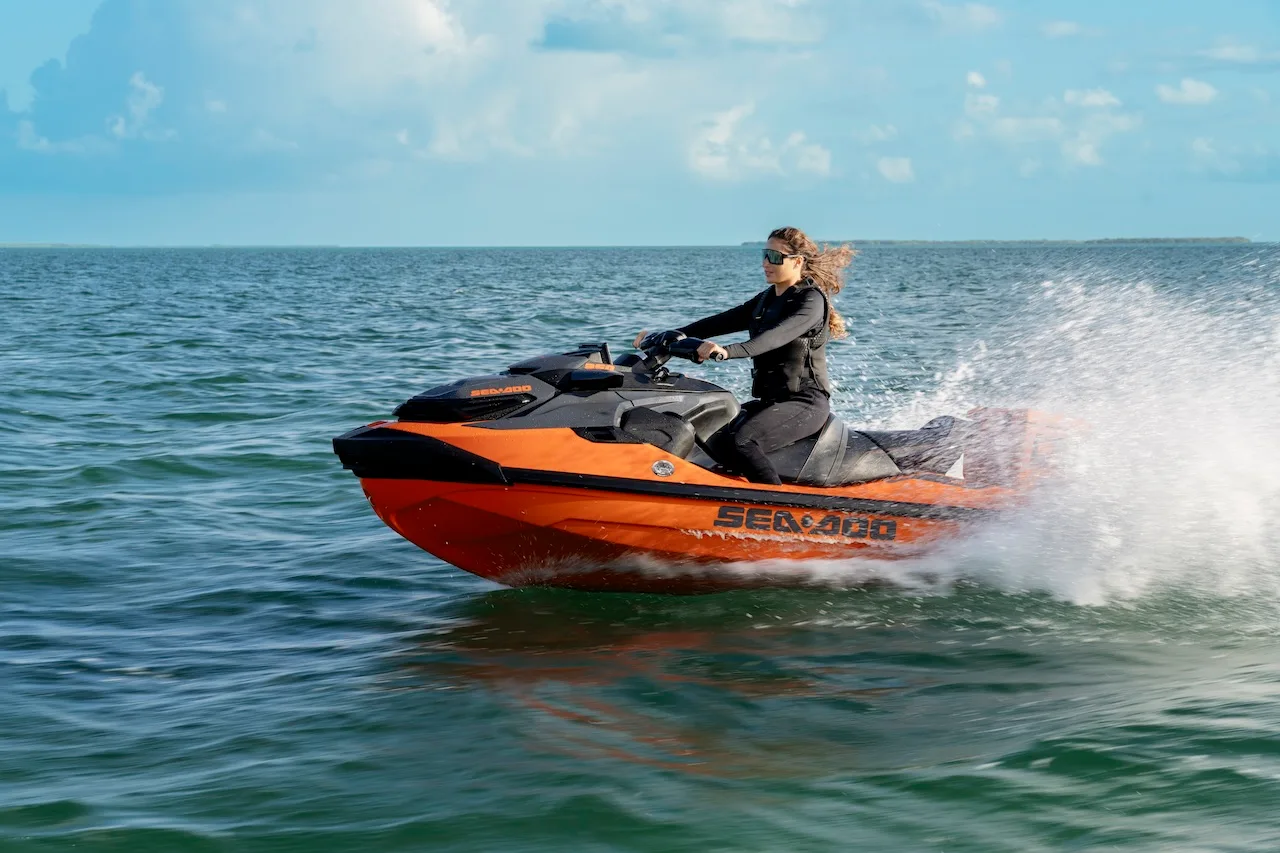
There was a time when personal watercraft occupied a fairly simple corner of the boating world, offering an engine, handlebars, a hull and sufficient performance to ensure that an afternoon on the water rarely lacked excitement, although the machines arriving at the Southampton International Boat Show 2026 demonstrate just how far the PWC has travelled from those comparatively uncomplicated beginnings.
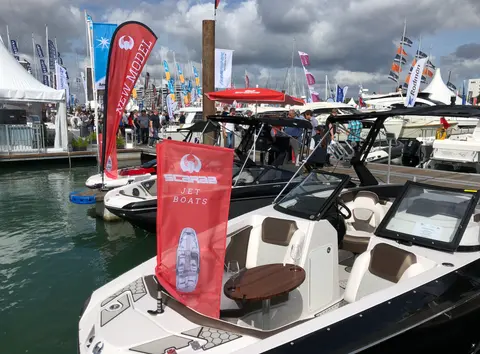
Sea-Doo is using this year's show for the UK debut of its new RXT-X and Spark-X, with the two machines appearing on stand P46 and representing very different interpretations of what a modern personal watercraft can be. One is a powerful offshore performance machine equipped with a new 350hp Rotax engine, while the other develops the lighter and more playful Spark concept with a new 110hp engine, improved performance and an assortment of technology that would have seemed distinctly ambitious aboard a personal watercraft not so many years ago.
The arrival is particularly appropriate because Sea-Doo's connection with the personal watercraft stretches back almost to the beginning of the category itself. BRP traces the Sea-Doo story to 1968, when Bombardier introduced what the company describes as the industry's first personal watercraft, beginning a relationship with powered recreation on the water that has now lasted for more than half a century. Rotax subsequently became part of Bombardier in 1970, creating an engine connection that remains central to Sea-Doo today.
The early machines were a very different proposition from the sophisticated craft now appearing in Southampton. Personal watercraft developed enormously through the following decades as engines became more powerful, hulls more capable and control systems more sophisticated, gradually moving the category beyond the simple image of a small machine for tearing around close to the beach. Today's market ranges from relatively accessible recreational craft to touring machines and high-performance models capable of covering serious distances in conditions that would once have been considered far beyond the natural territory of a PWC.
RXT-X brings 350hp to the water
At the performance end of Sea-Doo's new generation sits the RXT-X, where the headline number is difficult to ignore because its new Rotax 1630 ACE engine develops 350hp. BRP describes the 350 as the highest-output factory engine it has fitted to a Sea-Doo, giving some indication of the extraordinary development that has taken place within the PWC world.
Power alone, however, does not make a useful offshore machine, particularly once flat water disappears and the surface becomes considerably less cooperative. The RXT-X therefore combines its new engine with Sea-Doo's ST3 hull, X sponsons, a polished impeller and an extended Variable Trim System with launch mode, all intended to provide the rider with greater control over how the machine accelerates, turns and responds to changing conditions.
That emphasis on hull behaviour is significant because anyone who has driven a powerful PWC in rough water understands that outright horsepower quickly becomes less impressive when the hull cannot translate it into controlled progress. Stability, predictable cornering and the ability to keep the machine composed through chop matter every bit as much as the number printed on the engine specification.
For comparison, Sea-Doo's current 2026 British RXT-X is listed with the supercharged 1630 ACE producing 325hp, a 70-litre fuel capacity and the ST3 fibreglass hull, so the move to 350hp represents another step in an already serious performance platform.
The result is a machine aimed squarely at riders who regard a PWC as rather more than something for a quick blast around sheltered water. The RXT-X belongs to a generation of craft increasingly capable of longer-distance and offshore use, provided the rider has the experience, equipment and judgement to match the performance available beneath them.
Spark-X takes a different route
The Sea-Doo Spark-X approaches the water from almost the opposite direction, although its development is equally interesting. The original Spark was launched for the 2014 model year and represented an important change of direction for Sea-Doo, concentrating on lower weight, compact dimensions, accessibility and customisation rather than simply chasing ever larger engines and greater performance. BRP's corporate history records the Spark launch in 2014, while contemporary material described it as lightweight, easy to tow and designed to make personal watercraft ownership more approachable.
More than a decade later, the Spark-X retains that playful philosophy while gaining considerably more muscle. The new Rotax 1000 ACE produces 110hp, with BRP saying the additional power increases top speed by as much as 15 per cent while improving the machine's power-to-weight performance.
The important figure may not actually be the top speed, because a relatively light machine with additional power can feel markedly different throughout its operating range. Stronger acceleration and more immediate throttle response can transform the character of a small PWC, particularly when the hull has been designed around agility rather than the greater stability expected from a larger touring machine.
Sea-Doo has also equipped the Spark-X with its Intelligent Debris-Free Pump System, known as iDF, allowing the rider to clear debris from the pump through a handlebar-mounted control rather than immediately resorting to a more traditional investigation at the water's edge. A boarding step, speed regulator and portable BRP audio system broaden the machine's everyday usefulness, while the coloured deck provides a little visual theatre for owners who prefer their machinery not to disappear quietly into the marina scenery.
Trixx adds another level of mischief
For riders who consider simply travelling across the water rather too conventional, the Spark-X Trixx package takes the playful character further through adjustable riser handlebars, extended Variable Trim System range and a dedicated Trixx mode.
The purpose is to make manoeuvres such as lifting the bow and performing tight, playful tricks more accessible, with additional reverse thrust and greater trim adjustment giving riders more control over the attitude of the machine.
There is something rather clever about Sea-Doo maintaining these two distinct personalities within the same family. The RXT-X is increasingly serious machinery, with enormous power and an offshore-orientated platform, while the Spark-X Trixx embraces the fact that sometimes people simply want to get onto the water and have an entertaining afternoon.
Both machines can also make use of Sea-Doo's LinQ accessory system, which allows equipment including coolers, additional cargo and camera-related accessories to be attached without turning every installation into a small engineering project. Sea-Doo has increasingly used LinQ to make the PWC adaptable for different types of ownership, moving the machine away from being a single-purpose toy towards something that can be configured for longer days and different activities.
More than fifty years of Sea-Doo development
Looking at the RXT-X and Spark-X together also provides an interesting snapshot of how the personal watercraft has evolved since that first Sea-Doo appeared in 1968. Modern riders now expect electronic control systems, sophisticated hull design, intelligent braking and reverse functions, integrated accessories and engines producing outputs that would once have belonged to considerably larger boats.
Sea-Doo itself has played a substantial part in that development, with BRP highlighting innovations including its iBR braking system alongside decades of Rotax-powered machinery. The company now divides its PWC range into different categories according to how people actually use them, from smaller recreational machines such as the Spark family through to touring and high-performance models.
That diversification matters because personal watercraft have become an established part of the wider boating landscape rather than simply sitting at its edges. They are used for recreation, exploring coastlines, tow sports and longer-distance adventures, while specialist machines have also found working roles in areas including rescue and safety operations.
Southampton International Boat Show is therefore a natural place for Sea-Doo to introduce this latest generation to British riders. The show brings together sailors, motorboaters, watersports enthusiasts and people taking their first steps towards getting afloat, which means the audience wandering past stand P46 is likely to include everyone from committed PWC owners to yacht sailors who maintain that they have absolutely no interest in such things while quietly stopping for a closer look.
The contrast between these two new machines is perhaps what makes the launch particularly interesting. The RXT-X demonstrates just how sophisticated and powerful a modern performance PWC has become, while the Spark-X shows that lightness, accessibility and sheer enjoyment still have an important place in the market.
More than half a century after the first Sea-Doo appeared, the basic attraction has survived all the additional horsepower and electronics remarkably well, because whether there are 110 horses or 350 waiting beneath the seat, the essential promise remains the same: get away from the pontoon, point towards open water and enjoy the ride.