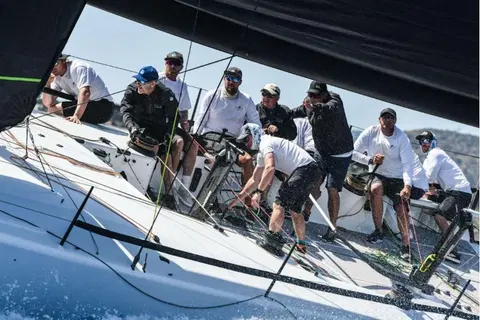
Warm spray is rarely regarded as a hardship, although it can still arrive with considerable force when an easterly trade wind has travelled across thousands of miles of Atlantic and finds a racing yacht pressed hard off Antigua’s south coast. Crews will return to that lively strip of water from 17 to 21 March 2027 for the second Antigua Racing Cup, a young regatta attempting to secure a permanent place within an already celebrated Caribbean season. Its appeal is deliberately straightforward, with frequent starts, properly managed courses, strong competition and a short passage back to Nelson’s Dockyard, where sails can be lowered before the arguments begin over the shift that paid, the mark rounding that did not and the few seconds lost on corrected time.
The idea was tested during the inaugural event in April 2026, when 21 boats completed nine races in trade-wind conditions that rewarded both speed and consistency. Eleven entries were scored under CSA and IRC, allowing crews to see how the same performance translated through the Caribbean Sailing Association rule and the internationally familiar IRC system. Steve Rigby’s Grand Soleil 46 Belladonna and the Antiguan RP37 Warthog, skippered by Jules Mitchell, finished level on points in CSA 2 before Belladonna secured the class on countback, while Bruce Chafee’s Reichel Pugh 42 Rikki placed third under CSA yet used five race victories to win IRC 1. Those results provided precisely the kind of evidence a new regatta needs, because close racing between contrasting designs is more persuasive than any promise printed in a brochure.
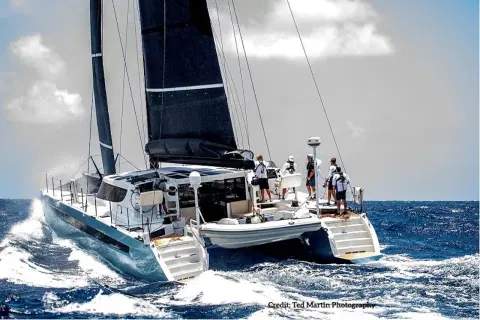
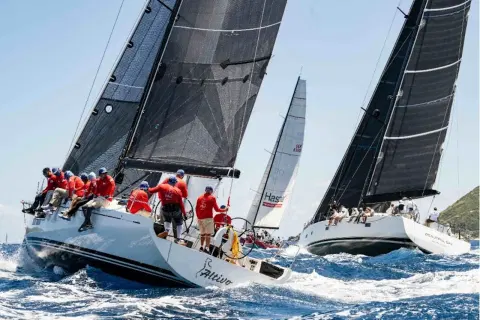
Antigua’s southern racecourse supplies the ocean edge described by the organisers, since the island sits on the exposed curve of the Leewards with very little to interrupt the easterly trades or flatten the swell before it reaches the fleet. March commonly brings breeze in the high teens and sometimes beyond, accompanied by one to two metre seas that demand an active approach from helmsmen and trimmers. Upwind speed depends upon keeping the boat driving through the waves without allowing it to become overpowered, which can require careful changes between height, footing and acceleration as the sea state alters. Downwind sailing becomes more physical and opportunistic, with crews searching for the pressure that will release the boat onto a swell, then keeping enough control to carry speed into the next manoeuvre instead of burying the bow or arriving at the mark with too much sail and too little room.
Course design is central to the Antigua Racing Cup’s identity because the committee does not insist that every yacht should face the same test. Smaller performance boats can be given compact windward and leeward courses where starting accuracy, tacking and mark-rounding routines decide the result, while larger monohulls and offshore multihulls can race longer courses containing reaching angles that allow their speed to emerge. Virtual marks give the race team freedom to position turning points in useful water without laying a physical buoy, making it easier to adapt to wind direction, sea conditions and the needs of different classes. Dual scoring adds another layer for owners accustomed to comparing CSA and IRC results, although no rating rule can rescue a poor start, a slow sail change or an unnecessary extra tack when the opposition is already sailing cleanly towards the favoured side.
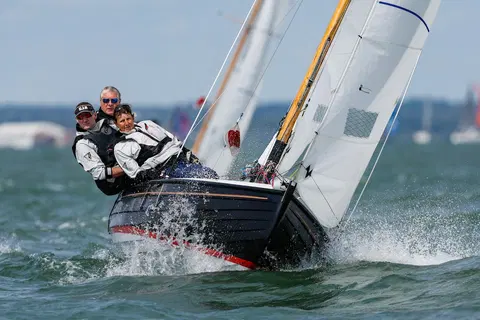
Early entries for 2027 show the variety that the format is designed to serve. Martin Zonnenberg’s J 111 Quickdraw, skippered by Scott MacGregor, brings experience from one-design competition and the Newport Bermuda Race, a useful combination for a boat that can reward disciplined crew work before accelerating strongly when Antigua provides a fast downwind angle. Ed Bell’s Kerr 46 smoking-hot is expected to make its Caribbean debut after crossing from the other side of the Atlantic, placing a powerful offshore design into conditions likely to expose any weakness in handling as quickly as they display its pace. Olympic bronze medallist and former RS Elite UK national champion Ossie Stewart is taking a different route with Aeolus, hoping to encourage a stronger one-design presence among the RS Elite boats already based in Antigua, where identical equipment leaves the outcome resting upon starts, shifts, boathandling and the difficult art of making fewer mistakes than the crew alongside.
Antigua hardly needs to invent a sailing reputation, because organised international racing has been woven into the island’s modern identity for nearly six decades. Antigua Sailing Week emerged in 1968 from the developing Caribbean charter industry and grew into one of the region’s defining regattas, drawing professional campaigns, club sailors and bareboat crews towards English Harbour and Falmouth Harbour. The Royal Ocean Racing Club added a different test in 2009 with the first Caribbean 600, a non-stop offshore course beginning and ending at Antigua while threading around 11 islands. That race became a modern classic because the distance suggests a conventional offshore contest, yet the geography produces repeated acceleration zones, wind shadows, sail changes and tactical decisions, forcing exhausted crews to remain alert almost until the finish beneath Fort Charlotte.
The Antigua Racing Cup is not trying to replace either institution, since its opportunity lies in offering a concentrated performance regatta within the wider season. Moving the second edition into March places it after the RORC Nelson’s Cup Series, the Caribbean 600 and the St Maarten Heineken Regatta, with the BVI Spring Regatta following afterwards. That sequence now carries additional meaning through the CSA Majors Trophy, which links those five events into a season-long Caribbean championship and rewards a yacht capable of delivering results across different courses, islands and conditions. Campaigns from Europe and North America already face the considerable expense of shipping or sailing boats into the region, so a coherent calendar gives owners and programme managers a stronger reason to keep racing before returning for the northern summer.
A championship built across several regattas should also favour complete teams rather than one-week specialists, because Caribbean success demands much more than raw boatspeed. Equipment must survive repeated hard racing, sail inventories need to cover offshore legs and short-course manoeuvres, and crews must maintain concentration while moving between islands and adapting to local wind effects. The best campaign may not dominate every event, although it must avoid the heavy score produced by damage, retirement or a badly judged tactical gamble. Antigua Racing Cup therefore occupies a useful position within the sequence, offering enough races for consistency to matter while giving sharp inshore teams repeated opportunities to attack, recover and learn before the next start.
Nelson’s Dockyard supplies the shoreside character, placing modern carbon sails and race electronics among Georgian naval buildings created around the deep, sheltered waters of English Harbour. The dockyard’s history includes Britain’s imperial expansion and the labour of enslaved Africans who built and sustained the naval complex, a difficult inheritance that sits behind today’s UNESCO World Heritage status and should not be reduced to attractive stonework beside a marina. Contemporary Antigua has turned the harbour into a gathering place for local sailors, visiting crews and marine businesses, allowing a regatta to move naturally from intense racing offshore to prize-givings, food, music and detailed post-race analysis only a few metres from the moored yachts.
A second edition is the point at which a promising launch begins to reveal whether it can become a lasting regatta, since novelty no longer fills the entry list and reputation must be earned through reliable race management, fair class divisions and competition strong enough to persuade travelling teams to return. Antigua Racing Cup has chosen a sensible identity by concentrating upon the sailors rather than surrounding the event with unnecessary theatre, while its March dates and CSA Majors Trophy place give it a clearer role within the Caribbean circuit. When the first warning signal sounds off the south coast next March, the trade wind and Atlantic swell will provide the spectacle, although the future of the event will be decided in less romantic details such as accurate courses, close corrected times and crews leaving Nelson’s Dockyard already planning another campaign.