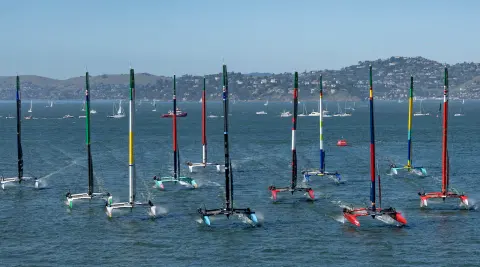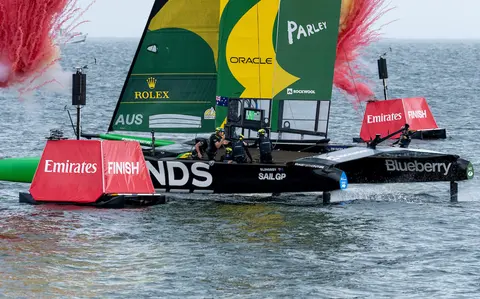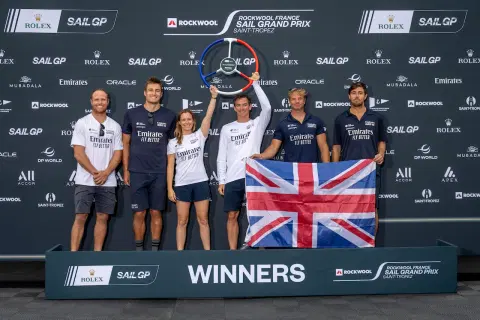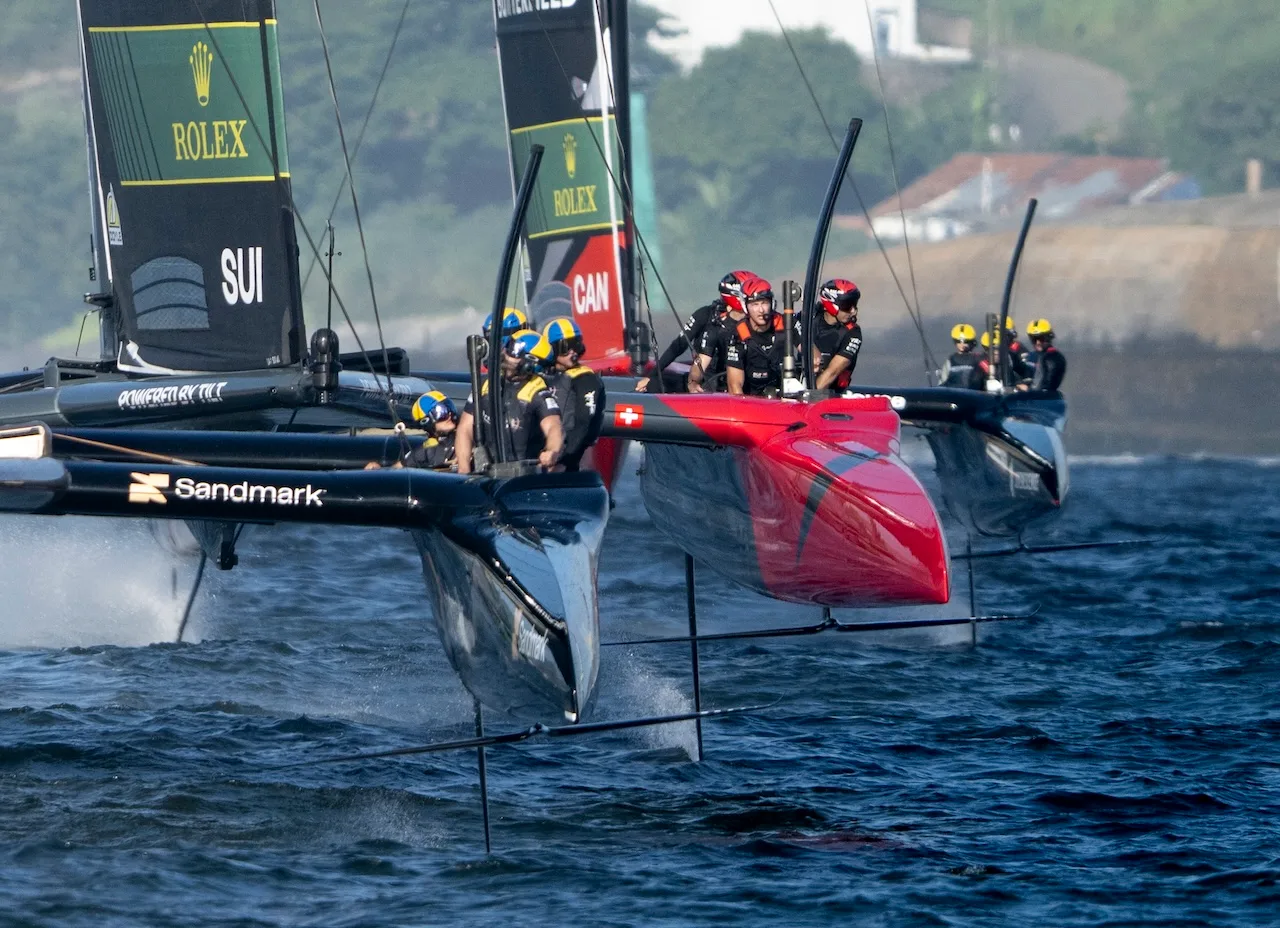
There is a particular kind of hush that falls over a crowd right before an F50 catamaran comes off the water. Thirteen thousand people packed onto the shoreline at Sassnitz will know that hush well by Sunday evening, because Germany's stretch of the Baltic Sea has already proven itself one of the most theatrical stages in professional sailing. The ROCKWOOL Germany Sail Grand Prix returns to this corner of Rgen island on August 22 and 23, the ninth stop of the 2026 Rolex SailGP Championship season, and the fleet arrives with a year of history already stacked up behind it. Sassnitz earned its reputation the hard way. When SailGP first raced here in 2025, the weekend became known among sailors and fans alike as "Crashnitz," a nickname born from a rudder failure that sent France's Quentin Delapierre to hospital mid-event, a starboard-right-of-way collision that tore a hole in Emirates GBR's hull and forced an overnight repair scramble, and a wing and beam failure that eliminated Brazil before racing had properly begun. Six different teams won a race across that opening weekend, a level of unpredictability rarely seen on the circuit. France's crew, battered but unbroken, somehow rebuilt themselves from that opening-day disaster to beat the home German team and reach the Grand Final, then held off the BONDS Flying Roos and Emirates GBR to claim their first event win since Season 3. It remains one of the great redemption stories in SailGP's short history.
That history itself only stretches back to 2018, when five-time America's Cup winner Sir Russell Coutts joined forces with Oracle founder Larry Ellison to build something sailing had never quite managed before: a genuine global racing league, with identical high-performance boats, a fixed nation-versus-nation format, and a season structure borrowed deliberately from Formula 1. The F50 catamarans that resulted, foiling, wing-sailed, and capable of speeds that still seem to defy the physics of sail, transformed the sport's ceiling almost overnight. Sassnitz's own stretch of water became part of that transformation last year when Denmark's ROCKWOOL Racing recorded a top speed of 103.93 kilometres per hour, the fastest anything has ever moved under sail in SailGP's history.
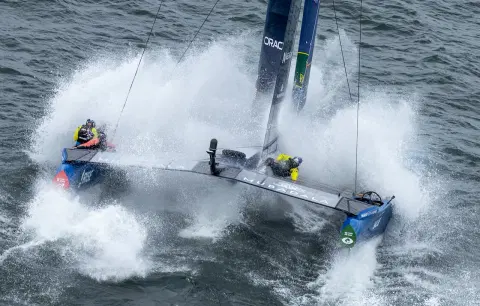
That record now sits at the centre of this weekend's build-up. Danish driver Nikolai Sehested believes stronger forecast winds could push the fleet past the 105 km/h mark for the first time, though he is careful to note how narrow the margin for that kind of speed really is. Everything, he says, has to line up. His team came uncomfortably close to finding the limits of that margin during training earlier this week, when a near-capsize reminded everyone watching just how violently these boats can punish a misjudged gust. A crash at ninety kilometres an hour, he admits, hurts nearly as much as hitting something solid.
For the German team, presented by Deutsche Bank, this weekend carries a different weight entirely. Sitting eighth in the championship but racing in the strongest form of their existence, with more fleet-race top-three finishes this season than in any previous campaign, driver Erik Kosegarten-Heil and his crew arrive at their home event still chasing a first-ever SailGP win. Last season's breakthrough moment came in exactly this venue, when the energy of a home crowd turned a difficult campaign around. Heil is candid about what still needs work: starts remain the team's biggest limitation, even as their straight-line speed has improved to the point where they can now overtake rivals mid-course. A maiden victory in front of their own fans would mean, in his words, the world.
The championship picture adds further tension to an already loaded weekend. Spain's Los Gallos arrive on the back of consecutive wins in Halifax and Portsmouth, now just twelve points behind leaders the BONDS Flying Roos, and wing trimmer Florian Trittel knows precisely how fragile that momentum can be. Their last purple patch, he points out, was immediately followed by a poor showing at this very event last season. Sweden's Artemis Racing bring their own version of unfinished business, having twice finished runner-up this year without yet closing out an event win. Driver Nathan Outteridge, at the helm of a squad still finding its identity as a new team, describes their season as one of steady if unspectacular progress, results edging closer to podiums without quite arriving.
None of that history changes the maths of Sassnitz's brutal draw. Germany finds itself grouped alongside the championship-leading BONDS Flying Roos, Artemis, Emirates GBR, NorthStar Canada, and the United States, a group stacked with three of the four teams currently occupying the top of the standings. There will be no easy passage to the Final for the home crew, whatever the crowd noise does for their confidence off the start line. What Sassnitz offers, more than almost any other stop on the calendar, is proof of how quickly this sport has learned to write its own drama. A venue with barely two years of SailGP history already carries a speed record, a nickname born of chaos, and a fairytale comeback story that sailing fans in Germany will be retelling long after this weekend's results fade from the leaderboard. Whatever unfolds under Rgen's cliffs this time, the smart money says it will not be quiet.