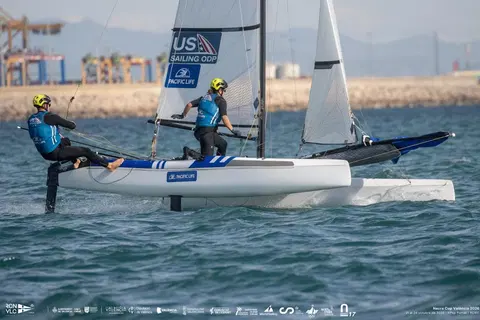
The season has travelled through hard sea breezes, treacherous light-air contests, collisions, penalties and the relentless pressure of 13 identical boats fighting for the same narrow strip of clean wind, although the entire 2026 Rolex SailGP Championship has now been compressed into two weekends beneath the heat of the United Arab Emirates. Australia’s Bonds Flying Roos and Spain’s Los Gallos have already secured their places in the championship-deciding Grand Final, leaving Artemis, the United States and defending champion Emirates Great Britain separated by only six points as they approach Dubai with one remaining place available and no room left for a forgettable weekend.
The Emirates Dubai Sail Grand Prix presented by DP World will take place at Mina Rashid on 21 and 22 November, serving as the penultimate event and the last major opportunity to shape the championship order before the fleet moves to Abu Dhabi. One week later, racing resumes at Mina Zayed on 28 and 29 November, where the full fleet will contest the final championship points before the three highest-ranked teams enter a separate winner-takes-all Grand Final carrying a US$2 million prize and the Rolex SailGP Championship crown.
SailGP was announced in 2018 and began racing in 2019 with six national teams competing across a five-event inaugural season, creating a global championship around identical high-performance foiling catamarans. Australia, led by Tom Slingsby, immediately established the first dynasty by winning Seasons 1, 2 and 3, before Diego Botín and Spain broke that dominance by claiming the Season 4 title. Dylan Fletcher’s Emirates GBR defeated Australia and New Zealand in the 2025 Grand Final, becoming the third nation to lift the championship trophy and arriving in 2026 as defending champions.
That history makes the final qualifying contest especially intriguing, since each contender represents a different stage of SailGP development. Artemis is attempting to become the first expansion team to reach the Grand Final during its debut season, the United States is searching for the reward promised by a campaign of dramatic peaks and difficult interruptions, while Emirates GBR is fighting to preserve a title defence that began with victory but gradually lost momentum as the season unfolded.
Artemis Stands Closest to the Door Nathan Outteridge’s Artemis will arrive in Dubai holding third place with 59 championship points, giving the Swedish team a three-point advantage over the United States and six points over Emirates GBR. The margin is useful without offering security, because one poor start, boundary penalty or equipment problem could erase the entire advantage before the first afternoon has finished.
Artemis has built its challenge through consistency rather than event victories, finishing inside the leading group often enough to remain ahead of teams that have occasionally appeared faster. The Swedish crew has reached three event Finals without winning one, while its record across the season places it behind only Australia and Spain for sustained performance. Nearly half of its race finishes have been podium results, suggesting that the team’s championship position has been earned through reliable execution rather than a single fortunate weekend.
Outteridge brings an exceptional background to the campaign as an Olympic champion, America’s Cup sailor and one of the most naturally gifted multihull specialists of his generation. His understanding of foiling boats makes him particularly dangerous when conditions require rapid adjustments between displacement sailing and full flight, while his experience under pressure should help a new team avoid becoming consumed by the significance of its position.
The difficulty for Artemis will involve balancing caution against ambition, because protecting third place without attacking the races could allow the Americans or British to sail past. A conservative start may avoid an early penalty, although the compressed SailGP courses make overtaking difficult once the leading boats reach Mark 1 with clean wind and freedom to choose their manoeuvres.
America’s Driver Returns The United States sits fourth with 56 points and possesses one of the season’s most unusual performance records. Taylor Canfield’s team has reached two event Finals and won both, giving the Americans a perfect Finals conversion rate even while inconsistency elsewhere prevented them from securing an earlier championship position.
Victories in Sydney and Valencia demonstrated that the United States can defeat every leading team when the complete performance comes together. The Valencia result carried particular significance because it arrived in light conditions, with the Americans making fewer manoeuvres and choosing an efficient route to overcome Australia after Slingsby’s crew had led much of the Final.
Canfield’s late-season injury disrupted that momentum and forced former Brazil driver Martine Grael into the American boat for Geneva. Reserve driver Harry Melges was also unavailable through injury, exposing the importance of squad depth within a championship where teams cannot afford to lose their principal helmsman during the decisive part of the season.
Canfield has now confirmed his return for Dubai, restoring the driver whose aggressive match-racing instincts and starting ability brought the team its strongest results. The United States has also been statistically impressive in light wind during 2026, an important advantage if Dubai produces the delicate conditions that have often characterised racing around Mina Rashid.
Light-air racing requires a different approach from the spectacular high-speed contests used in SailGP promotional films, because the F50 may struggle to remain on its foils and every unnecessary turn can cost hundreds of metres. Crews must move their weight accurately, protect airflow across the wing and search constantly for isolated patches of pressure, while the driver attempts to avoid manoeuvres capable of dropping the boat from flight.
The Champions Have Nothing Left to Save Emirates Great Britain occupies fifth place with 53 points, six behind Artemis and carrying the uncomfortable knowledge that the reigning champions could be eliminated before reaching the Abu Dhabi Grand Final. Dylan Fletcher’s team opened the season with an authoritative victory in Perth, then added second-place finishes in Auckland and Sydney, creating the impression that Britain would move smoothly towards an opportunity to defend its title.
Momentum changed as penalties, equipment problems and inconsistent starts began affecting the campaign. Fletcher has spoken candidly about the need to improve his starting performance, particularly under the split-fleet format, where fewer boats create cleaner wind for the leaders and reduce the opportunities available to crews attempting to recover from the back.
Modern SailGP races are often shaped within seconds of the start, since an F50 reaching the line at speed can establish an immediate advantage and arrive at the first mark with control of the favoured lane. A boat trapped behind disturbed air loses acceleration, while additional tacks or gybes create further separation from rivals sailing directly towards the next turning point.
Emirates GBR became the first team to use SailGP’s new permanent training base in Pensacola, completing a focused camp designed to improve starts and sharpen crew coordination before the UAE double-header. That preparation could become the difference between elimination and qualification, although simulator work, video analysis and training laps cannot reproduce the emotional pressure of entering a final weekend knowing every point matters.
Fletcher can draw confidence from previous British victories in both Dubai and Abu Dhabi, while his Olympic gold medal and successful 2025 championship campaign prove he can perform when the situation becomes uncomfortable. The arithmetic also gives the British team a simple mindset, because protecting fifth place achieves nothing and the only useful direction is forward. Australia and Spain Wait for Their Opponent Australia’s Bonds Flying Roos enters the UAE as the season’s outstanding team, having equalled the SailGP record of five event victories during a single campaign. One further victory would establish a new benchmark, while the team’s accumulated prize money could move beyond US$10 million if the final weekends unfold successfully.
Tom Slingsby has already led Australia to three championships, giving the Flying Roos more experience of SailGP’s winner-takes-all format than any rival. That history provides confidence without offering protection, because the Grand Final discards the comfortable mathematics of the season and reduces everything to one race where a poor start, boundary error or damaged foil can destroy months of superior performance.
Spain arrives with three event victories and the confidence generated by its most recent success in Geneva. Diego Botín’s team has already shown its ability to perform in a championship shootout, having stunned Australia and New Zealand to win Season 4 after reaching the Grand Final without carrying the favourite’s status.
Australia and Spain therefore face an unusual tactical dilemma during the remaining fleet racing. Both want to maintain competitive sharpness and establish psychological control, although an aggressive collision or serious penalty could jeopardise the F50 required for the Grand Final. Protecting the boat too carefully could also be dangerous, since a team that stops attacking may struggle to recover its intensity when the championship race begins.
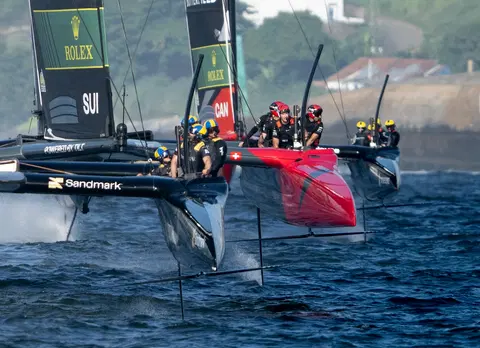
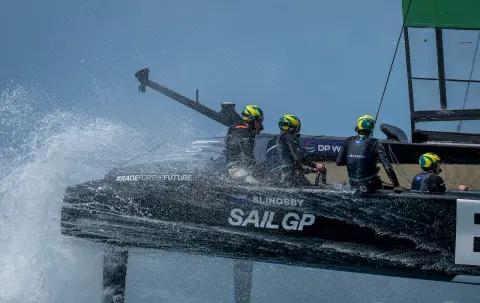
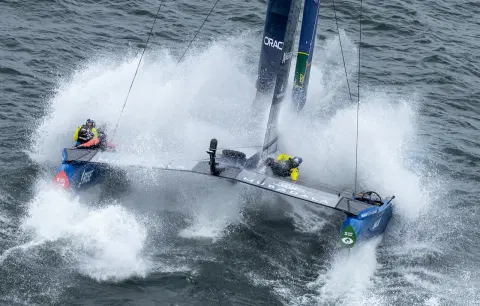
Why the F50 Makes the Finale Unpredictable Every SailGP team competes aboard an F50, a 15-metre one-design foiling catamaran developed from the AC50 boats used during the 2017 America’s Cup. Carbon foils lift the hulls above the surface, reducing drag and allowing the boats to exceed 100 kilometres per hour in suitable conditions, while the rigid wingsail and advanced control systems create performance reaching more than three times the wind speed.
The term one-design can be misleading because identical boats do not produce identical results, since crew movement, foil control, wing trim, tactical judgement and communication create enormous performance differences. Six athletes must coordinate every manoeuvre while the boat accelerates, banks and crosses waves at speeds where small mistakes become violent very quickly.
Dubai’s possible light wind could require the larger 27.5-metre wing, titanium foils and specialised light-air rudders, transforming the F50 from a high-speed machine into a delicate platform that demands constant attention. Remaining on the foils may become more important than reaching the theoretical fastest route, while crews that turn too often could watch rivals disappear on a single stable flight path.
Abu Dhabi may present a different test, with local effects around Mina Zayed producing shifts and areas of uneven pressure across a compact stadium course. The Grand Final will amplify every decision because only three boats compete, leaving more open water but fewer rivals capable of absorbing a mistake. The Most Expensive Race of the Season Approximately US$4 million remains available across the two UAE events, including prize money for the leading teams in Dubai and Abu Dhabi, a reward for the highest season points total and the US$2 million Grand Final purse. The final race therefore carries more than national pride and a championship trophy, since a single tactical decision could determine an extraordinary financial result.
SailGP’s Grand Final format has always created debate because a team can dominate an entire season before losing the title in one short race. Supporters argue that the format produces a clear and dramatic conclusion, while critics believe sustained excellence should carry greater protection from a single poor start or mechanical problem.
Australia experienced both sides of that argument after winning three consecutive championships and then losing Season 4 to Spain in the Grand Final. Emirates GBR used the same format successfully in 2025, defeating Australia and New Zealand when the championship reached its decisive race.
The format remains brutally simple, because the teams must perform when the pressure is greatest. Australia and Spain already know they will be there, while Artemis, the United States and Great Britain must first survive Dubai and complete another fleet-racing programme in Abu Dhabi before earning the right to challenge them.
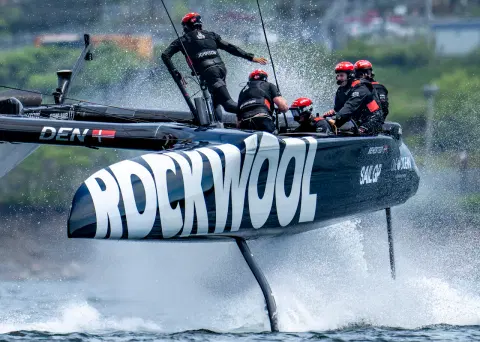
Only one of those three contenders can reach the final start, creating a battle within the wider fleet where every position surrendered to an eliminated team could become decisive. New Zealand’s Black Foils, Denmark’s ROCKWOOL Racing and the remaining crews may no longer control their own championship destiny, although they can take points from the leading contenders and reshape the qualification contest without carrying the same pressure.
Artemis holds the position, the United States brings proven light-air speed and Emirates GBR carries the experience of defending champions with nothing left to protect. Dubai will reveal which advantage matters most, before Abu Dhabi strips the season down to three boats, one race and a US$2 million decision.
The 2026 championship has travelled around the world to reach this point, although its entire history will ultimately be written across a few short minutes on the waters of Mina Zayed. Twelve months of preparation, thousands of kilometres of travel and countless hours of analysis will disappear behind the start signal, leaving three F50s accelerating towards the line and one final opportunity to become Champions of the Rolex SailGP Championship.