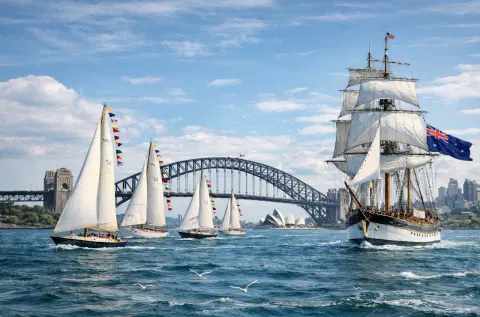
At one o’clock on Boxing Day, Sydney Harbour will become a rolling theatre of white sails, spectator boats, helicopter noise and nervous energy as the fleet gathers beneath the summer sky for the start of the 2026 Rolex Sydney Hobart Yacht Race, although this year there will be another vast fleet waiting beyond the harbour, invisible from the shoreline and scattered across bedrooms, offices and kitchen tables around the world. The Cruising Yacht Club of Australia has renewed its partnership with Virtual Regatta, allowing more than three million registered players to take part in a dedicated digital version of the race, where the same weather systems, difficult tactical decisions and unforgiving 628-nautical-mile course will test virtual navigators as the real yachts race south towards Tasmania.
The idea may sound wonderfully comfortable to anybody who has endured a freezing night watch in Bass Strait, since the virtual skipper can race without being soaked by green water, bruised by a slamming hull or summoned from a warm bunk to change a sail in darkness, yet success will still demand patience, concentration and a proper understanding of offshore navigation. Virtual sailors will need to study the changing breeze, choose a route down the New South Wales coast, judge the approach to Bass Strait and remain alert as their digital boats close on Tasman Island, Storm Bay and the notoriously uncertain River Derwent, where more than one real Sydney Hobart campaign has been transformed during the final few frustrating miles.
Virtual Regatta has spent more than a decade alongside the Rolex Sydney Hobart Yacht Race, turning one of the world’s most demanding offshore contests into an accessible international sporting challenge, while an earlier collaboration during the 2026 Noakes Sydney Gold Coast Yacht Race demonstrated how naturally the real and digital fleets can share the same stretch of ocean. More than 50 official Virtual Regatta events are staged each year, including digital versions of the Vendée Globe, Route du Rhum and Transat Jacques Vabre, creating a parallel world in which experienced sailors, weather enthusiasts, schoolchildren and complete newcomers can race together without needing an ocean yacht, a professional crew or the bank balance normally required to mount a serious offshore campaign.
The Rolex Sydney Hobart occupies a special place within that digital calendar because its course is comparatively short, brutally changeable and tactically intense from the moment the fleet leaves Sydney Harbour. The first race began in 1945 as a cruise south organised by the newly formed Cruising Yacht Club, although British naval officer Captain John Illingworth persuaded the sailors to turn the passage into a race, then proceeded to win aboard the little yacht Rani after six days, 14 hours and 22 minutes at sea. Nine boats started that first contest, establishing a tradition that has survived gales, calms, technological revolutions and the transformation of offshore sailing from an adventurous pastime into a highly professional international sport.
The course has remained recognisably faithful to that original challenge, carrying the fleet out through Sydney Heads before turning south along the Australian coast, crossing Bass Strait, passing Tasman Island and entering Storm Bay for the final approach to Hobart. Distance alone has never explained the race’s fearsome reputation, since the true difficulty comes from the succession of different weather systems and sea states compressed into a passage of 628 nautical miles. A boat can leave Sydney in sunshine and a warm northeasterly breeze, encounter a violent southerly change during the first night, wrestle with confused seas and strong currents off the coast, then cross Bass Strait beneath a cold front before becoming trapped in silence on the Derwent within sight of the finish.
The virtual fleet will experience those strategic problems through real-time weather information, bringing armchair navigators closer to the intellectual contest unfolding aboard the yachts themselves. Finding the fastest route will involve far more than drawing a straight line towards Hobart, because the East Australian Current can create areas of favourable flow, rough water and dangerous countercurrents, while an offshore move may offer stronger wind at the cost of additional distance. Staying close to the coast can shorten the course and occasionally provide shelter, although the breeze may weaken beneath the land as darkness arrives, leaving a cautious boat crawling while rivals further offshore continue south at speed.
Bass Strait introduces another set of calculations, since its shallow waters can become steep and confused when a strong wind opposes the current, creating conditions that punish yachts and crews far more severely than an ordinary ocean swell. Real navigators must balance forecast models against what they can see from the deck, what the instruments are recording and what the boat can safely withstand, while virtual competitors face their own version of the same decision as they decide whether to chase the strongest pressure or protect a more conservative position. Raw speed always attracts attention in the Sydney Hobart, yet the race has repeatedly shown that the fastest theoretical route can become a losing choice when a weather system arrives several hours earlier or later than expected.
History has filled the race with boats and sailors whose names have passed into Australian sporting folklore, including Morna, Kurrewa IV, Kialoa, Condor of Bermuda, Apollo, Ragamuffin, Wild Oats XI, Comanche and numerous smaller yachts that conquered the handicap standings through resilience, intelligent sailing and exceptional consistency. Syd Fischer became one of its great enduring characters through decades of competition, while figures such as John Illingworth, Bob Oatley, Mark Richards and the late Sir James Hardy helped shape the character of an event where wealthy owners, professional sailors and determined Corinthian crews share the same start line. Wild Oats XI became particularly associated with the modern race after collecting multiple line honours victories, while the 100-foot Comanche set the current race record of one day, nine hours, 15 minutes and 24 seconds in 2017.
Those giant maxis will again command attention as they accelerate out of Sydney Harbour, carrying enormous sail plans and highly experienced crews capable of driving a 100-foot yacht through darkness at speeds that earlier generations would scarcely have believed possible. Their contest for line honours will be compelling, although the deeper story of the Sydney Hobart has always extended far beyond the first yacht to reach Constitution Dock, because the Tattersall Cup for the overall handicap winner rewards the boat producing the finest performance relative to its size and rating. A well-sailed 40-footer can spend several nights at sea and still defeat the largest, most spectacular yacht once corrected times have been calculated, which remains one of the great democratic qualities of offshore racing.
Virtual Regatta opens that same tactical theatre to people who may never have stood on the deck of an ocean racer, giving them a reason to study weather charts, understand wind angles and appreciate why a yacht appearing to sail away from Hobart might actually be making the winning move. The game also allows friends, sailing clubs, families and workplaces to create their own rivalries within the larger race, turning the days between Christmas and New Year into a rolling navigational contest where checking the boat’s position can become an irresistible habit. Sleep remains optional for the virtual navigator, particularly when a wind shift is forecast for the middle of the night, proving that even a Sydney Hobart sailed from a comfortable chair can interfere considerably with seasonal relaxation.
The partnership also offers the Cruising Yacht Club of Australia a valuable bridge between traditional offshore racing and the digital audience that increasingly follows major sport through trackers, onboard cameras and interactive platforms. Television pictures of the Boxing Day start remain one of the great sights of the Australian summer, although the ability to race beside the fleet creates a deeper connection, encouraging viewers to understand why one boat chose the coast, why another headed offshore and why a seemingly secure lead disappeared during a windless approach to Hobart. Spectators become participants, while the tactical language of offshore sailing begins to make sense through experience rather than explanation.
Virtual racing cannot reproduce the cold, exhaustion, fear and companionship of a genuine Sydney Hobart, nor can it capture the sensation of passing Tasman Island after days at sea or hearing the first cheers from the Hobart waterfront during the final approach. Its importance lies elsewhere, in opening a famously difficult race to anybody curious enough to enter, while creating a new generation of followers who may eventually step aboard a dinghy, join a sailing club or stand on a real offshore start line. When the cannon fires on 26 December 2026, the yachts on Sydney Harbour will carry the visible race south, while millions of unseen navigators begin their own passage towards Hobart, discovering that the ocean can command attention even when experienced through a screen.