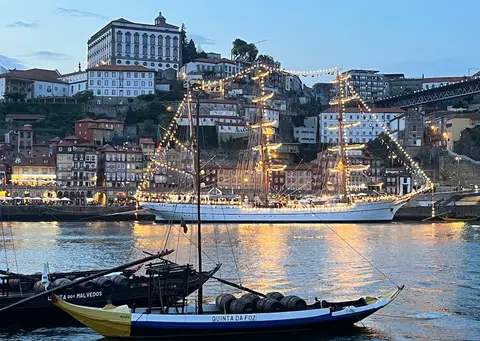
The Atlantic has always shaped the character of northern Portugal, carrying fishermen beyond the shelter of the coast, bringing merchant ships towards the Douro and giving generations of sailors a horizon that appeared to lead towards the wider world. On 19 November 2026, attention turned from crossing that ocean to repairing it, as The Ocean Race Summit Matosinhos-Porto gathered international policymakers, scientists, business leaders, financiers, sailors and ocean advocates at the Porto Leixões Cruise Terminal to ask how concern for declining marine health could finally become practical, measurable and properly funded recovery.
The gathering took place under the theme “Driving Ocean Regeneration: A Collective Effort for Ocean Recovery,” language chosen to move the conversation beyond conservation alone. Protecting what remains is essential, although regeneration demands something more ambitious, requiring damaged habitats to be restored, pollution to be reduced, communities to become active participants and financial systems to recognise that a functioning ocean is not an optional environmental luxury.
Matosinhos provided an appropriate setting because its identity has been built around fishing, shipping, beaches, food and the working Atlantic. Mayor Luísa Salgueiro described the sea as part of the city’s history, economy and culture, while Porto Mayor Pedro Duarte connected the Summit with the region’s centuries-old habit of looking outward through the ocean.
Portugal’s relationship with the sea carries a complicated history of exploration, trade, migration and maritime power, although its modern Atlantic identity increasingly includes marine science, renewable energy, coastal tourism, conservation and the blue economy. The Summit attempted to connect those different interests without pretending they will always agree, since economic growth and environmental recovery can only coexist when long-term ecological limits influence immediate political and commercial decisions. The Beginning of a Partnership Through 2040 The Summit became the first major public milestone in a long-term partnership between The Ocean Race, the City of Porto, Turismo de Portugal and Turismo do Porto e Norte de Portugal. The agreement will run through 2040 and establish Porto as the future global headquarters of The Ocean Race, creating a permanent Atlantic base for racing, education, science and international action focused upon ocean health.
Beginning in 2028, an historic waterfront building near Porto City Park is intended to become the race’s operational headquarters, accompanied by public and educational activities. A separate museum is also planned to celebrate The Ocean Race, its sailors and Portugal’s maritime heritage while explaining the importance of ocean science and recovery.
Porto is scheduled to host a special racing event in 2028, followed by the starts of three editions of The Ocean Race around the world in 2030, 2034 and 2038. Portugal is also expected to host at least six additional international sailing events connected with The Ocean Race Europe, together with future Summits and programmes covering science, education and ocean literacy.
Such a long agreement offers something rare within international sport, where host-city relationships are often constructed around a single event and dismantled soon after the trophies have been presented. A partnership lasting through 2040 creates the possibility of permanent expertise, local employment, educational programmes and infrastructure capable of supporting Portuguese sailors, marine businesses and researchers between race editions.
The arrangement also gives The Ocean Race a home facing directly into the Atlantic, where offshore teams can train, technical companies can develop equipment and young Portuguese sailors can see elite ocean racing as a realistic career rather than a distant spectacle arriving briefly from abroad.
A Race Born in the Southern Ocean The Ocean Race began as the Whitbread Round the World Race in 1973, when 19 boats and 324 sailors left Portsmouth for a four-leg course through Cape Town, Sydney and Rio de Janeiro before returning to Britain. The fleet entered the Southern Ocean at a time when offshore communications were limited, weather information was rudimentary and many of the yachts carried the equipment and accommodation of cruising boats rather than the stripped-out interiors of modern racing machines.
Mexican skipper Ramón Carlin won the first edition aboard the Swan 65 Sayula II, an achievement made more remarkable by the fact that he had encountered sailing relatively late and assembled a campaign many established sailors initially underestimated. Great Britain II, skippered by Chay Blyth, secured line honours after completing the course in 144 days, while the race revealed both the attraction and danger of taking fully crewed yachts through some of the most remote waters on Earth.
The Whitbread evolved through increasingly powerful maxi yachts, professionally organised campaigns and new generations of offshore design before becoming the Volvo Ocean Race and eventually The Ocean Race. Navigation moved from sextants and paper charts to satellites, digital routing and constant communications, while the yachts changed from comparatively heavy displacement designs to lightweight carbon machines and foiling IMOCAs capable of sustained speeds that earlier crews would have considered extraordinary.
The fundamental relationship between sailors and the ocean never changed, because every technological improvement remained subject to wind, waves and the physical condition of the racecourse. Crews crossing the Southern Ocean experienced warming seas, plastic pollution and changing weather patterns directly, giving the event an unusual platform from which to discuss marine decline. From Racing Around the Ocean to Racing for It The Ocean Race’s environmental Summits began as a stand-alone gathering during the 2014-15 edition at Newport, Rhode Island. During the 2017-18 race, the programme focused heavily upon ocean plastics, encouraging governments and businesses to join international initiatives and reduce avoidable plastic use.
Later Summits broadened their attention towards ocean governance, marine protection and the developing argument for recognising the ocean’s rights within political and legal systems. During the 2022-23 edition, the events worked to build support for stronger governance and restoration, while The Ocean Race expanded its scientific programme by carrying instruments aboard racing yachts travelling through waters rarely visited by research vessels.
Those onboard measurements have included information concerning temperature, atmospheric conditions, carbon dioxide and microplastics. Racing yachts cannot replace dedicated research ships, although their repeated passages through remote ocean regions offer scientists valuable observations from areas where permanent monitoring remains difficult and expensive.
The Summit programme now supports the United Nations Ocean Decade and its effort to rebuild society’s relationship with the sea, using the visibility of offshore racing to reach audiences who may never attend a scientific conference or read an international policy document.
Staying the Course When Progress Is Slow Race Chairman Richard Brisius used a familiar offshore lesson to frame the Summit’s central challenge, explaining that the ocean teaches sailors to continue even when progress is measured in centimetres rather than miles. Ocean recovery shares that frustration, because damaged ecosystems can take years to respond while political priorities and investment decisions often change within months.
A crew cannot negotiate with weather or vote to remove a storm from the course, although it can change sails, alter direction and prepare the boat for what is approaching. Minna Epps, Global Ocean Director at the International Union for Conservation of Nature, drew upon that reality when arguing that society must adapt its course while protecting and restoring what has already been lost.
Portuguese Olympic and offshore sailor Mariana Lobato brought the discussion back to the personal connection formed when a sailor is alone on deck and becomes aware of the ocean’s immense scale. Lobato co-skippered United by the Ocean to victory in The Ocean Race Atlantic during 2026, giving her perspective the authority of somebody who understands both competitive ambition and the humility imposed by open water.
Big-wave surfer Garrett McNamara described a similarly personal debt to the sea, having built his life around waves including the enormous Atlantic swells found at Nazaré. His presence widened the Summit beyond offshore sailing and reinforced the idea that surfers, fishermen, coastal residents, marine businesses and racing sailors may approach the ocean differently while remaining dependent upon its health.
Pascal Lamy, former European Commissioner and Director-General of the World Trade Organization, argued that ocean regeneration must overcome deficits in both emotional connection and scientific understanding. Data can explain the scale of ecological decline, although people rarely protect something they regard as remote, abstract or separate from their daily lives.
Ocean Health Is Financial Stability One of the Summit’s most important discussions concerned finance and the persistent failure of economic systems to recognise the value supplied by healthy seas. The ocean regulates climate, stores carbon, supports food production, protects coastlines, enables international trade and sustains employment, yet many of those services remain absent from conventional financial risk models.
The Ocean Maelstrom: Navigating the Climate Storm report, produced by the Institute and Faculty of Actuaries with the University of Exeter and The Ocean Race, was presented within that context. It examines how climate change, biodiversity loss, pollution and excessive extraction of marine resources could combine with wider economic pressures to produce cascading effects across food systems, supply chains, insurance, investment markets and coastal communities.
Its Ocean Maelstrom scenario is not presented as a forecast, although it demonstrates how ocean degradation could move rapidly from an environmental issue into inflation, weaker economic growth and financial instability. The report introduces the idea of Ocean Solvency, asking whether marine systems can continue providing the essential services upon which human societies and economies depend.
This approach matters because finance generally responds to risks it can identify, measure and price. Marine damage often develops beyond public view, allowing declining fish populations, acidification, warming and habitat loss to remain economically invisible until the consequences appear in disrupted trade, expensive coastal damage or falling food production.
Blue finance attempts to direct investment towards projects that improve marine resilience while creating credible economic value. Opportunities include restoring mangroves and seagrass, improving wastewater systems, reducing plastic leakage, developing cleaner ports, supporting sustainable aquaculture and helping coastal communities adapt to climate change.
The challenge lies in proving that projects deliver genuine ecological improvement rather than becoming another source of attractive claims unsupported by evidence. Effective blue finance therefore needs clear standards, long-term monitoring and transparency capable of showing where money went and what changed as a result. Cities and Regions Cannot Wait for Global Agreement International treaties remain essential because the ocean crosses every political boundary, although many practical decisions are made by cities, ports, tourism authorities and regional governments. Wastewater systems, coastal construction, harbour operations, public education and habitat restoration depend heavily upon local institutions with the power to turn broad commitments into visible action.
Rui Costa, Vice-President of Northern Portugal’s regional development commission, argued that the ocean’s future would not be decided by international agreements alone. His message reflected one of the Summit’s strongest themes, since cities and regions can act as laboratories where policies are tested, finance is directed and communities see whether environmental promises produce meaningful local results.
Tourism creates an especially difficult balance for Portugal because clean water, beaches, seafood and attractive coastal landscapes are central to the visitor economy. Poorly managed growth can damage those assets through construction, waste and overcrowding, while responsible tourism can help finance conservation, create employment and give political value to healthy marine environments.
Carlos Abade, President of Turismo de Portugal, presented the sea as both part of Portuguese identity and a source of economic opportunity. Lasting advantage will depend upon growth that preserves the ocean rather than steadily consuming the qualities that attract visitors and maritime investment in the first place.
Measuring the Wake Left Behind Large conferences often produce stirring speeches before participants fly home and daily political pressures return. The value of The Ocean Race Summit Matosinhos-Porto will therefore be determined by what follows, including the programmes financed, policies changed, habitats restored and communities given a meaningful role in decision-making.
The partnership through 2040 offers an unusually long period in which those results can be measured. By the time Porto hosts race starts in 2030, 2034 and 2038, there should be enough evidence to judge whether the relationship has strengthened ocean education, Portuguese offshore sailing, scientific knowledge and practical marine recovery.
The next round-the-world edition of The Ocean Race will begin from Alicante on 17 January 2027, sending teams back onto the global racecourse where the environmental changes discussed in Porto become physical realities. Sailors will cross warming waters, gather scientific information and carry the ocean story between ports, although the greater responsibility will remain ashore with the governments, businesses and financial institutions capable of changing how marine systems are valued.
Offshore sailors understand that reaching a distant finish requires persistence, adaptation and thousands of small decisions made correctly over time. Ocean regeneration demands the same discipline on a far larger scale, with no sheltered harbour available if society decides the work has become inconvenient.
Porto has committed itself to a partnership extending across the next 14 years, while The Ocean Race has chosen an Atlantic home from which its sporting and environmental missions can develop together. The Summit supplied the words and ambitions, although the ocean will ultimately judge the results through cleaner water, recovering habitats and communities able to build their future without destroying the sea upon which that future depends.