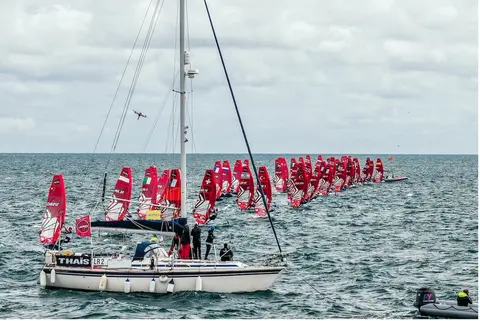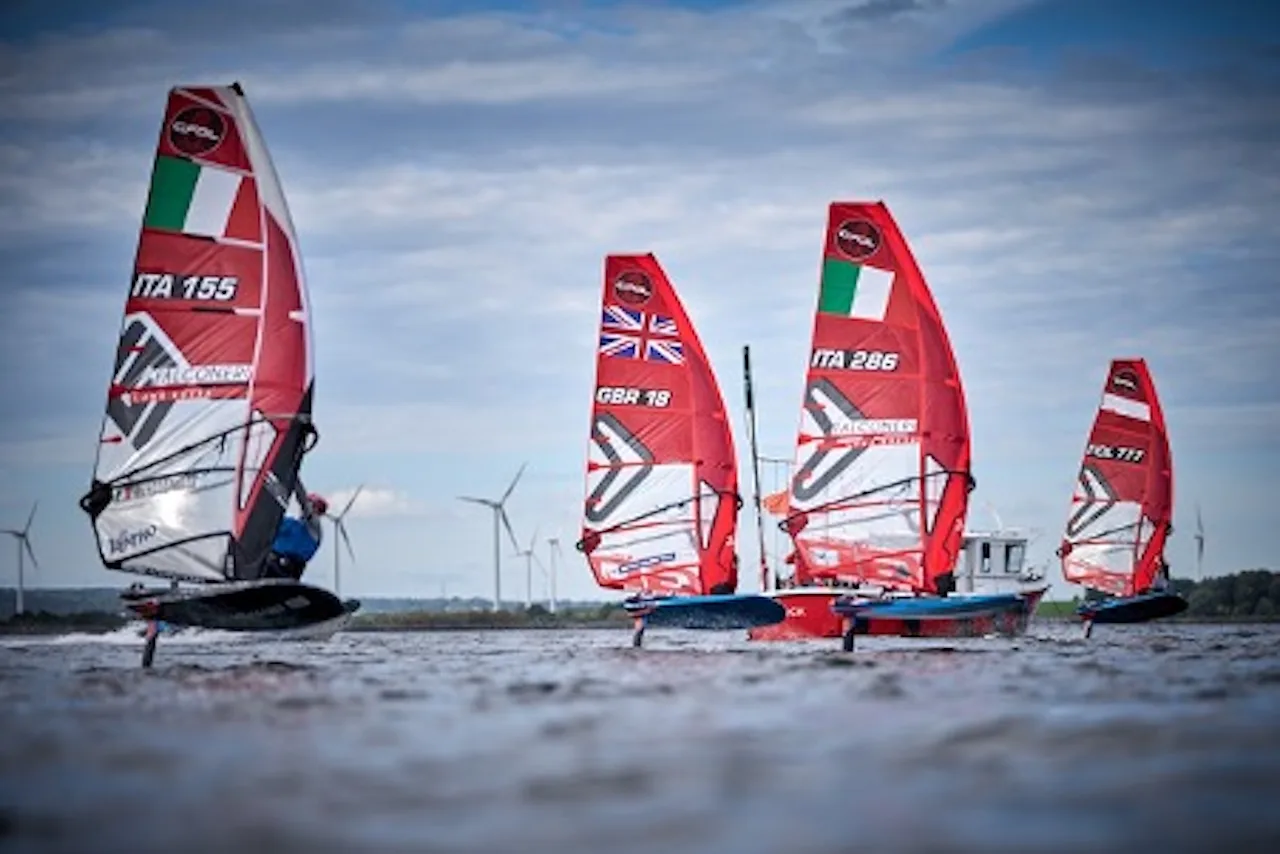
The wind had almost deserted the Bay of Puck when the most important races of the week finally arrived, leaving the world’s finest young iQFOiL sailors searching for enough pressure to lift their boards clear of the water and carry their championship dreams towards the finish. Every movement mattered in the fragile Polish breeze, where one poorly timed gybe could stop a board almost completely and a single tactical error could overturn five days of disciplined racing within a few silent seconds.
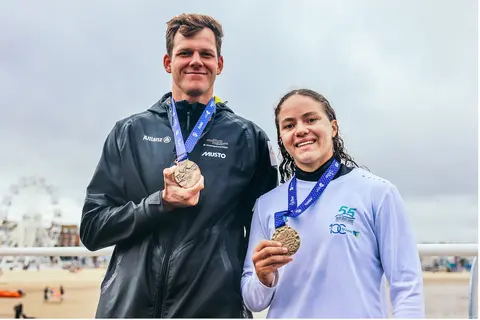
Aimee Bright of New Zealand and Leonardo Tomasini of Italy emerged from that examination as the 2026 iQFOiL U23 World Champions, although their journeys towards gold could hardly have been more different. Bright completed a week she had controlled from its opening races, while Tomasini overturned the advantage held by Italian teammate Federico Alan Pilloni when the men’s title was decided in the final Slalom contest.
The championship brought 148 sailors from 34 nations to Puck for six days of racing across a wide range of conditions. Stronger winds allowed the fleets to stretch their legs through conventional Course Racing, while lighter days demanded the compressed speed, instinctive decision-making and aggressive mark handling of Slalom.
That variety provided a thorough examination of the next generation of Olympic windsurfers. Powerful conditions rewarded commitment and control, while the final day removed much of the obvious speed and replaced it with uncertainty, leaving the leading sailors to defend their ambitions in air so light that simply remaining on the foil became a tactical weapon.
Bright Controls the Championship
Aimee Bright established her authority from the opening day, winning three of the first four Course Races as winds of 15 to 18 knots swept across the Bay of Puck. Her early performance immediately placed the New Zealander at the head of the women’s fleet, where she remained throughout the qualification series.
Bright’s consistency became particularly impressive because the championship repeatedly changed character. Course Racing requires sailors to interpret a larger tactical picture, judging wind shifts, pressure, laylines and the movement of rivals across an open course, while Slalom compresses the contest into short, high-speed legs where starts and manoeuvres carry disproportionate importance.
Bright handled both disciplines with the confidence of a sailor who had already experienced the pressure of a world championship final. She had won silver behind fellow New Zealander Stella Bilger at the 2025 iQFOiL U23 World Championships in Portimão, where the Kiwi pair completed a memorable one-two finish.
That result provided experience as well as disappointment. Reaching the final establishes a sailor among the championship favourites, although finishing one place short of gold creates a lesson that can remain long after the medal ceremony has ended.
Puck offered Bright another opportunity, and this time she arrived at the decisive day as the sailor everybody else needed to defeat. Her direct passage into the Grand Final reflected the strength of her qualification campaign, although the Medal Series format ensured that her accumulated advantage could provide protection only up to a point.
Maya Gysler of Norway joined her in the title contest after producing an increasingly determined challenge during the later stages of the championship. Gysler’s progress brought the women’s title down to a final confrontation between two sailors who had earned their positions across the week.
The decisive moment arrived at the second mark. Gysler approached too low, underlaying the turning point and forcing herself into additional gybes when the board could least afford them. Every extra manoeuvre in marginal wind carries the danger of dropping from the foil, surrendering speed and allowing a nearby rival to escape.
Bright recognised the opening and converted it with the composure that had characterised her championship. Her final victory secured the women’s world title, while Gysler collected silver after coming agonisingly close to changing the order.
Stella Bilger of Australia completed the podium in third, adding another strong result to a young career already closely connected with this championship. Sophia Meyer of Germany produced the most dramatic journey through the Medal Series, advancing from tenth place through the knockout rounds before finishing fourth overall.
Meyer had been outside the leading ten only two days earlier, making her final-day rise a reminder that the Medal Series rewards sailors who arrive with momentum and refuse to be intimidated by earlier results.
Tomasini Turns the Italian Order Around
The men’s championship appeared to belong to Federico Alan Pilloni for much of the week. The Italian completed the qualification series in first place after demonstrating speed and control across changing conditions, while compatriot Leonardo Tomasini remained close enough to keep the title dispute firmly within their national squad.
Both sailors earned direct passage to the Grand Final, removing the need to survive the Quarter Finals and Semi Finals. Their qualification positions offered an important advantage, although neither could treat the title as secure once the final sequence began.
Pilloni understood the dangers of the format particularly well. During the 2025 U23 World Championship in Portimão, he had advanced from the Quarter Final while Australia’s Grae Morris eventually secured the men’s world title. A year later in Poland, Pilloni entered the decisive race from the strongest possible position, yet the knockout structure again demonstrated its capacity to rewrite a championship.
Tomasini produced his finest sailing when the title depended upon it. The Italian found enough speed in the super-light Slalom to defeat the sailor who had controlled much of the week, turning the national order around and claiming the greatest championship result of his young career.
Pilloni’s silver medal remained the reward for an exceptional qualification performance, even if the colour must have felt difficult to accept immediately after racing. His speed across the championship confirmed Italy’s considerable strength in Olympic windsurfing, while Tomasini’s victory demonstrated how intense the competition has become within their own national programme.
Stanisław Trepczyński gave the home supporters a result to celebrate by securing bronze. The Polish sailor had placed himself in contention during the penultimate day, winning three races to earn his position in the Semi Final before carrying that form into the Medal Series.
A podium on home water carries a particular weight because familiar surroundings do not remove pressure. Every mistake is witnessed by coaches, friends and local sailors, while every successful manoeuvre brings an immediate response from the shore.
Trepczyński converted that pressure into a composed final performance, completing the championship behind the two Italians and adding a Polish flag to the podium in Puck.
A Championship Decided by Marginal Wind
Light-air foiling can appear gentle from a distance, although the physical and technical demands remain severe. A sailor must create enough board speed for the hydrofoil to generate lift, then protect that flight through body movement, sail trim and precise steering.
Once the board drops back onto the surface, drag increases dramatically. A rival who remains foiling can disappear ahead while the grounded sailor pumps the sail and board in an exhausting attempt to fly again.
Slalom intensifies the problem because the course is shorter and the fleet converges rapidly upon each mark. Sailors approach at speed, choose a line through disturbed air and attempt to complete the gybe without allowing the foil to lose lift.
The manoeuvre requires the rider to control the rig while transferring body weight and guiding the board around the turn. In stronger wind, power can cover a modest error, although the final day in Puck offered almost no margin for correction.
Numerous attempts and re-runs were needed before the Quarter Finals, Semi Finals and Grand Finals could be completed. Such interruptions test concentration because competitors must repeatedly prepare for racing, manage their emotions and then wait for another opportunity.
The eventual results were therefore decided by more than outright speed. Patience, tactical judgement and the ability to remain mentally composed during an uncertain day became as important as physical strength.
From Windsurfer to Olympic Foiling Machine
Competitive windsurfing has occupied a place in the Olympic Games since 1984 for men and 1992 for women, although the equipment has changed repeatedly as the sport developed. The Windglider, Lechner, Mistral and RS each represented a different stage in the search for equipment capable of testing sailors across a broad range of conditions.
The iQFOiL replaced the RS for the Paris 2024 Olympic cycle, transforming the appearance and speed of Olympic windsurfing. A hydrofoil beneath the board produces lift in much the same way that an aircraft wing works through air, raising the hull above the water and dramatically reducing drag.
The board is wider and shorter than the RS, while the foil allows the sailor to travel far faster once airborne. World Sailing described starting speeds of approximately 25 kilometres per hour for the iQFOiL, compared with around five kilometres per hour for the older displacement board.
Greater speed changed the tactical character of racing. Decisions must be made earlier because marks arrive quickly, while a poorly executed manoeuvre costs more distance when surrounding sailors remain on the foil.
The class can also use different formats according to conditions. Course Racing retains many familiar elements of sailing strategy, while Slalom delivers short, visually immediate contests and Marathon racing examines endurance over longer distances.
That adaptability helped iQFOiL establish itself during its first Olympic cycle, culminating in its Games debut off Marseille in 2024. The class now looks towards Los Angeles 2028, where many sailors emerging from the U23 fleet hope to represent their nations at the highest level.
The Importance of the U23 Pathway
An Under-23 World Championship occupies an essential position between youth competition and senior Olympic campaigning. The sailors are old enough to train and race at an extremely high level, yet many are still developing the physical strength, tactical maturity and financial support required for a complete Olympic programme.
Previous champions demonstrate how quickly success at this level can lead towards the senior fleet. Tamar Steinberg won the 2024 women’s U23 world title in Silvaplana before continuing her rise through international iQFOiL competition, while Grae Morris and Stella Bilger claimed the men’s and women’s crowns in Portimão during 2025.
Morris dominated much of the 2025 qualification series, winning 14 of 19 races before securing the title in the final. Bilger used a decisive tactical shift to capture the women’s championship, with Bright taking silver and learning the lessons she later carried to Puck.
Those championships illustrate the different routes towards a world title. Some sailors dominate the qualification races and complete the job under pressure, while others remain within striking distance before producing their best performance in the Medal Series.
Bright and Tomasini represented both stories in Poland. Bright led throughout the week and resisted the final challenge, while Tomasini waited behind Pilloni before striking when the championship became a direct contest.
Two Champions Leave Puck
The final podiums reflected the international strength developing beneath the senior Olympic fleet. New Zealand, Norway and Australia occupied the women’s medals, while Italy claimed gold and silver in the men’s championship ahead of host nation Poland.
The results also revealed the value of strong national training groups. Tomasini and Pilloni forced one another towards a higher standard throughout the week, while Bright’s progression followed a 2025 championship in which New Zealand sailors had taken the first two women’s places.
Training partners can become the most uncomfortable rivals because neither carries much mystery. Their speed, preferred tactics and technical strengths are already familiar, leaving the outcome to be decided through execution rather than surprise.
Bright leaves Puck as a champion who controlled the fleet from the beginning and refused to surrender when one final race threatened to erase her advantage. Tomasini departs with a title won through patience, sustained pressure and the ability to defeat the championship leader at the decisive moment.
Pilloni and Gysler will remember how close they came, although both demonstrated the speed required to challenge at senior level. Trepczyński gave Polish supporters their home medal, while Bilger reinforced her position among the leading women of her generation.
The wind barely stirred the Bay of Puck when the medals were settled, yet the significance of those final metres travelled far beyond the Polish shoreline. Two young sailors left the water as world champions, carrying titles earned in opposite ways and ambitions already turning towards the longer Olympic journey ahead.