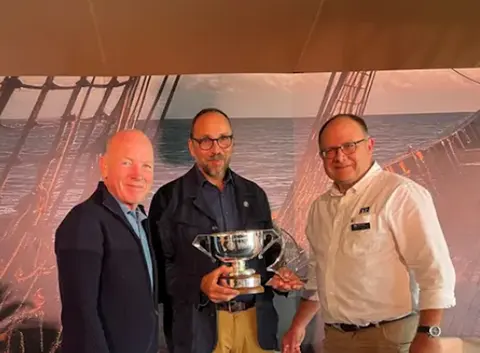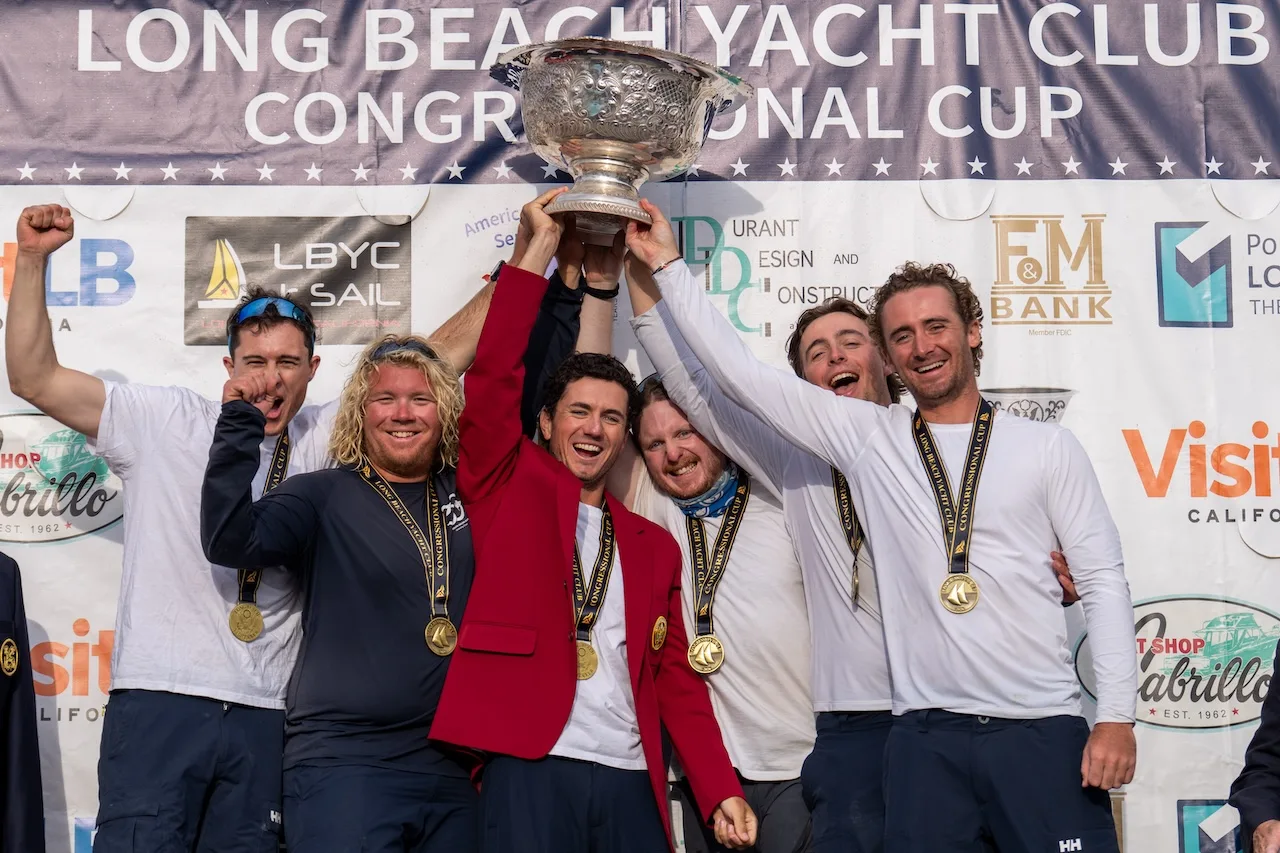
The silver cup was held high above a crowd of smiling faces, yet the brightest detail in the photograph was the jacket worn by the young Australian standing beneath it. Cole Tapper had just won the 61st Congressional Cup at Long Beach Yacht Club, and the Crimson Blazer across his shoulders carried a weight far greater than its cloth and brass buttons suggested. Dennis Conner, Ted Turner, Peter Gilmour, Chris Dickson, Dean Barker, Ian Williams and Taylor Canfield had all earned their place in the same company, while Tapper and his Sydney-based Kairos Racing crew had now added a new name to one of match racing’s most distinguished lists.
Tapper arrived in Long Beach with evidence that his generation was ready to challenge the established order, having won two consecutive Governor’s Cups and finished third at the Congressional Cup in 2025. His 2026 campaign was anything except comfortable, particularly when world number one Chris Poole gained the early advantage in their semi-final, although the Australians recovered with the composure expected from a far older team. Victory over Poole carried Kairos Racing into the final against defending champion Eric Monnin, where Tapper, Max Brennan, Jack Frewin, Nathan Guliksen, George Richardson and Hamish Vass produced a decisive 3–0 sweep.
Every element of the final demonstrated the peculiar intensity of match racing, where two identical boats can turn a short course into a contest of nerve, geometry and controlled aggression. The crucial work often begins before the starting signal, as each skipper circles for position, hunts the opponent’s vulnerable side and tries to force a penalty without surrendering speed. Tapper’s crew controlled those opening exchanges, protected the favoured lanes and executed the tacks and spinnaker sets with sufficient precision to deny Monnin a single race. Straight-line pace mattered, although authority over the opponent mattered more.
That combination of close combat and tactical clarity explains why the Congressional Cup has remained compelling while many regattas have passed into memory. Spectators gather on Belmont Veterans Memorial Pier and watch the boats duel close enough to identify individual crew movements, while commentary translates the shifting rules and invisible wind patterns for those ashore. A conventional fleet race can scatter across a wide expanse of water, yet a match race compresses its drama into two boats, one finish line and a simple verdict that leaves no room for anonymity.
A Trophy Born in Long Beach
The story began during the early 1960s, when Long Beach Yacht Club sought an international match racing competition capable of bringing leading sailors to Southern California. Club member and United States Congressman Craig Hosmer helped create the formal foundation, presenting a Deed of Gift in 1964 with Senator Thomas Kuchel. An early suggestion that the prize should carry a presidential title failed to find approval in Washington, so the Congressional Cup emerged instead, with Hosmer reportedly typing the parchment himself.
The inaugural racing followed in February 1965, when Gerry Driscoll claimed the trophy before returning to defend it successfully in 1966. The names soon gathering on the trophy revealed the event’s growing stature, with America’s Cup winner Bill Ficker succeeding in 1974, Dennis Conner prevailing in 1973 and 1975, and the formidable Ted Turner taking the title in 1977. Their presence established Long Beach as a place where outstanding helmsmen could be measured without the distraction of unequal machinery.
The Crimson Blazer gradually became the visible symbol of that achievement, much as golf’s Green Jacket marks victory at the Masters. A trophy may return to its cabinet, whereas the blazer identifies its wearer as part of an enduring fellowship. The ceremony also gives the Congressional Cup a character of its own, balancing Californian informality with the kind of tradition that sailors value because it must be earned on the water.
The Regatta That Changed the Rules
Long Beach contributed more than famous winners and handsome ceremonies, because the Congressional Cup helped change the way match racing was judged. Traditional protests could require competitors to finish racing, return ashore and argue their cases before a committee, creating delays and results that sometimes changed long after spectators had departed. The event introduced on-water umpiring in 1988, allowing officials to deliver immediate decisions while the contest was still unfolding before them.
The principle was transformative because match racing depends upon rapid manoeuvres and deliberate pressure at close quarters. Skippers need to know whether a penalty has been imposed before choosing their next tactic, while spectators need a result that makes sense at the finish. On-water umpiring became central to elite match racing and later helped make the discipline suitable for the Olympic Games and the international professional circuit.
Another major step arrived in 1990, when the Congressional Cup began using its fleet of matched Catalina 37s. Donated by Catalina Yachts and maintained through the sustained work of Long Beach Yacht Club, these robust boats shifted attention away from design advantages and towards crew performance. Teams rotate through the fleet, leaving sailors to adapt quickly to an unfamiliar hull while organisers work continuously to keep rig tension, sails, underwater surfaces and deck systems as equal as possible.
Careful maintenance reduces differences between the Catalina 37s until the decisive factors become timing, communication and boat handling. Heavy manoeuvres demand purposeful crew work, particularly during spinnaker hoists and drops where one mistake can turn a narrow lead into a penalty at the mark.
A Roll Call of Match Racing Royalty
Rod Davis, Peter Gilmour, Chris Dickson, Gavin Brady, Peter Holmberg, Ed Baird, Ken Read and Dean Barker carried the event through generations shaped increasingly by America’s Cup professionalism. The World Match Racing Tour, founded in 2000 from the Swedish Match Grand Prix Sailing Tour, later provided an international championship framework for the discipline, with the Congressional Cup becoming one of its most respected stages. Ian Williams became the Tour’s dominant figure with eight world titles and five Congressional Cup victories, while Taylor Canfield matched Williams with five Long Beach wins of his own.
Recent editions have proved that the old trophy remains difficult to hold. Chris Poole won in 2023 and 2024 before Switzerland’s Eric Monnin claimed the 60th edition in 2025. Tapper’s triumph one year later represented only the second Australian victory in the event’s history after Peter Gilmour’s success in 1988, linking a rising Sydney crew with one of the great pioneers of Australian match racing.
Youth Earns Its Place
Tapper’s victory mattered because it was not awarded to youth as a gesture of encouragement, but seized through sustained pressure against accomplished opponents. Kairos Racing survived the round-robin demands, recovered against the world’s leading skipper in the semi-final and then denied a defending champion any foothold in the final. The result demonstrated how quickly a disciplined young team can progress when it studies the rules, trusts its manoeuvres and refuses to become intimidated by reputation.
The 62nd Congressional Cup is scheduled for 28 April to 2 May 2027, following registration and practice on 27 April, with New Zealand’s Josh Hyde receiving the first invitation. Another field will arrive in Long Beach carrying ambitions shaped by the same names engraved upon the trophy, while Tapper will return to the conversation as the young champion everyone wants to measure.
Modern sailing often celebrates speed through foils, composite structures and astonishing bursts across open water, although the Congressional Cup offers a more concentrated examination. Its boats are familiar, its course is short and its grandest prize is a red jacket, yet beneath that apparent simplicity lies a contest involving rules, instinct, teamwork and courage. Cole Tapper’s smile beneath the silver cup belonged entirely to 2026, while the Crimson Blazer on his shoulders carried every hard-fought start since Gerry Driscoll first won at Long Beach in 1965.