A hard gust arrived across Lake Dąbie on the final downwind leg, bending the surface into darker water and offering Lucas Karlemo one last route back into the Szczecin Match Race final. The Finnish skipper saw it first, gybed into the pressure and crossed the line ahead of Jakub Gołębiowski, turning what had appeared to be a decisive Polish victory into a contest once again. Gołębiowski did not allow the moment to become a collapse, because the HRM Racing skipper returned for the fourth match, controlled his opponent and completed a 3–1 victory that secured the 2026 Szczecin Match Race and a fourth consecutive Polish match racing championship.
The final supplied a fitting conclusion to four days in which 15 crews from eight nations completed 105 round-robin matches before the regatta moved into its knockout stages. Gołębiowski and Marek Stańczyk had dominated the opening phase with 12 victories from 14 races, although Gołębiowski advanced directly to the semi-finals after winning their head-to-head encounter. Lucas Karlemo followed with 11 wins, while Dutch skipper Lennard Bal recorded nine and a group containing France’s Marin Micoulot, Estonia’s Mati Sepp and Poland’s Patryk Zbroja reached the quarter-finals with eight victories apiece. Those figures describe consistency, yet match racing rarely allows a sailor to remain comfortable for long because every new opponent brings another pre-start problem and every knockout series can overturn several days of good work.
Gołębiowski discovered that danger after selecting Micoulot as his semi-final opponent, a privilege earned by winning the round robin that appeared sensible until the Frenchman claimed the opening two matches. One more defeat would have ended the Polish skipper’s campaign, although HRM Racing recovered through the third and fourth contests before taking the deciding fifth match and completing a reversal from 0–2 to 3–2. The other semi-final followed a similarly tense pattern as Karlemo built a two-match advantage over Stańczyk, watched the Polish crew level the series, then progressed after Stańczyk collected two penalties in the final encounter. Such moments reveal the particular cruelty of match racing, where a week’s fastest crew can be removed by a single poor approach, an infringement or a rival who holds the stronger position for only the few minutes that matter.
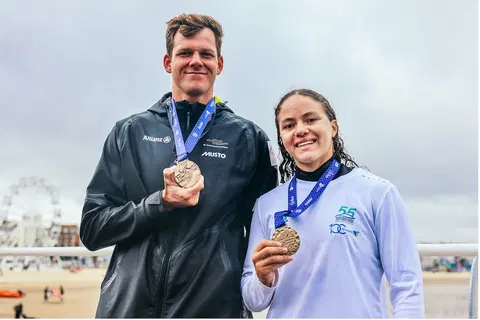
Gołębiowski began the final with that escape still fresh in his mind and won the first two races against Karlemo, placing the championship within one point of completion. The Finnish crew’s opportunistic use of the final-leg gust in race three showed why match racers never treat a lead as secure, since a small change in pressure can create a passing lane that did not exist seconds earlier. HRM Racing responded by keeping closer control during the fourth race, protecting the advantage rather than allowing Karlemo another chance to split towards different breeze, and the resulting 3–1 score delivered both the international regatta and the national title. Stańczyk completed the overall podium after defeating Micoulot 2–1 in the petit final, while Zbroja’s seventh place earned the bronze medal among the Polish skippers.
Match racing looks simple from shore because only two identical boats enter the course, yet simplicity is precisely what makes weakness so visible. The contest begins before the starting gun as each skipper attempts to control the other yacht, force it towards the unfavoured side, provoke a rules infringement or leave it late and slow at the line. Once racing begins, the leader tries to cover by staying between the opponent and the next mark, while the trailing boat searches for a wind shift, a patch of stronger pressure or enough separation to escape disturbed air. Umpires follow on the water and decide incidents immediately, which means penalties become part of the tactical contest rather than a dispute postponed until everyone returns ashore.
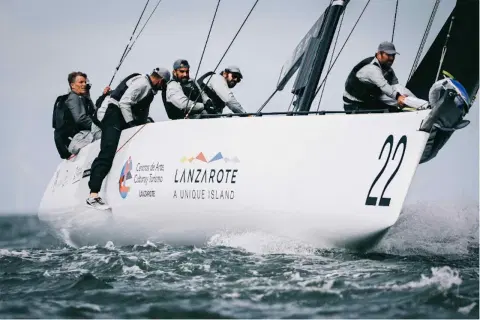
The RS21 yachts used on Lake Dąbie sharpen that emphasis upon judgement and teamwork because the supplied boats are identical and rotated between crews. Launched as a modern one-design keelboat in 2018, the RS21 is responsive enough to reward precise manoeuvres while remaining substantial enough for a coordinated crew to matter at every tack, gybe and sail change. A skipper may initiate the attack, although victory depends upon communication from the bow, clean trimming, rapid weight movement and the ability to complete repeated manoeuvres without surrendering a boat length. Conditions during the round robin ranged from light wind to gusts approaching 50 kilometres per hour, forcing teams to change technique while preserving the aggressive positioning that match racing demands.
Szczecin Match Race has developed since its first edition in 2008 into one of Poland’s most recognisable match racing events, combining the Open Polish Match Racing Championship with a place on the World Match Racing Tour. Its winners and visitors have included sailors such as Ian Williams, Eric Monnin, Staffan Lindberg, Maxime Mesnil, Timothée Rossi, Jeppe Borch and Gołębiowski himself, whose young HRM Racing team produced a notable victory in 2023 during the first Szczecin season sailed in RS21s. Borch won the 2025 edition, while the 2026 success returned the trophy to a local skipper who had already established national dominance but still needed to defeat a strong international field to claim the larger prize.
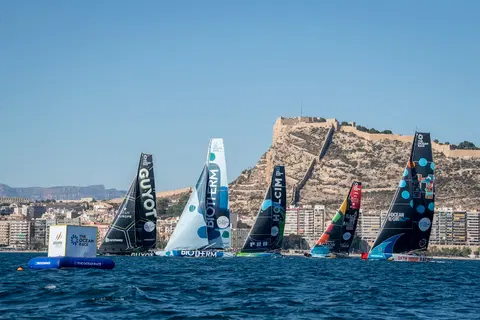
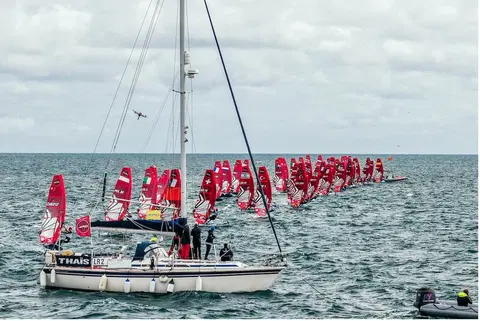
Polish match racing has grown around more than one weekend, with the Polish Match Tour beginning in 2007 and completing its twentieth season in 2026 after staging well over 100 regattas at different levels. Sailors including Przemysław Tarnacki, Patryk Zbroja, Marek Stańczyk, Igor Tarasiuk and Gołębiowski have given the country a depth of specialists able to challenge visiting crews rather than merely provide a domestic supporting cast. Lake Dąbie offers useful theatre because short courses can be placed close enough to shore for spectators to follow the circling pre-starts, rapid penalties and lead changes, allowing a technical discipline to become understandable without reducing its complexity.
The wider history reaches much further back than Szczecin, because one-on-one racing developed centuries before the World Match Racing Tour and eventually became inseparable from the America’s Cup. The Cup has used match racing since its first contests during the nineteenth century, establishing the principle that a crew need defeat only one rival rather than an entire fleet. Modern on-water umpiring emerged through events such as the Congressional Cup during the late 1980s, while the global professional series that became the World Match Racing Tour was launched in 2000. The Tour now carries World Sailing Special Event status and crowns the official Match Racing World Champion, providing a pathway on which sailors refine the pre-start aggression, rules knowledge and crew coordination required at the highest levels of the sport.
Szczecin formed Stage 15 of the 2026 World Match Racing Tour and represented one of the final opportunities to earn points towards the championship finale scheduled at AMAALA in Saudi Arabia from 10 to 14 November, with the Bermuda Gold Cup still to be raced beforehand. That position within the season increased the pressure upon international crews who arrived needing more than a respectable result, although Gołębiowski’s victory carried a significance beyond qualification calculations. He had defended a national title, recovered from the edge of semi-final elimination and beaten an opponent alert enough to steal a race on the final metres of the course.
The enduring attraction of match racing lies in the absence of somewhere to hide, since equal boats remove the comforting explanation of inferior equipment and a single opponent remains close enough to punish every hesitant decision. Lake Dąbie produced 105 preliminary duels, two five-race semi-finals and a final containing its own late reversal, yet the championship eventually belonged to the crew that responded most effectively when control began to disappear. Gołębiowski left Szczecin with another trophy and a fourth straight national crown, although the lasting image was not simply a Polish boat crossing ahead, because it was the calmer recovery after Karlemo found that dark patch of wind and briefly reopened the door.