INEOS and Sir Ben Ainslie's Athena Racing have settled their Admiralty Court fight over Britain's America's Cup yacht, with every claim withdrawn and the boat already in Naples for 2027.
It took Sir Jim Ratcliffe's company eight months, a writ in the Admiralty Court and a case management conference before one of the High Court's more patient judges to get to this point, and when the end came on Monday morning it arrived in a statement so short that it would fit comfortably on the back of a race entry form: "INEOS has reached a settlement with Athena Racing and considers the matter now closed." Those fourteen words, issued just after 10am on 16 November and later posted by GB1, the name under which Sir Ben Ainslie's Athena Racing now campaigns, bring to an end the most expensive argument about a boat that British sailing has seen in a very long time, and they do so without telling the rest of us a single thing about who paid what to whom.
Athena, for its part, was not much more forthcoming, telling Yachting World that the terms of the settlement are confidential and that it would not be commenting further on either the settlement or the litigation. It did, however, offer the one sentence that every British Cup supporter wanted to hear, confirming that "Athena Racing/GB1 have always been, and remain, the owners of their assets", which, if words mean anything, is the polite legal way of saying that the boat stays where it is. The Royal Yacht Squadron, the Cowes club that challenged for the original cup in 1851 and is now Challenger of Record for the 38th America's Cup, went further in a note to members from Lord Grade of Yarmouth, chairman of Royal Yacht Squadron Ltd, who said he was "delighted to announce that this dispute has now been settled, with any and all claims between the parties now withdrawn", and called it "excellent news indeed as GB1 prepares to challenge for the 38th America's Cup in Naples next year."
The sums that were in play had been eye-watering even by the standards of a sport in which a winch can cost as much as a family car. When INEOS went public in March 2026 it said the boat "we built for the last America's Cup" had been "taken" by Athena, that it was "inappropriate to assume it can be used for the next competition without seeking our permission", and that the yacht, which raced in Barcelona as INEOS Britannia, had cost INEOS £180 million, having evolved from a first boat that cost a further £170 million. The approved judgment of Mr Justice Andrew Baker in Ineos Racing Limited v Athena Racing Limited, handed down on 16 October and published by The National Archives, recorded that INEOS's total funding under the 2021 partner agreement was said to have been about £170 million, and that the assets in issue went well beyond the race boat to a whole flotilla of race and support craft, which is the sort of inventory that would make even a Solent marina manager blink.
Most importantly for anyone hoping to see a British boat on the start line, the judge had refused INEOS's request for an early hearing in April 2027 on the meaning of the disputed clause, and had instead set the case on course for a single trial in January to February 2028, which would have been some months after the America's Cup Match in Naples, due to begin on 10 July 2027 according to the official event site. That meant Ainslie's team would have spent the whole of its campaign racing a boat whose ownership was formally in question, with the faint but real possibility of having to hand it back, or pay for it, after the event. The settlement removes that cloud entirely, and it does so before the British team, which reached the Match in Barcelona in 2024 and lost 7-2 to Emirates Team New Zealand, has to start racing in earnest.
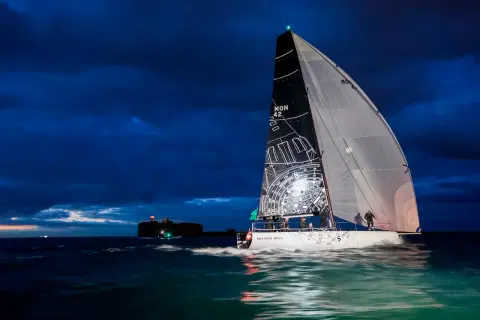
Nor is the boat sitting idle in a shed waiting for the lawyers. According to Yachting World, the AC75, which the team has code-named RB4, has already been taken to Naples after a major refit at Persico in northern Italy, which suggests that GB1 has been working on the reasonable assumption that it would get to keep it all along. What the settlement does not tell us is whether any money changed hands, whether INEOS got anything back for its hundreds of millions, or whether the design data and intellectual property that also sat in the background of the dispute have been divided up in some way, and we suspect that, given the confidentiality, we may never know.