There is something faintly ridiculous about standing beside the sea in September, with boats still occupying their summer berths and sailors squeezing the last decent weekends from the season, while somebody starts talking enthusiastically about January. Yet anyone who has visited boot Düsseldorf knows that this particular January date deserves to go into the diary early.
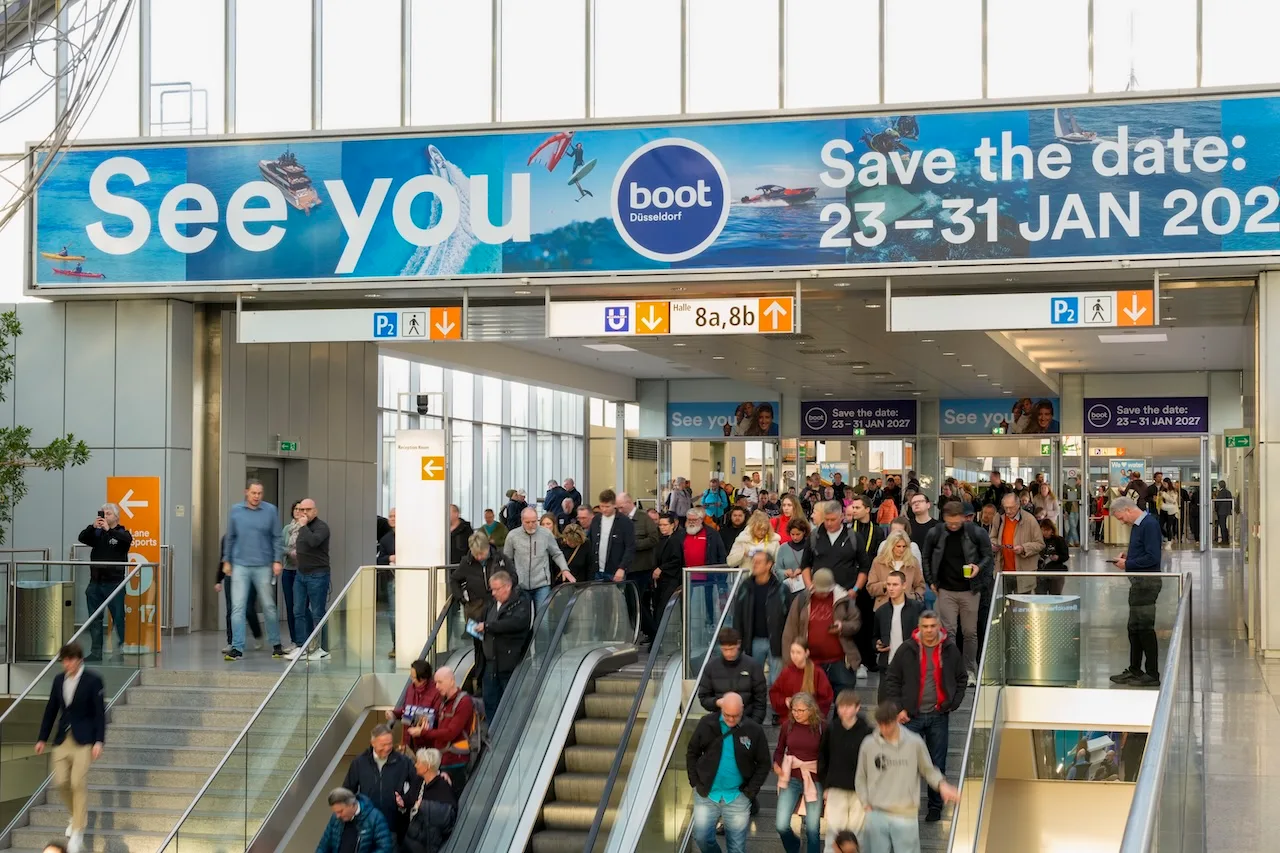
From 23 to 31 January 2027, Düsseldorf will once again become one of the most extraordinary temporary boating centres anywhere in the world, as nearly 1,500 exhibitors and more than 200,000 visitors from over 100 countries are expected to descend on Messe Düsseldorf.
Tickets are now on sale, including discounted two-day admission for members of the free boot.club, making this the first proper signal that the countdown to boot Düsseldorf 2027 has begun.
Calling boot Düsseldorf a boat show does not really describe it. The event occupies Halls 1 to 17, covering everything from dinghies and cruising yachts to motorboats, superyachts, diving, surfing, paddlesports, marine equipment, destinations, conservation and emerging maritime technology.
For sailors accustomed to wandering along pontoons at Southampton or Cannes, Düsseldorf takes a little getting used to. There is no marina outside the doors and certainly no sea lapping against the exhibition hall. Instead, some remarkably large boats are transported across Europe, manoeuvred into the halls and assembled into what feels like an enormous indoor harbour.
The scale is part of the attraction, although the real importance of boot lies in the extraordinary cross-section of the boating world gathered in one place.
From a small German show to a global boating institution
The history of boot Düsseldorf stretches back to 1969, when the first exhibition opened with just over 100 exhibitors. What began as a relatively modest German boating event grew steadily as recreational boating expanded across Europe during the 1970s and 1980s.
Those decades transformed sailing.
Fibreglass construction brought production yachts within reach of many more sailors, charter fleets expanded, marinas developed around the Mediterranean and manufacturers began producing boats on a scale that earlier generations could scarcely have imagined.
Düsseldorf grew alongside that industry.
Over the following decades, the exhibition developed into an important international meeting place for builders, designers, equipment manufacturers, sailors, divers, surfers, charter companies and marine businesses. Its January date also proved particularly useful, arriving at precisely the time when northern European sailors have usually had quite enough of winter.
There is something wonderfully dangerous about walking into a heated exhibition hall in January and discovering a new yacht sitting beneath bright lights. Summer suddenly seems a very long way away, while the possibility of buying another boat begins to appear entirely reasonable.
Yachts remain at the heart of Düsseldorf
Sailing remains one of the foundations of boot Düsseldorf, with production builders, specialist yards and equipment manufacturers traditionally using the show to present new models and developments for the coming season. For prospective yacht buyers, the indoor format has an unexpected advantage. Boats can be examined without rain running down your collar, queues forming on slippery pontoons or a crosswind making boarding unnecessarily entertaining. Visitors can move from cockpit to saloon, inspect cabins, compare layouts and examine the small details that photographs rarely reveal.
Those details matter.
Modern cruising-yacht design has changed substantially over the past two decades. Hulls have generally become broader, particularly aft, while chines, twin rudders and increased interior volume have become familiar features across much of the production-yacht market.
Cockpits have grown larger, bathing platforms wider and accommodation considerably more sophisticated. Sail handling has increasingly been designed around smaller crews, reflecting the reality that many cruising yachts are sailed by couples or families rather than a full complement of racing crew.
Düsseldorf provides an unusually good opportunity to compare those design philosophies side by side. One boat may prioritise offshore capability and sea-kindly behaviour, while the next places greater emphasis on Mediterranean living space, easy sail handling and enormous accommodation. Neither approach is necessarily wrong. Sailors simply need to work out which compromises suit the sailing they actually intend to do rather than the heroic ocean passages they occasionally imagine undertaking after the second glass of wine.
Much more than sailing
Motorboats occupy another substantial part of boot, ranging from practical family craft and sports boats through to large luxury yachts. The diversity extends far beyond conventional boating. Diving has long been an important part of the Düsseldorf exhibition, while surfing, kitesurfing, stand-up paddleboarding, canoeing and other watersports bring an entirely different audience into the halls.
That mixture gives boot much of its character.
A visitor can spend the morning examining a serious offshore cruising yacht, move on to navigation electronics before lunch, investigate diving equipment during the afternoon and somehow finish the day watching people demonstrate watersports indoors.
Few marine exhibitions attempt quite so much under one roof.
Technology moves aboard
The boats themselves may attract the crowds, although some of the most significant changes in recreational boating are increasingly found behind panels and beneath cabin soles. Electric and hybrid propulsion, onboard energy management, lithium battery systems, solar generation and more efficient electrical equipment are changing the way cruising yachts and motorboats are designed and operated. Navigation technology continues moving just as quickly. Modern chartplotters can integrate radar, AIS, autopilots, cameras, engine information, weather data and sophisticated sailing instruments into systems that would have seemed extraordinary only a generation ago.
None of it removes the need for seamanship.
A glowing screen cannot compensate for poor judgement, while an impressive battery bank remains considerably less useful if nobody aboard understands the electrical system attached to it. Shows such as Düsseldorf nevertheless provide an important opportunity to see these technologies together, speak directly with manufacturers and understand where the marine industry is heading.
Sustainability moves towards centre stage
Environmental issues will again form an important part of boot Düsseldorf 2027, with marine conservation and sustainable technologies among the subjects receiving particular attention. The blue innovation dock, organised in cooperation with European Boating Industry, has developed into a meeting point for discussions involving marine businesses, technology specialists, policymakers and the wider industry.
Recreational boating faces some complicated questions.
Boatbuilding consumes energy and raw materials, ageing fibreglass yachts present recycling challenges, propulsion remains dependent in many areas on fossil fuels and coastal environments are under increasing pressure. Progress will not come from pretending those problems do not exist. Better materials, cleaner propulsion, improved recycling and more efficient manufacturing all have a part to play, which makes the technology displayed at events such as Düsseldorf increasingly significant.
What boot Düsseldorf 2027 tickets cost
For visitors planning ahead, the cheapest route into the show comes through free boot.club membership.
Members can buy a two-day ticket for €21, while school pupils and students qualify for a reduced €16 ticket. Children aged 13 and under receive free admission.
Standard online admission costs €23 for one day, with concessions priced at €16.
Trade visitors pay €28 for a single day or €44 for two days, with admission from 9.30am and access to the B2B Lounge in Hall 13.
For anyone travelling from Britain, the ticket itself is likely to be one of the smaller items in the overall budget once flights, trains, hotels and the inevitable German beer have entered the calculation.
The real financial danger begins after walking into the yacht halls.
Nine days to remember why we sail
Boat shows are curious places because most visitors will leave without buying a boat. Many will not even be seriously considering one. They come because boats still possess an ability to make us imagine journeys. Standing at the wheel of a yacht inside a German exhibition centre, hundreds of miles from salt water, somebody will inevitably picture an anchorage in Greece, a passage across Biscay or a quiet evening somewhere along the English coast.
That imagination is part of what has sustained boot Düsseldorf since 1969.
Technology changes, fashions come and go, hull shapes evolve and equipment becomes increasingly sophisticated. The fundamental attraction remains much simpler. Somewhere beyond the exhibition doors there is water, and somewhere on that water is another harbour waiting to be entered.
Come January, Düsseldorf will once again remind more than 200,000 people why they wanted a boat in the first place.