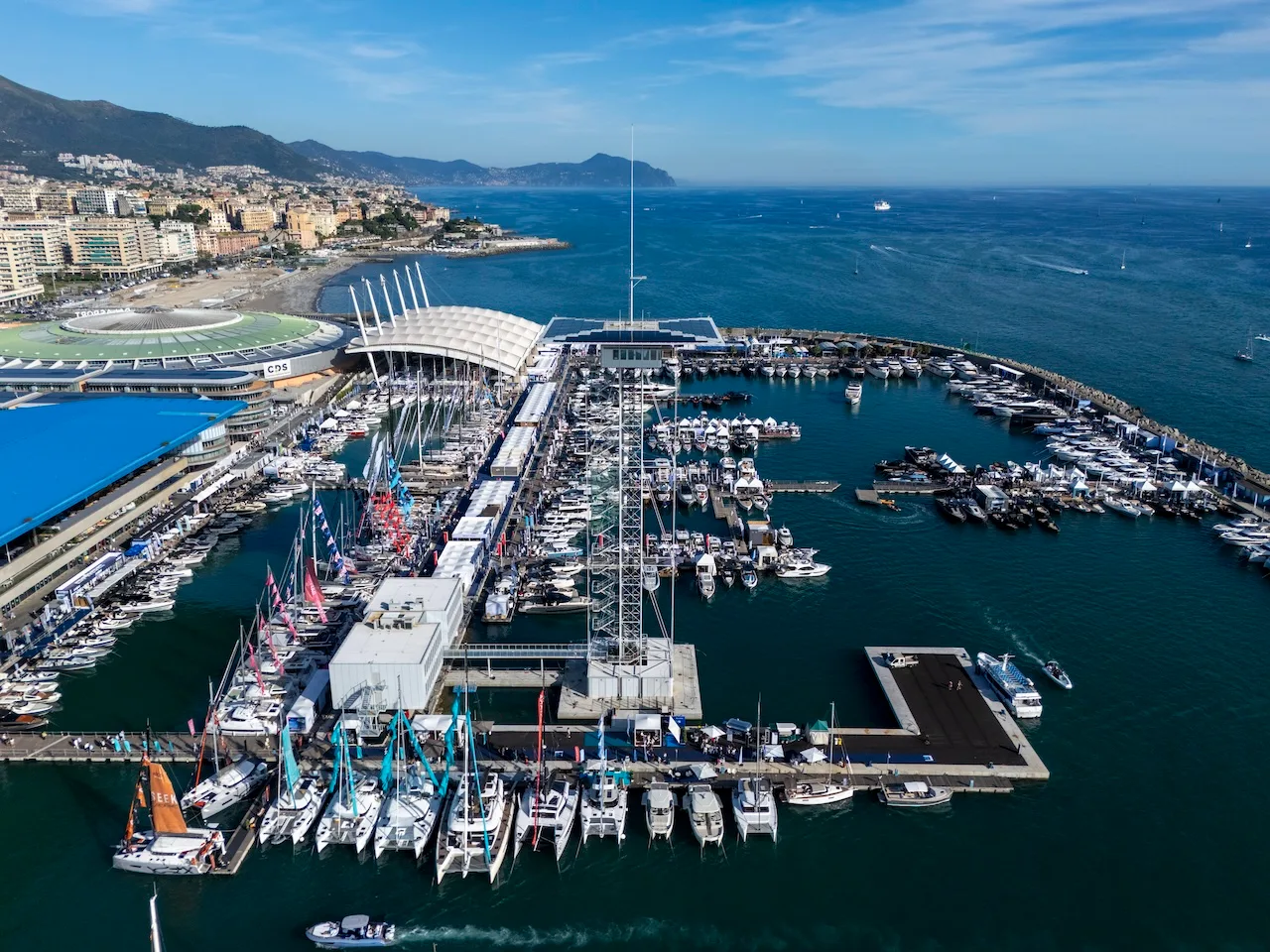
Genoa has always faced the sea with the confidence of a city that understands ships, trade and the restless movement of people, while this October its waterfront will once again fill with polished hulls, new technology and the commercial ambitions of an industry navigating increasingly unsettled waters.
The 66th Genoa International Boat Show will take place from 1 to 6 October 2026, bringing yacht builders, equipment manufacturers, designers, sailors, marina operators and prospective owners together at the completed Waterfront di Levante.
This year’s event arrives at a significant moment for international yachting. Large yachts continue to attract confident buyers, charter and nautical tourism remain comparatively healthy, yet many small and medium-sized marine businesses are confronting higher costs, uncertain consumer demand, geopolitical tension and disruption surrounding international trade.
The show must therefore deliver more than attractive boats beside immaculate pontoons. It must provide somewhere for contracts to be discussed, technical ideas compared and an industry divided between buoyant luxury markets and more cautious family boating to examine what comes next.
A Waterfront Finally Taking Shape
Completion of the Waterfront di Levante project will give the 2026 Genoa Boat Show a setting intended to connect the exhibition more naturally with the sea and the surrounding city.
The redevelopment was shaped by Genoese architect Renzo Piano, whose work has repeatedly explored the relationship between ports, public spaces and urban life. New basins, walkways and exhibition areas have gradually transformed a site once dominated by older trade-fair infrastructure.
Central to the latest phase is the fully operational Palasport Pavilion, which now includes 74 retail units and an entire floor devoted to food and drink. The building remains an indoor sports arena throughout the year, although during the show it will host programmes connecting maritime culture, training, institutions, innovation and the marine industry.
Opening the pavilion to a wider public reflects a useful change in emphasis. Boat shows have traditionally concentrated upon transactions between exhibitors and established customers, while future growth depends upon persuading younger visitors and people without a boating background that the water is not a closed world.
The Under-25 ticket will return following its success in 2025, creating a modest but important invitation to the generation that will eventually design, build, buy, crew and maintain the boats now appearing on the pontoons.
Italy’s Large-Yacht Confidence
The growing number of yachts measuring more than 24 metres provides one of the clearest signals of industry confidence ahead of the show.
Italy holds an exceptional position within the international superyacht market, supported by shipyards, designers, interior specialists, craftsmen and equipment manufacturers whose work reaches far beyond the country’s coastline.
The phrase Made in Italy can sound like a convenient marketing label, yet within yacht building it describes an industrial network combining advanced composites, naval architecture, engineering, furniture making and a powerful instinct for visual proportion.
Large yachts have remained relatively resilient while smaller recreational sectors have faced more caution. Wealthier clients are less directly exposed to ordinary interest-rate pressures, while many large vessels are commissioned several years before delivery, giving established yards a longer order book.
That resilience does not remove every difficulty. Raw-material prices, skilled labour shortages, component costs and international uncertainty continue squeezing margins, particularly when contracts were agreed before later inflation became apparent.
Genoa offers large-yacht builders direct access to customers, brokers and international media, although the event’s broader value comes from placing those headline vessels beside the supply chain that makes them possible.
An Industry Looking for Bearings
Piero Formenti, President of Confindustria Nautica, described the Genoa International Boat Show as a working instrument for the yachting industry rather than simply a successful annual event.
Returning to the traditional October position was intended to match the commercial rhythm of exhibitors more closely. The timing follows the principal Mediterranean boating season, allowing companies to review summer activity while discussing future purchases, model launches and dealership arrangements.
Market confidence remains complicated by forces extending well beyond the marina. Geopolitical tension, conflict in the Middle East and uncertainty surrounding United States tariffs have affected both businesses and consumers.
Small and medium-sized boat builders often feel those pressures first because their customers are more sensitive to finance costs and disposable income. Dealers can become reluctant to carry stock, while buyers may postpone replacing a boat even when they have not abandoned the idea entirely.
Large-yacht demand, nautical tourism and charter activity provide a more positive picture. The continuing appetite for experience at sea suggests that people still value boating, even when they are cautious about ownership and its associated maintenance, mooring and depreciation costs.
The official 2026 Genoa Boat Show announcement confirms the October dates, expanded Waterfront di Levante setting and increased participation from yachts above 24 metres.
Technology Behind the Finished Boat
TechTrade Days will return for its second edition, bringing more than 400 marine-equipment, component and accessory brands into a concentrated business programme.
The finished yacht naturally attracts the crowds, although much of the industry’s progress occurs inside less glamorous components. Battery management, digital switching, navigation electronics, recyclable materials, propulsion systems and more efficient manufacturing can change the environmental and practical performance of a boat without altering its profile at the dock.
Marine businesses also face the difficult task of choosing which new technologies are ready for ordinary use. Experimental systems can create impressive demonstrations, yet equipment installed aboard a cruising yacht must survive salt, vibration, heat and years of imperfect maintenance.
TechTrade provides a meeting place for boatyards, naval architects, suppliers and purchasing teams to examine those systems before they enter production. Such conversations rarely provide the visual theatre of a new superyacht, although they determine whether future boats become more dependable, efficient and repairable.
Design, Sustainability and the America’s Cup
The seventh Design Innovation Award ceremony will take place on 2 October, recognising products and vessels that combine technical progress with intelligent design.
Established in 2020 by Confindustria Nautica and I Saloni Nautici, the award arrived during a period when yacht design was being pushed in several directions at once. Customers expected greater interior space and comfort, while regulation and environmental responsibility demanded improved efficiency.
The fifth World Yachting Sustainability Forum will take place on the same day, addressing the uneasy relationship between an industry devoted to the sea and products that can consume considerable energy and materials.
Meaningful sustainability will require more than fashionable fabrics or vague promises surrounding future fuels. Hull construction, propulsion, marina infrastructure, refit potential and the eventual disposal of composite boats must all form part of the discussion.
Sport will provide another strand, with particular attention given to the 38th Louis Vuitton America’s Cup. Confindustria Nautica continues as the event’s Strategic Marine Industry Advisory Partner, while the Italian Sailing Federation, class associations and leading sailors will also participate in Genoa.
The America’s Cup has always driven marine technology beyond the boundaries of ordinary sailing. Foils, composite construction, simulation and control systems developed for competition eventually influence other boats, even when their original purpose was chasing a silver trophy at extraordinary speed.
Measuring the Market
The latest edition of La Nautica in Cifre, or Boating in Figures, will be presented on 30 September at the eve of the show.
Produced by the Confindustria Nautica Research Department in partnership with Fondazione Edison, the report has provided statistical analysis of Italian yachting since 1980.
Reliable figures become particularly valuable when market sentiment is confused. Busy marinas and crowded show aisles may create an impression of prosperity, while order books, exports, employment and production data reveal whether that confidence extends through the supply chain.
The presentation should offer a more disciplined picture of the Italian marine sector before exhibitors begin six days of meetings. It will also provide context for the contrast between strong superyacht activity and the more difficult position facing smaller manufacturers.
From a Winter Exhibition to an International Institution
The first Genoa International Boat Show opened on 27 January 1962, occupying approximately 30,000 square metres of a fairground that was not yet fully complete.
That inaugural exhibition attracted 430 boating exhibitors, including a substantial international contingent, with 16 countries represented. Approximately 300,000 visitors passed through the gates, paying 250 lire for admission to an event that immediately demonstrated the public appetite for recreational boating.
Britain’s celebrated yacht designer Uffa Fox was among the distinguished visitors, alongside shipowners, industrialists, diplomats and representatives of European maritime businesses.
The early 1960s offered particularly fertile conditions for such a show. Post-war economic growth was expanding Italy’s middle class, fibreglass construction was changing boat production and the Mediterranean was becoming increasingly accessible to private leisure craft.
Genoa possessed the necessary maritime identity, industrial base and coastline to turn a trade exhibition into something much larger. The show gradually became both an international marketplace and an annual expression of Italy’s relationship with the sea.
Confindustria Nautica, founded in 1967, developed into the national representative body for the Italian marine industry and now organises the event with I Saloni Nautici.
The show has survived economic recessions, political disruption, changing ownership habits and the Covid period. Its long history reflects an ability to adapt without abandoning the working boats, engines, equipment and practical businesses supporting the glamour displayed on the largest pontoons.
Genoa Beyond the Exhibition Gates
Improved transport connections are intended to make the 2026 show easier to reach. Aeroitalia has introduced services to Genoa from Rome Fiumicino, Cagliari, Catania, Comiso-Ragusa and Salerno, while major motorway works in Liguria are expected to be suspended until the event concludes.
Access has long been one of the practical challenges surrounding major exhibitions. Visitors may admire a yacht for an hour, but they remember spending considerably longer trapped in traffic or searching for transport.
The completed waterfront should strengthen the relationship between the show and Genoa itself. Restaurants, shops and public areas can keep visitors within the district after exhibition stands close, extending the event’s value into the city rather than containing it behind the show entrance.
Genoa does not need artificial maritime decoration because ships, ferries, fishing boats and working harbour structures remain part of its daily landscape. The boat show is most convincing when it feels like a temporary concentration of that identity rather than an isolated luxury village.
More Than Polished Hulls
The 66th Genoa International Boat Show will open amid difficult questions concerning affordability, sustainability, international trade and the future shape of boat ownership.
Its completed waterfront and greater superyacht participation will provide an impressive setting, while TechTrade, the sustainability forum, market research and training initiatives should give the event practical depth.
Success cannot be measured only by visitor numbers or the length of the largest yacht. The more important judgement will concern whether businesses leave Genoa with stronger orders, useful partnerships and a clearer understanding of the market ahead.
Sixty-four years after visitors first entered an unfinished exhibition complex beside the Ligurian Sea, Genoa is still building around its boat show.
The waterfront may now be complete, although the industry gathering upon it remains very much a work in progress.