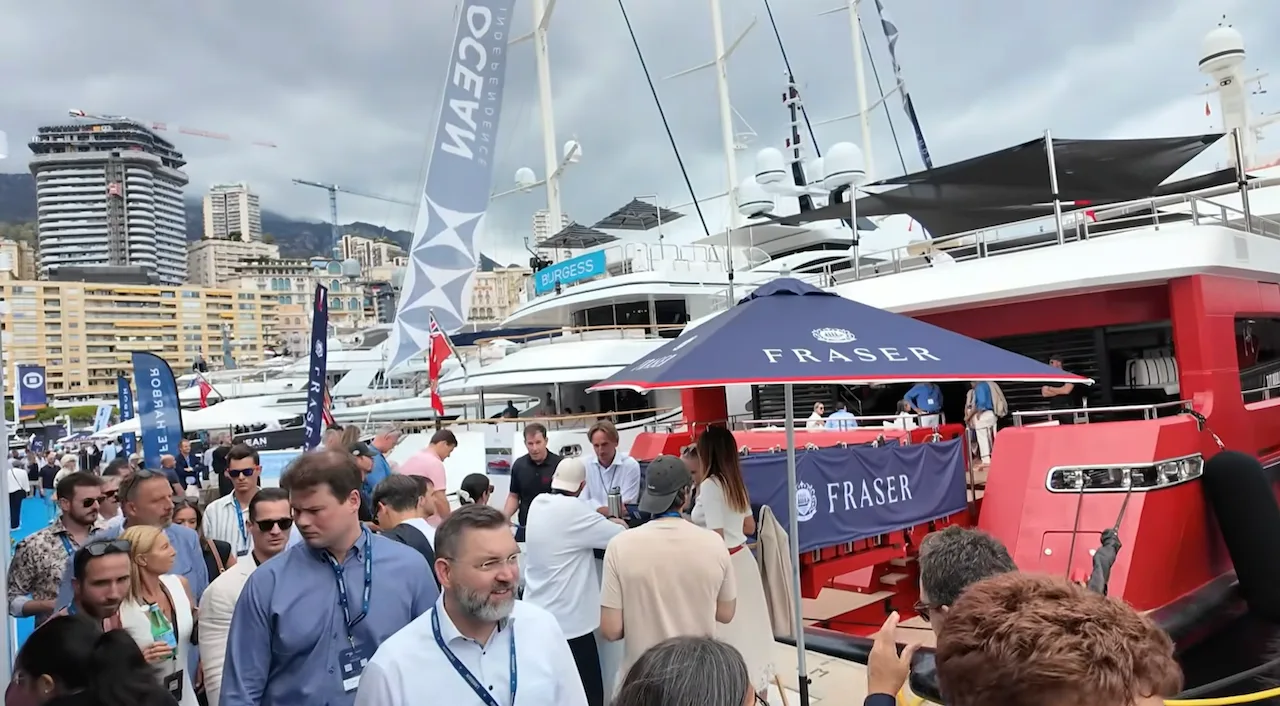
Grey clouds settled over Monaco as the crowds began moving through Port Hercule, softening the familiar Riviera colours without diminishing the theatre below. The air remained warm, the pontoons grew increasingly busy and some of the world’s most remarkable yachts rose above the harbour like waterfront buildings temporarily released from their foundations.
Sunshine usually plays a dependable supporting role in Monaco, polishing the sea and sharpening the white hulls against a brilliant Mediterranean sky. This year offered a more subdued canvas, with silvery light falling across the harbour while visitors threaded their way between exhibition stands, shaded hospitality areas and sterns large enough to dwarf many ordinary houses.
The atmosphere remained energetic throughout the show because the Monaco Yacht Show has never depended entirely upon the weather. Serious conversations were taking place beneath awnings and inside temporary offices, where owners, brokers, designers, shipyards and equipment manufacturers discussed vessels worth tens or even hundreds of millions of pounds.
Staged from 23 to 26 September, the 2026 Monaco Yacht Show marked the 35th edition of an event that has developed into the most influential gathering in the international superyacht calendar. Around 120 superyachts were assembled in Port Hercule, supported by more than 560 exhibitors representing almost every element of yacht ownership, construction, charter and operation.
Forty-three yachts delivered during 2026 were expected among the fleet, providing visitors with an unusually concentrated view of the latest thinking in naval architecture, propulsion, interior design and onboard technology. Approximately 70 tenders completed a display that stretched beyond the main harbour and into an expanded Adventure Area.
Port Hercule Becomes the Centre of Yachting
The Monaco Yacht Show was established in 1991, when the modern superyacht industry was considerably smaller and many of today’s specialist builders were only beginning to explore the possibilities created by new materials, advanced engineering and increasingly ambitious private clients.
Port Hercule has hosted the event throughout that transformation. The natural harbour, surrounded by Monaco’s steeply rising streets and apartment buildings, provides a setting that few exhibition centres could hope to match. Yachts sit within walking distance of brokerage offices, designer galleries, engineering displays and some of the most valuable property in Europe.
The first shows belonged to a world in which a 40-metre yacht attracted considerable attention. Modern fleets regularly include vessels extending beyond 80 metres, with several carrying helicopters, swimming pools, beach clubs, submarines and fleets of tenders that would once have been considered substantial yachts in their own right.
Size remains an unavoidable feature of Monaco, although the show has become increasingly concerned with what happens inside and beneath those enormous hulls. Hybrid propulsion, battery storage, quieter hotel systems, alternative materials and improved hull efficiency now occupy conversations previously dominated by length, speed and interior volume.
Walking through the show reveals how many separate disciplines must come together before a yacht reaches the water. Naval architects create a hull capable of carrying the required weight efficiently, exterior designers establish the vessel’s identity and interior specialists produce rooms expected to rival the finest hotels and private residences.
Engineers must somehow fit propulsion machinery, generators, watermakers, air-conditioning systems, stabilisers, fuel tanks and countless kilometres of wiring and pipework into the remaining space. Crew circulation, maintenance access, safety regulations and seakeeping cannot be treated as secondary matters, regardless of how extravagant the owner’s ambitions become.
From Scale Models to Ocean-Going Reality
One of the most revealing sights at any Monaco Yacht Show is not necessarily the largest yacht in the harbour, since the carefully finished scale models displayed within the design pavilions offer an equally fascinating glimpse into the industry’s imagination.
A striking blue concept from Cor D. Rover Design demonstrated how a future yacht can begin as an elegant miniature, complete with sculpted decks, sweeping glazing and carefully integrated outdoor spaces. The model appeared almost ready to move across its mirrored base, although translating such graceful shapes into a seaworthy vessel demands years of engineering, negotiation and construction.
Every curved window must withstand considerable loads at sea, while each open terrace needs drainage, structural support and protection against weather. Beach clubs positioned close to the water must remain secure during an offshore passage, while pools, spas and heavy tenders must be placed without compromising the yacht’s balance.
Monaco brings designers and shipyards close to the people who may commission these vessels. A conversation beginning beside a scale model can eventually become a steel or aluminium yacht requiring several years of work and the combined skills of hundreds of craftspeople.
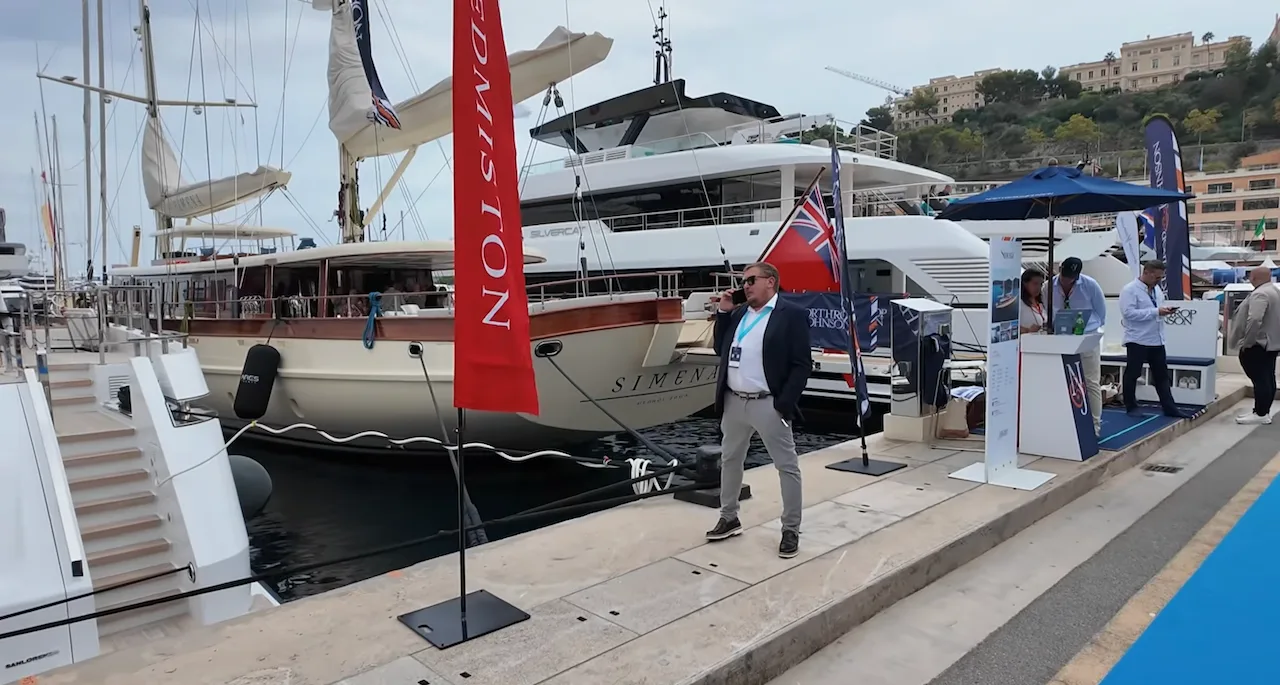
Traditional elegance still found its place among the more radical concepts. The sailing yacht Simena, displayed near the Northrop & Johnson area, offered tall spars, warm timber detailing and the composed lines of a yacht designed to cross oceans beneath sail.
Her presence provided a welcome contrast with the sharp windows and towering profiles of the surrounding motor yachts. Sailing superyachts represent a smaller part of the market, although their ability to combine engineering, craftsmanship and genuine wind-powered passage-making gives them an enduring distinction.
Technology Moves Beyond the Yacht
Modern owners increasingly expect their yachts to provide access to places and experiences that cannot be reached from an ordinary marina. That change has encouraged the development of expedition vessels carrying diving centres, scientific equipment, helicopters, all-terrain vehicles and sophisticated submersibles.
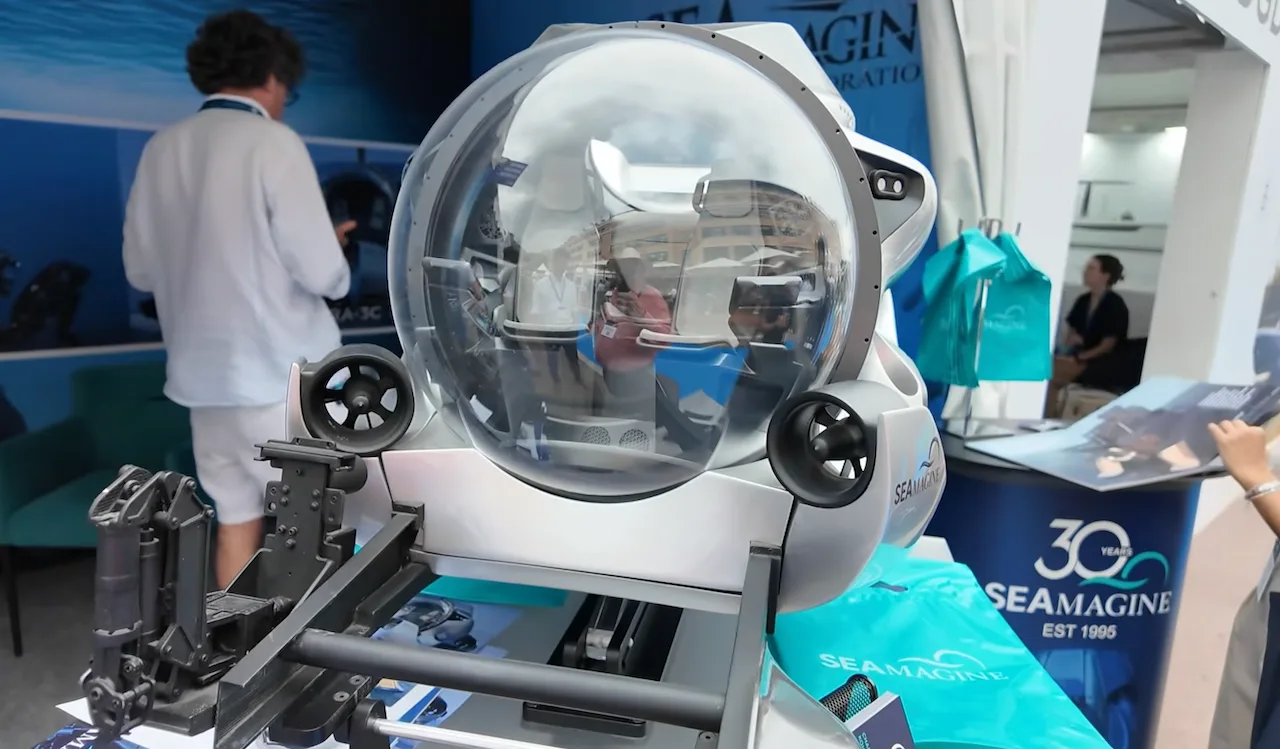
A compact Seamagine personal submarine attracted considerable attention inside the exhibition. Its transparent pressure sphere offered an almost uninterrupted underwater view, while the surrounding frame carried propulsion equipment and articulated mechanisms designed for operation beneath the surface.
Such machines demonstrate how far the superyacht experience has travelled from sunbathing and waterskiing. An owner can now use a yacht as a base for underwater exploration, marine research or journeys into regions far beyond the established Mediterranean and Caribbean routes.
A large specialist drone presented another side of the developing technology market. Designed for cleaning and maintaining yacht exteriors, it addressed the less glamorous reality behind every immaculate vessel in the harbour.
Keeping a superyacht presentable requires constant work from a professional crew. Salt gathers on glass, painted surfaces become marked and enormous sections of superstructure must be cleaned while the vessel remains afloat. Robotic equipment could reduce the need for people to work from suspended platforms or awkward positions above the water, improving efficiency while limiting unnecessary risk.
Innovation at Monaco therefore ranges from dramatic equipment intended to carry guests beneath the sea to practical machinery developed for the daily work of yacht ownership. Both are important because the most successful technology often solves an existing problem without adding another layer of complication.
Brokers, Builders and Serious Business
The major brokerage houses occupied prominent positions throughout Port Hercule, with names including Fraser, Burgess and Northrop & Johnson visible above busy hospitality areas and crowded passerelles.
These companies sit at the centre of the superyacht market, advising clients who may wish to purchase, sell, construct or charter a yacht. Their work extends beyond arranging a transaction because ownership involves registration, insurance, crewing, management, maintenance, berthing and compliance with an increasingly complex collection of international regulations.
The conversations taking place around their stands were generally discreet, although the commercial energy was unmistakable. Meetings followed one another through the day, while brokers guided clients towards carefully selected yachts and shipyard representatives explained why their latest vessel offered something its rivals could not.
Monaco remains a show where access matters. Boarding appointments are often arranged in advance, while permission to visit individual yachts rests with the exhibiting broker or shipyard. The controlled approach may appear formal, although showing a large private vessel requires consideration for owners, crews and genuine prospective clients.
The opening day reserved parts of the dockside exhibition for invited and VIP guests, allowing serious buyers and charter clients to move through the harbour before the wider crowds arrived. Public access followed on Thursday, Friday and Saturday, bringing greater energy and much heavier footfall to the quays.
Tenders Become Attractions of Their Own
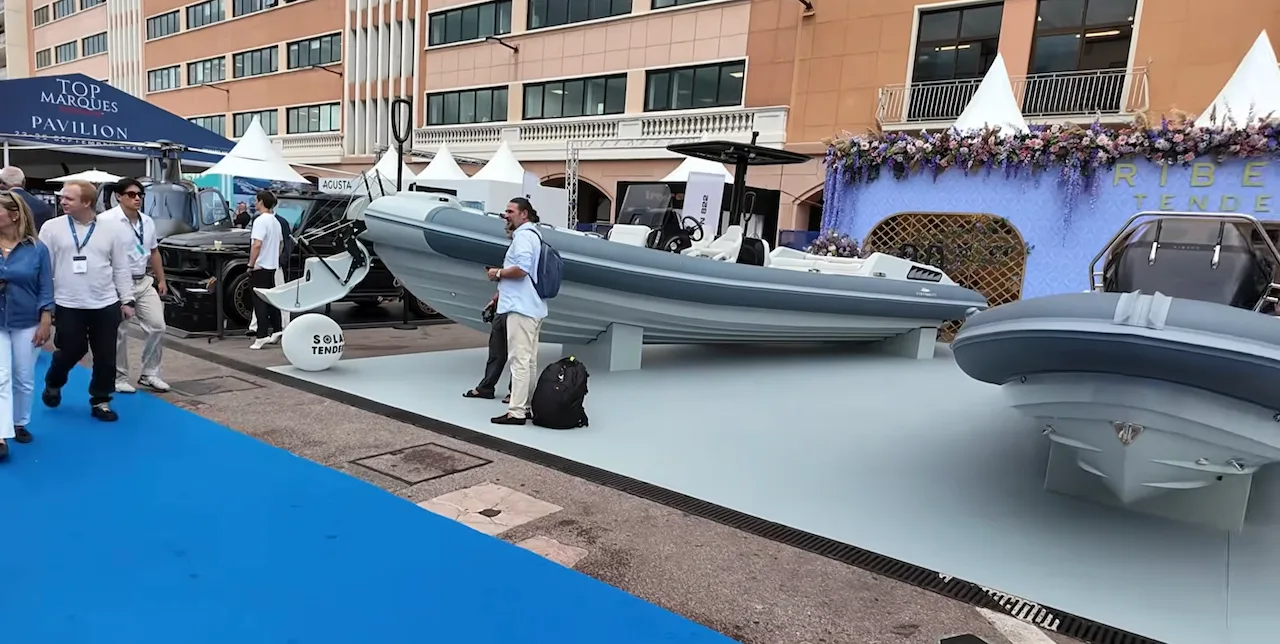
The Adventure Area has grown considerably as the distinction between yacht equipment and luxury recreation has become increasingly blurred. A third quay at Quai Antoine Ier was added for 2026, providing room for 15 additional tenders and increasing the wider display to approximately 70 boats.
Modern superyacht tenders are no longer simple launches kept only for transporting guests between yacht and shore. Many are powerful, carefully styled craft equipped with advanced electronics, luxurious seating and enough performance to become attractions in their own right.
Rigid inflatable boats sat beside sleek limousine tenders and fast open craft designed for fishing, diving or exploring shallow coastlines. Builders increasingly tailor each tender to the appearance of its parent yacht, matching colours, upholstery, materials and design details so that the smaller vessel appears to belong to the same family.
This attention is not entirely cosmetic. Tenders must operate safely beside a moving yacht, carry guests in comfort and withstand constant launching, recovery and exposure to saltwater. Their dimensions may also be dictated by a yacht’s garage, leaving designers to achieve the required performance within strict limits.
The surrounding equipment displays included water toys, diving machinery and products intended to extend the owner’s experience beyond the main deck. Monaco now presents the yacht as the centre of a much broader collection of activities rather than simply a vessel for moving between fashionable ports.
Supercars Beside Superyachts
The Top Marques Monaco Pavilion introduced another kind of machinery, with Ferraris, customised Mansory vehicles and carefully prepared classics standing beneath the exhibition roof.
Luxury cars have become a familiar element of the Monaco Yacht Show because the automotive and yachting worlds share an appetite for performance, rarity and personalisation. Both industries also understand that affluent clients seldom want precisely the same product as everybody else.
A striking Ferrari finished in red with contrasting stripes sat close to darker, more aggressively styled cars, while luxury off-road vehicles and classic models broadened the display. Their polished bodywork provided a dry-land counterpart to the sculpted yachts only a short walk away.
Some visitors may question the relevance of cars at a yacht exhibition, although Monaco has always represented a wider luxury ecosystem. Owners arriving by private aircraft or bespoke motorcar may transfer to a high-performance tender before joining their yacht, making the different machines part of one carefully managed journey.
A More Responsible Future
Environmental responsibility has become one of the most difficult subjects confronting the superyacht industry. Large private vessels consume considerable resources during construction and operation, making vague sustainability claims particularly unconvincing unless they are supported by measurable improvements.
The Blue Wake programme has attempted to bring greater discipline to the discussion by highlighting independently assessed environmental solutions. Sixty validated exhibitors took part in 2026 across areas that included emissions reduction, circular materials, eco-design, marine protection and yacht services.
Hybrid propulsion can reduce generator use and improve efficiency under certain operating conditions, while better hull forms lower resistance and intelligent energy systems allow machinery to run closer to its most efficient load. Improved treatment systems also reduce the impact of waste water, while quieter propulsion can limit underwater noise.
No single technology removes the environmental cost of building and operating a superyacht. Progress will depend upon shipyards, designers, suppliers and owners making hundreds of better decisions, then measuring whether those decisions produce genuine results.
Monaco remains an unapologetic display of wealth and ambition, although the questions asked around the harbour are changing. Future yachts will still need to be beautiful and comfortable, yet increasingly they must also demonstrate that their engineering belongs to a more thoughtful generation.
Warm Rainclouds and a Busy Harbour
The expected Riviera sunshine never properly established itself, leaving the yachts beneath a ceiling of grey and the mountains behind Monaco partly lost in low cloud. Warmth remained in the air, however, while the crowded walkways showed little sign of slowing.
The softer weather gave Port Hercule an unusual character. White superstructures appeared almost silver, darker hulls gained depth and the brilliant red of one yacht’s stern brought a sudden flash of colour among the crowds.
Monaco under cloud felt less like a postcard and more like the working centre of an international industry. Crew members prepared decks, technicians demonstrated equipment, designers discussed proportions and brokers kept appointments moving through the day.
The Monaco Yacht Show has travelled a considerable distance since 1991, growing alongside yachts that have become larger, more capable and far more technically complex. Its enduring importance comes from gathering the people responsible for that evolution within one compact harbour.
Sunlight may have been in short supply, although ideas, ambition and serious business were everywhere. Beneath the grey Mediterranean sky, the future of international yachting remained brightly illuminated.