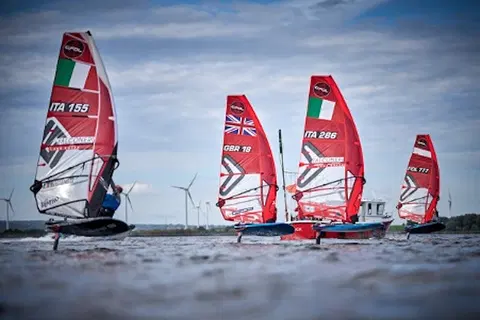
Varkiza had spent the opening days teasing a fleet of 290 young windsurfers with light patches, unstable shifts and long periods when patience mattered more than outright speed, although everything changed when the stronger breeze finally swept across the Greek racecourse. Sunshine sharpened the colour of the sea, white water began appearing across the bay and the foils lifted with the urgent hiss that has become the unmistakable sound of modern Olympic windsurfing, sending sailors towards the starting line at speeds that left little room for hesitation. Five course races were completed across all four fleets in approximately 20 knots, turning the fourth day of the 2026 iQFOiL Youth and Junior European Championships into a physical examination of technique, endurance and courage.
The championship had brought sailors from 31 nations to the Nautical Club of Vari-Varkiza, where the U19 men and women raced alongside the U17 boys and girls across a programme intended to test more than one style of foiling. Light weather demands patience, delicate pumping and an instinct for finding the smallest usable patch of pressure, while 20 knots changes the contest into something faster and considerably more physical. Sailors must keep the board level as the foil accelerates beneath them, control a heavily loaded rig, choose the correct moment to cross the course and enter crowded mark roundings with enough speed to remain airborne without arriving so fast that control disappears.
Taisiia Stopchenko entered the decisive part of the week as the reigning U19 world champion and immediately looked comfortable when the breeze strengthened. Julia Przybyl of Poland remained close enough to apply persistent pressure, while Israel’s Alba Klein climbed into third during the heavy-air course racing, yet Stopchenko protected her advantage through a combination of speed and mature decision-making. Her greatest strength was not simply the ability to win races, because championship sailing also requires a competitor to recognise when victory is unavailable, protect a useful score and avoid the crash or premature start that can undo several hours of good work.
The U17 girls produced one of the clearest demonstrations of national strength as Türkiye occupied the leading positions. Reigning world champion Parla Kabasakal won four of the five heavy-air races, building what appeared to be a commanding position ahead of Nisa Üstündağ and Ece Melis Baş. Turkish youth windsurfing had not merely produced one exceptional sailor, since the presence of three athletes at the front suggested a programme with considerable coaching depth, strong domestic competition and an effective pathway between junior racing and the international fleet.
Artun Şenol appeared equally formidable in the U19 men, trading first and second places with Poland’s Leon Jankowski while the pair separated themselves from much of the field. Jankowski’s speed lifted him into second overall, while Kfir Nov of Israel slipped to third after spending much of the championship among the leaders. Şenol retained the advantage, and his combination of consistency and heavy-air pace made him look increasingly capable of carrying the title through the remaining qualification races.
The U17 boys remained the least predictable fleet, with František Burda of the Czech Republic, Enric Patiño Riutord of Spain and France’s Swann Manhaval separated by only one point after the five strong-wind races. Burda held the lead, although the margin offered no protection against a single mistake, while Patiño Riutord and Manhaval had shown enough speed to take advantage of any opening. Such close racing demonstrated the unforgiving nature of youth iQFOiL, where sailors competing at remarkable speeds can complete several races only to find the championship separated by the equivalent of one place.
Two more days of qualification followed before the championship reached its Medal Series on 31 October, when the long week of fleet racing was compressed into short, high-pressure downwind slalom contests. The leading sailors carried advantages earned through qualification, although the format ensured that no commanding points margin could provide complete security. Quarter-finals and semi-finals offered lower-ranked qualifiers a route into the Grand Final, while every start, mark rounding and foil transition became magnified by the knowledge that one short race could decide a European championship.
The U19 men delivered the most dramatic reversal of the event. Kfir Nov advanced from the semi-final to face Şenol, Jankowski and Canadian Valentino Blewett in the Grand Final, where the title required more than one confrontation before it could be settled. Nov won the opening race and Blewett claimed the second, leaving all four sailors holding one match point and placing the championship upon the next victory. Şenol and Nov fought for the lead during the deciding race until the Turkish sailor crashed on the final reach, bringing a cruel conclusion to a week he had led with such authority, while Nov remained upright and crossed the line as European champion ahead of Jankowski and Blewett.
The outcome captured both the attraction and severity of the Medal Series, because Şenol’s qualification performance had established him as the sailor to beat, yet the final demanded another level of precision under an entirely different form of pressure. Nov had remained close enough throughout the week to reach the elimination stages, then delivered his best sailing when the championship had become a sequence of direct confrontations. Speed carried him into contention, while resilience and control allowed him to complete the final reach that ended his rival’s challenge.
Enric Patiño Riutord turned his U17 qualification position into a more controlled victory. Early-start penalties forced two rivals to begin the Grand Final five seconds behind, a substantial disadvantage when foiling boards accelerate rapidly and clean air becomes precious. The Spanish sailor used the opening ruthlessly, protecting clear pressure and sailing towards a convincing European title, while Swann Manhaval secured silver and Luca Pacchiotti of Italy completed a determined journey through the semi-final to claim bronze.
Stopchenko completed the week with the authority expected of a reigning world champion, winning the U19 women’s Grand Final and adding a European title to an already impressive season. Greek sailor Danai Giannouli gave the home supporters a memorable silver medal, while Przybyl produced one of the finest recoveries of the final day. The Polish sailor had fallen to sixth during qualification, forcing her to survive both the quarter-final and semi-final before reaching the Grand Final and earning bronze, a result built through repeated high-pressure performances rather than the protection of an automatic place.
The U17 girls supplied the final surprise as Ece Melis Baş overturned Kabasakal’s dominance. Kabasakal had won four races during the heavy-air programme and entered the Medal Series carrying the confidence of a world champion, although Baş took control of their Grand Final contest and held the lead despite making a costly mistake at the second mark. Kabasakal recovered to claim silver, while Üstündağ completed an entirely Turkish podium, confirming that Türkiye’s strength extended far beyond the identity of the eventual champion.
The equipment beneath these young sailors represents a major change in the history of Olympic windsurfing. Traditional Olympic boards relied upon a fin and remained in contact with the water, while iQFOiL uses a hydrofoil to lift the board above the surface once sufficient speed has been generated. Reduced drag creates far greater pace, with racing speeds capable of approaching 35 knots in suitable conditions, although the apparent smoothness of a flying board conceals a continuous contest between lift, pitch, sail power and rider movement.
World Sailing selected iQFOiL for the Paris 2024 Olympic cycle as the replacement for the RS:X, which had served as Olympic windsurfing equipment from Beijing 2008 through Tokyo. The change brought faster racing, new tactical possibilities and a more dramatic visual identity, while also requiring an entirely new generation of sailors to master foil control alongside conventional windsurfing technique. The class made its Olympic debut on the waters off Marseille during Paris 2024 and remains the chosen Olympic pathway towards Los Angeles 2028.
Youth and junior competition has consequently become one of the most important development routes in international sailing. The youth equipment is designed as the final step before the full Olympic configuration, allowing sailors to develop foil awareness, starting technique, tactical judgement and physical conditioning before entering senior fleets. Previous champions have already shown how quickly the level is advancing, with Italy’s Mattia Saoncella and Medea Falcioni winning the 2025 U19 European titles in Arzachena, while Finn Brüll of the Netherlands and France’s Thea Le Borgne Zibetti secured the U17 honours.
Varkiza added four more names to that developing history, although the week also demonstrated that the final standings reveal only part of the story. Şenol and Kabasakal left without the titles their qualification performances appeared to deserve, yet both displayed the speed required to compete at the highest level. Giannouli delivered a home medal under considerable pressure, Przybyl fought through two elimination stages, Pacchiotti climbed from the semi-final to the podium, while the Turkish U17 girls displayed a depth that other national programmes will study closely.
The championship began with sailors waiting for uncertain breeze and ended with four champions surviving one of the most unforgiving formats in modern sailing. Strong-wind course racing had revealed who could manage speed and exhaustion across repeated starts, while the downwind Medal Series exposed the competitors capable of remaining composed when an entire week rested upon a few minutes. Varkiza did more than award European titles, because it offered a glimpse of the sailors who may carry Olympic windsurfing towards Los Angeles and beyond, flying above the water with the confidence of a generation that has never considered foiling unusual.