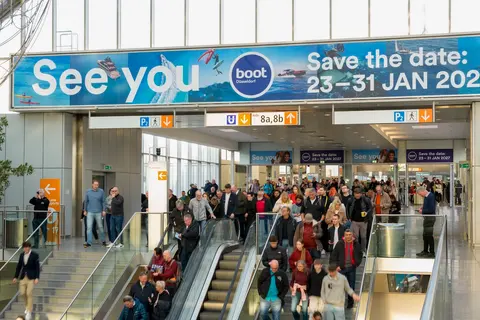
January in Düsseldorf usually brings cold pavements, pale skies and the sort of weather that encourages sensible people to remain indoors, although the atmosphere inside Hall 12 at boot Düsseldorf 2027 will bear little resemblance to an ordinary German winter. Foilers will rise above a 65-metre pool, wakeboarders will carve across its surface, skimboarders will attack a new bi-level course and complete beginners will discover that their first attempt at surfing need not involve waves, saltwater or an alarming encounter with the North Sea.
From 23 to 31 January 2027, boot Düsseldorf will move its complete surfing section into Hall 12, combining it with the World of Paddling to create a large indoor action centre built around participation as much as spectacle. An enlarged pool, a redesigned canoe circuit, a high-rope climbing course, professional competitions and expanded tuition will bring several branches of modern watersports beneath one roof, creating a place where established champions, curious newcomers and committed enthusiasts can share the same water.
The decision reflects how boot Düsseldorf has evolved during more than half a century. What began as an inland boat exhibition has gradually become a celebration of almost every activity connected with water, from sailing and motorboating to diving, paddling, surfing, foiling and marine conservation.
From 116 Exhibitors to the World’s Largest Watersports Show
The first boot Düsseldorf opened during November 1969 on a foggy day in Fischerstraße, far from any fashionable Mediterranean marina or celebrated ocean-racing harbour. Establishing a major boat show in an inland German city appeared an unlikely proposition, although exhibition director Kurt Schoop and experienced boating journalist Horst Schlichting understood that water sports could attract an audience wherever enthusiasm existed.
That inaugural event brought together 116 exhibitors from seven countries and attracted 34,000 visitors during six days. Boats displayed inside an exhibition building were still enough of a novelty to draw considerable public interest, while the success of the first show immediately demonstrated that Düsseldorf could become an international meeting place for the marine industry.
Only one year later, 183 companies representing 25 countries attended, requiring twice the original exhibition space. The show moved to the Düsseldorf Exhibition Centre in 1972 and changed from an autumn event to its now familiar January position, allowing manufacturers to introduce new boats and equipment shortly before the European season began.
Surfboards first appeared at boot in 1973, when the sport carried much of its Californian mystique and remained an unfamiliar pursuit to many European visitors. Diving became a permanent part of the exhibition during 1978 and 1979, while environmental concerns entered the programme with the show’s first conservation award in 1989.
A dedicated superyacht exhibition followed in 1997, before themed experience areas arrived under the “Experience Watersports 360°” concept in 2010. The ocean tribute award was introduced in 2017, recognising projects intended to protect marine environments and drawing greater attention towards the responsibilities accompanying recreational use of the sea.
Modern boot Düsseldorf attracts more than 200,000 visitors from over 100 countries and around 1,500 exhibitors, filling the exhibition complex with dinghies, cruising yachts, motorboats, equipment, destinations and increasingly adventurous opportunities to become wet without leaving the building.
Hall 12 Becomes the Action Hall
The move into Hall 12 represents another stage in that development. Surfing and paddling will be housed together for the first time, allowing visitors to move between the energetic spectacle of the action pool and the calmer experience of the redesigned canoe channel.
The centrepiece will be an XXL pool extended to 65 metres, giving professional competitors more room for their runs while increasing the number of opportunities available to visitors. Andrea Hoeppner, surfing specialist and organiser of the section, describes the move as a logical next step for surfing at boot, with the larger pool offering an improved stage for competition and participation.
Indoor surfing events require a considerable feat of temporary engineering. Thousands of litres of water must be held securely inside an exhibition hall, while towing systems, wind machines, starting platforms and safety teams transform an apparently simple pool into several different sporting arenas during the same day.
Pump foilers need enough space to lift their boards above the surface and maintain flight through repeated physical movement. Wakeboarders rely upon controlled towing systems to generate speed, while windsurfers competing in tow-in freestyle enter the run under external power before releasing into their aerial manoeuvres.
Skimboarding places different demands upon the venue, which explains the introduction of a new bi-level course. Riders accelerate across a thin layer of water before attacking changes in height, rails or other features, where board control and commitment determine whether a trick ends in applause or an undignified slide across the course.
The attraction lies partly in the proximity. Ocean competitions often take place hundreds of metres from spectators, making the finer details difficult to appreciate from shore, while an indoor pool places the athletes almost within touching distance of the crowd. Every landing, mistake and narrow victory becomes immediately visible.
Four Competitions Across Two Weekends
World-class competition will occupy both weekends of boot Düsseldorf 2027. The opening weekend on 23 and 24 January will feature the SFT Indoor Pump Foil World Cup and the World Skim Board Masters, bringing international athletes to the enlarged pool and new skimboarding course.
Pump foiling appears almost mysterious when performed well. The rider uses carefully timed movements of the legs and body to generate forward motion through the hydrofoil beneath the board, continuing without a sail, paddle, motor or breaking wave.
Efficiency matters as much as strength because an undisciplined movement increases drag and can bring the board back onto the water. Competitive races demand balance, endurance and a precise understanding of how the foil responds as speed changes around turns.
The second weekend on 30 and 31 January will belong to wakeboarding and windsurfing. The Pooltastic Wakeboard Masters will bring leading riders onto the pool, while the FPT Indoor Tow-In Freestyle gives windsurfers an opportunity to perform their most spectacular manoeuvres despite the complete absence of natural wind.
Tow-in freestyle was developed as a way of allowing windsurfers to compete when the weather refuses to cooperate. A mechanical system accelerates the rider towards the feature, creating enough speed for jumps, rotations and aerial tricks that would normally require a powerful breeze.
The controlled environment removes some of the uncertainty found outdoors, although it does not make the competition easy. Riders have limited space to build speed, complete their manoeuvre and recover before reaching the pool’s boundary, leaving little room for hesitation.
Previous indoor events at Düsseldorf have shown how effectively emerging sports can be presented to a large audience. The 2026 pump-foil competition attracted international riders and produced extremely close head-to-head racing, with the pool becoming more like a compact stadium than a conventional trade-show display.
Visitors Move from Watching to Doing
Professional competition provides the spectacle, although participation remains central to the boot Düsseldorf philosophy. The Surf Academy will allow beginners to explore several disciplines with practical instruction, while additional sessions will be available in pump foiling, wakeboarding, stand-up paddleboarding, windsurfing and skimboarding throughout the nine-day show.
Trying an unfamiliar sport inside a heated exhibition hall removes several common barriers. Wetsuits may still be necessary, although cold seas, uncertain waves and distant beaches no longer stand between a visitor and the first lesson.
Instructors can demonstrate basic stance, balance and board control in predictable conditions, giving newcomers a safer introduction before they progress towards open water. Equipment manufacturers also benefit because visitors can experience a product on the water instead of relying entirely upon technical descriptions delivered beside a display stand.
Experienced riders will gain a new opportunity through “Train with a Pro”. Small-group sessions will place advanced participants beside established professional athletes from wakeboarding, windsurfing, pump foiling and skimboarding, allowing individual technique to be examined under unusually close supervision.
A useful correction from a respected athlete can achieve more than weeks of unguided practice. Foot position, body movement, timing and equipment setup may require only subtle adjustments, although those small changes often separate an inconsistent performance from a controlled one.
Paddling Without the Traffic Jam
The World of Paddling will introduce a canoe channel running as a continuous circuit around a landscaped island. Earlier layouts required paddlers to turn at the ends of the course, creating awkward encounters whenever several canoes or kayaks reached the same point together.
The continuous route should allow participants to keep moving naturally, providing a better opportunity to understand how a boat tracks, turns and responds to different paddle strokes. Beginners will gain time to settle into the craft without immediately performing a tight turn beneath the gaze of waiting spectators.
Paddling offers a gentler counterpoint to the noise and athleticism surrounding the pool, although good technique remains important. An efficient stroke uses the larger muscles of the torso rather than relying entirely upon the arms, while balance and rhythm allow a kayak or canoe to travel smoothly without wasting energy.
Visitors preferring altitude to water can tackle the high-rope climbing course, extending the hall’s theme beyond board sports. Combining the pool, paddling circuit and climbing area should ensure that Hall 12 remains active throughout the day rather than becoming busy only when a scheduled competition begins.
Knowledge Beside the Water
The Pool Stage will provide interviews, demonstrations and discussions covering the latest equipment and developing disciplines. Professional athletes will explain their experiences, while technical specialists explore the changes shaping board design, foils, materials and electrical propulsion.
E-foiling will receive particular attention. An electric motor mounted on the foil allows the board to rise above the surface without relying upon waves, wind or continuous pumping, opening foiling to riders who may not have access to ideal natural conditions.
The technology also raises practical questions concerning battery range, charging, safety, regulation and responsible use around swimmers or wildlife. A major exhibition provides a useful setting for comparing systems and discussing those limitations alongside the excitement surrounding the sport.
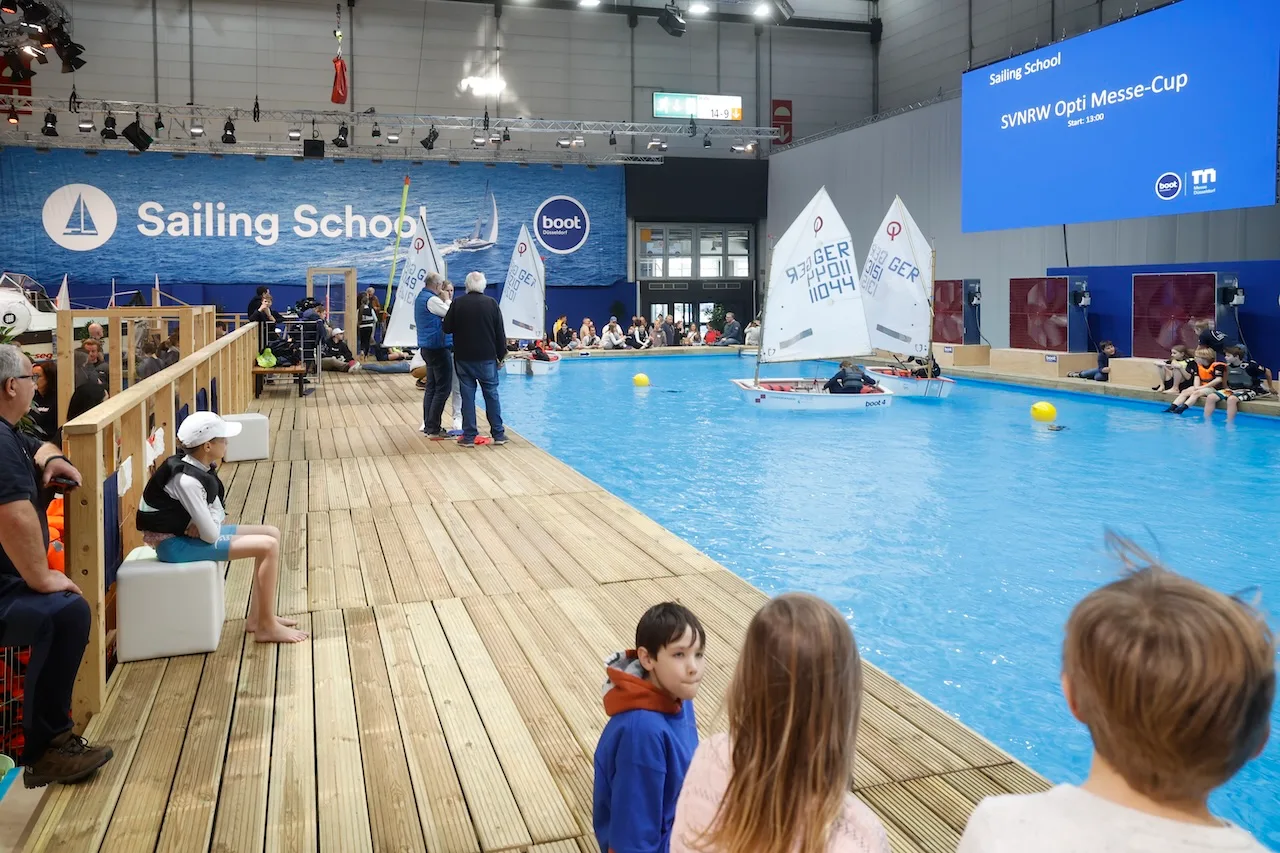
Hall 13 will place diving close to the action, including pools and a diving tower, while Hall 15 will host the boot Sailing School with small boats operating on its indoor sailing basin. Visitors can therefore move from boards and paddles to regulators and sails without leaving the exhibition complex.
A Campervan Village Beside the Show
Water sports culture has always extended beyond equipment because shared trips, improvised accommodation and evenings spent discussing the day form part of the experience. The Surf Festival Camp on car park P1 will give visitors with campervans an affordable base beside the exhibition grounds.
The published rate is €25 per night, plus a €3 nightly city tax, with showers, water and electricity available on site. Free shuttle buses will connect the camp with the exhibition, while a heated marquee will provide breakfast, dinner and space for visitors to gather after the halls close.
The arrangement offers an alternative to Düsseldorf hotel prices and creates a small temporary community of surfers, paddlers and other water-sports enthusiasts. Admission to boot must be purchased separately, which visitors should remember when planning their trip.
More Than Boats Beneath a Roof
The sight of a superyacht standing inside a German exhibition hall remains one of boot Düsseldorf’s great curiosities, although the event’s strength now comes from the breadth of activity surrounding those boats. Sailing, diving, surfing, paddling and environmental innovation occupy their own areas while remaining part of one wider conversation about life on the water.
Marine conservation and sustainable technology will again form an important part of the 2027 show. The blue innovation dock, organised with European Boating Industry, brings together political, technical and commercial voices to discuss how the leisure-marine sector can reduce its environmental impact.
Hall 12 represents the more energetic side of that future. Foils reduce contact with the water and produce an extraordinary sensation of flight, electrically powered boards are creating new ways to travel and younger disciplines are attracting participants who may never have considered walking through the doors of a traditional boat show.
A January exhibition cannot reproduce the salt, swell and shifting wind of the open sea, although it can provide the moment when curiosity becomes participation. Someone who enters Hall 12 intending only to watch may leave having stood on a board, paddled a kayak or received advice from a world champion.
boot Düsseldorf began in 1969 by performing the unlikely trick of bringing boats into the heart of an inland city. Nearly six decades later, it is bringing an entire watersports world indoors, complete with flying boards, competitive athletes and enough water to make everyone briefly forget the cold streets waiting outside.