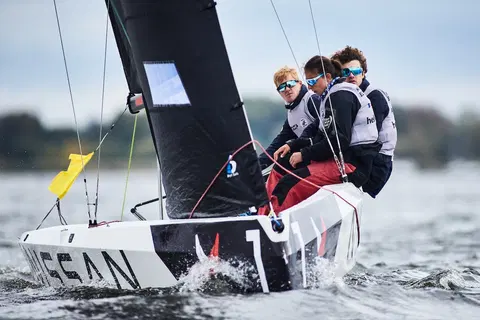
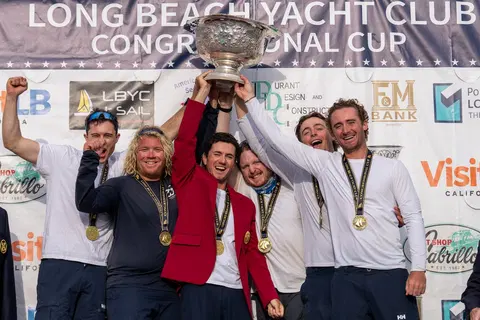
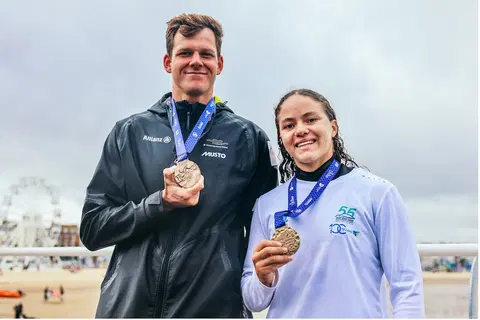
Ten metres separated Christian Hamilton from one of the greatest victories of his sailing career, although those final metres across Hamilton Harbour contained enough tactical danger to undo a week of outstanding match racing. Chris Poole, the World No 1, was carrying a penalty but had sailed over the top of Hamilton’s Khumbu Racing Team on the final run, giving the American one last opportunity to slow the race beside the committee boat, trap his opponent and complete the turn required to clear his punishment. Hamilton resisted the temptation to rush towards the line, drew upon instincts developed through years of team racing and kept enough control to escape Poole’s final move, winning the deciding match and lifting the King Edward VII Trophy at his first Bermuda Gold Cup.
The final provided a fitting conclusion to the 74th edition of an event that had delivered more than 100 matches during six days of racing. Hamilton and Poole reached the best-of-five final as two very different figures within the World Match Racing Tour, with the American established at the top of the rankings after more than a decade in the discipline, while Hamilton had returned to serious match racing only around 18 months earlier. Khumbu Racing had risen quickly, yet defeating Poole in Bermuda required more than improved form and enthusiasm, because the confined waters of Hamilton Harbour punish hesitation and reward crews capable of changing tactics within seconds.
Poole moved ahead 2-1 in the final, leaving Hamilton one defeat from second place, although the British crew retained an unusual sense of confidence rather than allowing the scoreline to dictate the mood aboard. Hamilton levelled the contest and forced a fifth race, where every pre-start exchange, boundary decision and manoeuvre carried the weight of the trophy. The deciding match developed in Hamilton’s favour when Poole received a penalty, giving Khumbu Racing a potentially decisive advantage as the boats approached the closing stages.
A match-racing penalty does not simply add time after the finish, because the penalised boat must complete a prescribed turn before crossing the line. That requirement creates opportunities for both crews, since the leading unpenalised yacht wants to keep the race flowing towards the finish while the penalised opponent may deliberately slow the contest, engage at close quarters and create enough separation to perform the turn without surrendering the match. Poole’s final attack was therefore not desperation without method, because a well-executed mark trap can reverse a race within the length of a boat.
Hamilton had been leading down the final run when Poole rolled over him and positioned his boat near the committee vessel, attempting to create the slow-speed confrontation he needed. Both yachts still carried spinnakers, making the demand to stop or sail more slowly particularly awkward, while the crews had to control their boats within a confined patch of water beside the finish. Hamilton and tactician Ian Williams recognised the team-racing pattern, resisted Poole’s attempt to dictate the final approach and preserved the advantage until the line.
Williams brought exceptional experience to Khumbu Racing, having won the World Match Racing Championship multiple times and lifted the Bermuda Gold Cup in 2006 and 2019. His presence alongside Hamilton, Richard Sydenham and Jon Gundersen gave the British skipper a crew capable of handling the boat precisely while also seeing several tactical moves ahead. The final seconds demonstrated why match racing cannot be reduced to one sailor standing behind a wheel, because trimming, boat placement, communication and anticipation must operate as a single system when two yachts are separated by only metres.
Hamilton’s route to Bermuda had begun much earlier in his sailing life. During his twenties he had wanted to reach the highest level of match racing and spent six years competing with a strong crew, before marriages, changing priorities and the ordinary movement of life interrupted the campaign. An opportunity to assemble another committed team arrived several years later, allowing him to return with a planned two or three-year programme and the maturity to understand that progress would depend upon continuity as much as raw ability.
That return produced a rapid rise through the rankings and brought Hamilton to Bermuda as World No 5, although his first appearance at the Gold Cup placed him among sailors with considerably more experience of the venue. Hamilton Harbour is a compact and unforgiving arena, where surrounding land can influence the breeze, boundaries arrive quickly and the short course compresses tactical decisions. Crews have limited time to recover from a poor start, while spectators can follow the engagements from shore rather than watching distant sails disappear over a horizon.
The 2026 regatta introduced an important technical change when the Royal Bermuda Yacht Club replaced the International One Design yachts traditionally associated with the event with its new fleet of FarEast 28Rs. The modern sportboats brought asymmetric spinnakers, quicker acceleration and a different style of manoeuvring to the harbour, requiring experienced Gold Cup competitors to reconsider familiar tactical situations. The change also placed greater emphasis upon rapid crew work, particularly during short legs where a slow hoist, delayed gybe or untidy drop could decide the match before the next tactical exchange began. bermudagoldcup.com
Hamilton’s victory added a new British name to one of sailing’s most historic trophies. The King Edward VII Gold Cup was first presented in 1907 during the Jamestown Tri-Centenary Regatta in Virginia, where C. Sherman Hoyt won it sailing the Q yacht Capsicum. Hoyt retained the trophy for approximately three decades before returning it to British custody through the Royal Bermuda Yacht Club, recognising the long sporting relationship between Bermuda and sailors from the United States. bermudagoldcup.com
The trophy entered its modern competitive life in Bermuda during 1937, when it was raced for in 6-Metre yachts and won by American sailor Briggs Cunningham. Bermuda’s Bert Darrell later created one of its defining stories after acquiring the wrecked 6-Metre Achilles from an insurance company, rebuilding the yacht in his boatyard and sailing directly from the slipway to defeat George Nicholls and the highly rated Goose in 1939. Darrell went on to become one of Bermuda’s most successful Gold Cup sailors and established a record that remained untouched until Russell Coutts surpassed it decades later. bermudagoldcup.com
Racing resumed after the Second World War in 1951 using International One Design yachts, beginning a relationship between the event and the IOD fleet that lasted almost continuously until the FarEast 28R arrived in 2026. The identical boats placed emphasis upon starts, tactics and crew work rather than design advantages, helping preserve the Gold Cup’s reputation as an examination of match-racing ability. Bermuda sailors claimed the trophy repeatedly during those earlier decades, with Bert Darrell, Archie Hooper, Warren Brown and other local figures ensuring that visiting internationals never regarded the event as an easy addition to their season.
The Gold Cup grew in international importance after Australia’s America’s Cup victory in 1983 created renewed interest in match racing. The event became part of the World Match Racing Conference in 1985, while the Royal Bermuda Yacht Club introduced sponsorship, prize money, on-the-water judging, spectator boats and live commentary from 1988. Moving the racing into Hamilton Harbour turned tactical sailing into visible theatre, giving spectators the chance to watch pre-start circling, penalties and close mark roundings without requiring binoculars or a chase boat. bermudagoldcup.com
The winners’ list reads like a condensed history of elite match racing and the America’s Cup. Chris Dickson won in 1987 and 1989, while Russell Coutts collected seven victories between 1990 and 2004 to become the event’s most successful skipper. Peter Gilmour won three times, with James Spithill, Ben Ainslie, Taylor Canfield, Ian Williams, Francesco Bruni and Adam Minoprio among the later champions. Johnie Berntsson arrived in 2026 as the three-time defending champion after victories in 2023, 2024 and 2025, although Hamilton ensured the trophy would carry a different name for the first time in four editions. bermudagoldcup.com
Poole’s defeat was particularly difficult because the American had come within a single race of achieving one of his principal remaining objectives. He had sailed strongly enough to establish a 2-1 lead and still created an opportunity to win despite carrying the penalty in the decider. Small errors ultimately proved expensive, while Hamilton’s crew responded without offering the World No 1 an equivalent opening.
Poole nevertheless completed his sixth consecutive podium finish on the World Match Racing Tour, a record demonstrating consistency across different boats, venues and conditions. Match racing rewards specialists who can transfer pre-start timing, rules knowledge and tactical judgement between events, although every location presents distinct problems. Hamilton Harbour remained one of the venues Poole acknowledged he had not yet fully mastered, giving the American a clear reason to return for another attempt.
The rest of the fleet underlined the depth of the competition. Denmark’s Jeppe Borch finished third ahead of France’s Aurélien Pierroz, while Oscar Engström placed fifth and experienced Swedish skipper Johnie Berntsson finished sixth. Women’s World No 1 Pauline Courtois took seventh in the combined field, ahead of Switzerland’s Eric Monnin, with Anna Östling, Tom Picot, Martina Carlsson and Allie Blecher completing the 12-skippers’ standings.
The inclusion of leading women’s and open-ranked teams in the same competition strengthened the Gold Cup’s sporting value, because match racing depends upon decision-making, crew coordination and rules knowledge rather than the physical advantages that shape some other disciplines. Courtois and Östling arrived with extensive championship experience, while the larger 2026 field ensured more varied styles and tactical approaches across the week.
Hamilton’s success also gave Great Britain another place in a national history that includes victories by Eddie Warden-Owen, Andy Green, Ian Williams and Ben Ainslie. His name now sits on the same trophy as Coutts, Gilmour, Spithill, Ainslie and generations of Bermudian sailors, an association made more remarkable by the fact that he had never previously raced the event. Few debutants arrive expecting to understand Hamilton Harbour immediately, especially when facing the highest-ranked match racer in the world during a final extending to all five races.
Celebration followed Gold Cup tradition, with champagne opened and the winning crew jumping into the harbour after returning ashore. The ritual offered a cheerful release after a week in which every mistake had been measured in metres and every result recorded across more than 100 individual matches. Hamilton accepted that his victory would make Khumbu Racing a marked team at future events, because opponents who might once have regarded the campaign as an ambitious newcomer would now prepare for a Gold Cup champion.
The final ten metres provided the lasting image, with two boats slowing beneath spinnakers while Poole searched for the move that might clear his penalty and Hamilton refused to surrender control. Speed normally dominates sailing conversations, although match racing sometimes demands the opposite skill, requiring a crew to stop, hold position or arrive second at a particular point so it can finish first when the line finally matters.
Hamilton’s victory was therefore more than an upset based upon one mistake from the favourite. Khumbu Racing recovered from 2-1 down, won two consecutive matches under final-race pressure and solved a last tactical problem that could easily have reversed the championship. The King Edward VII Trophy has survived changing eras, different classes and generations of champions because it continues producing moments where sailing intelligence matters as much as outright pace, and the closing seconds of the 2026 Bermuda Gold Cup belonged comfortably within that history.