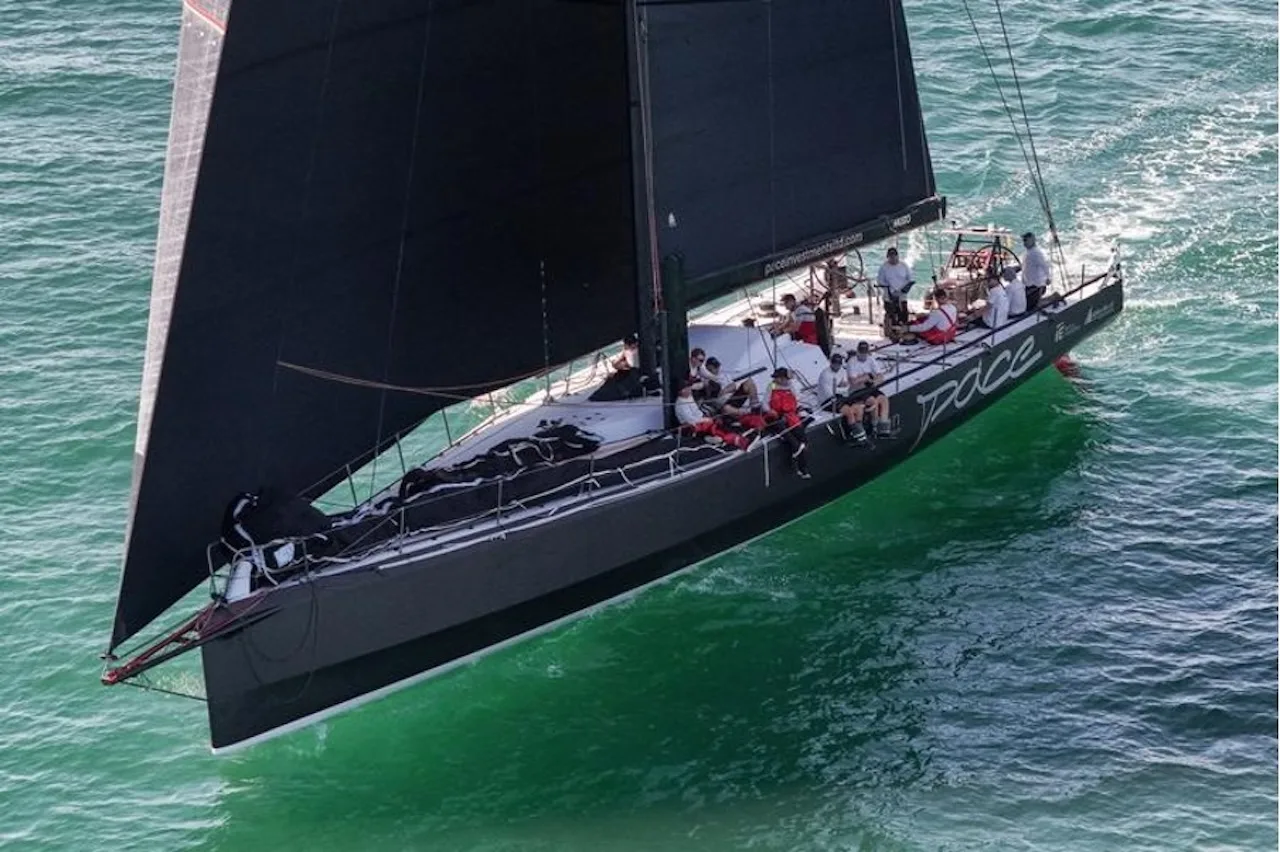
Seventy-two hours after the cannons released the fleet from Cowes, the 2026 RORC Round Britain and Ireland Race had acquired the unmistakable character of a true offshore epic. Johnny Vincent's Volvo 70 Pace was charging north beside the Hebrides, throwing curtains of Atlantic water across her deck as a powerful southerly breeze carried her towards the lonely turning point at Muckle Flugga.
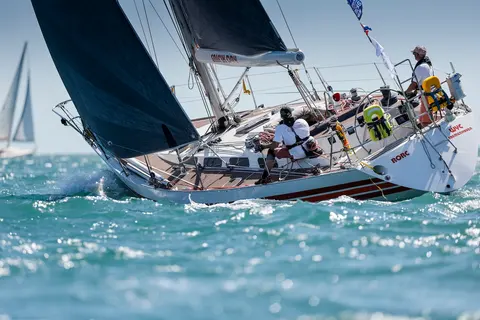
Behind her, the sea told an entirely different story. Boats approaching the Dingle Peninsula were feeling their way through sea fog, listening to the warning calls of ships they could identify on AIS but could not see through the grey. Others remained trapped in softer, variable conditions, watching valuable miles disappear as the leaders connected with the stronger airflow surrounding a deep Atlantic low.
The result was a fleet stretched across an enormous expanse of water and divided by more than position alone. At the front, sailors were wrestling with speed, noise and physical exhaustion. Further south, the battle concerned patience, concentration and the search for the next faint ribbon of wind.
Pace Finds Her Ocean
During one extraordinary 24-hour period, Pace covered approximately 428 nautical miles, maintaining an average close to 18 knots. With 932 miles of the 1,805-nautical-mile course remaining at the latest Day Four update, she held a commanding advantage on the water over Jens Kellinghusen's Ker 56 Varuna 6 and Antoine Magre's radical Mach 50 Palanad 4.
Those three yachts also filled the provisional podium positions in IRC Overall and IRC Zero, with Pace holding an estimated corrected-time advantage of almost 24 hours over Varuna 6. Such tracker calculations can change dramatically during a race of this length, particularly when competitors occupy different weather systems, although the numbers demonstrated just how effectively the Volvo 70 had used her opportunity.
A Volvo 70 is at her most impressive when the breeze reaches across the deck and allows the crew to release the enormous power contained within the boat. Designed for fully crewed racing around the world, these yachts combine length, sail area, a canting keel and a hull capable of sustained high-speed ocean passages. They demand skill and respect because every increase in speed raises the loads passing through the rig, sails and deck equipment.
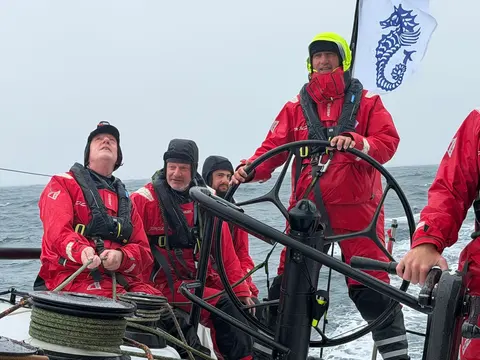
Boat captain Anthony Haines described a wet and physical night in 20 to 25 knots of wind, with Pace regularly travelling between 17 and 25 knots. Water swept the deck, sleep was gathered whenever circumstances allowed, and the crew gradually settled into the disciplined rhythm required to keep a powerful ocean racer moving without exhausting either boat or sailors.
That rhythm matters. Stu Bannatyne, one of Pace's watch captains, entered the race as a four-time winner of the fully crewed round-the-world race. Fellow watch leader Neal McDonald and navigator Jules Salter added further depth to a crew assembled around experience rather than celebrity. Their task was not simply to drive hard, but to judge when the conditions justified applying maximum pressure and when the boat needed protection.
Fifty Years Around the Edge
The 2026 edition marked the 50th anniversary of a race that began on 5 June 1976. That first contest attracted 25 boats divided between a non-stop race and a separate competition with scheduled stops at Crookhaven, Stornoway and Blyth. Electron II won the non-stop division, while Morningtown prevailed in the stopping race.
By 1980, the event had become an entirely non-stop challenge, with Chica Tica II securing both line and overall honours. The 1992 and 1994 editions temporarily returned to a legged format, although the modern race has become celebrated as an uninterrupted circumnavigation of Britain and Ireland.
Recent winners of the John Illingworth Trophy for IRC Overall illustrate the variety of yachts capable of mastering the course. Incisor of Wight won in 2000, followed by Kingspan-Chieftain in 2006, Artemis Ocean Racing in 2010, Varuna in 2014, Pata Negra in 2018 and the JPK 1010 Jangada in 2022. The race's history and official records are maintained by the Royal Ocean Racing Club.
The outright record remains the remarkable 3 days, 3 hours, 32 minutes and 36 seconds set by Sidney Gavignet's MOD70 Oman Sail Musandam in 2014. Ian Walker's VO65 Abu Dhabi Ocean Racing Azzam established the monohull record during the same edition, completing the course in 4 days, 13 hours, 10 minutes and 28 seconds. Those performances underline the rare combination of speed, weather and reliability required to produce a record around such an unforgiving coastline. RORC lists the race winners and standing records here.
Palanad Waits for Her Chance
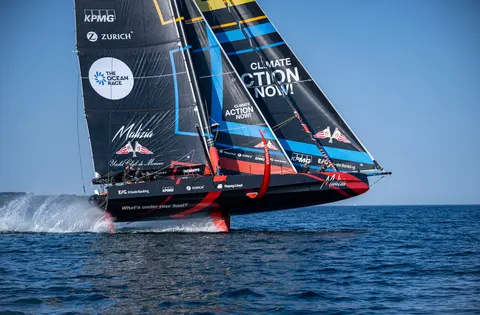
Antoine Magre and the crew of Palanad 4 had endured a very different opening. More than 70 tacks were required around the Isle of Wight before the French team began picking a path through the weak and unstable winds further west.
Navigator Pablo Santurde helped the Mach 50 remain in moving air and avoid the complete stops that can destroy a corrected-time campaign. The larger sail plans of Pace and Varuna 6 allowed them to escape, although Palanad 4 remained a serious IRC threat once stronger conditions arrived.
The Sam Manuard-designed yacht represents a newer school of offshore thinking, with a broad scow bow, canting keel and daggerboards intended to produce enormous power without the length of her larger opponents. Having already achieved major victories in the RORC Transatlantic Race, RORC Caribbean 600 and Aegean 600, Palanad 4 possesses a pedigree that makes dismissing her particularly unwise.
Close Fighting Through the Classes
Pierre Le Boucher's Penfret led the Class40 division after a night of high-teen and low-twenty-knot speeds. The crew had settled into ocean-racing mode, although Swift and Gambit remained close enough to punish every poorly chosen sail or missed shift. Technical problems forced the Dutch Class40 Tjoba to retire, with everyone aboard reported safe and well.
IRC One was led provisionally by Sam and Andrew Hall's Lombard 46 Pata Negra, ahead of Stickleback and the double-handed JPK 1180 Frida. The fresh breeze allowed Pata Negra to break away, while Cameron Davis and the crew of Espresso Martini Too were attempting to recover after becoming trapped near Land's End.
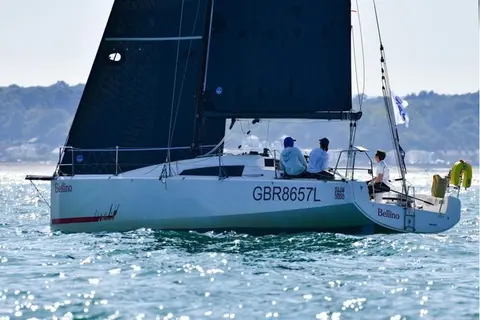
In IRC Two, Rob Craigie's Sun Fast 3600 Bellino held the provisional lead from Mzungu! and Sky Business Game On. RORC Commodore Deb Fish reported an intense running contest near the Skellig Islands, where forecasts, visible cloud patterns, wind shifts and the positions of nearby rivals all influenced the route north.
Mzungu!, sailed by Sam White and Nathan Steffenoni, led the IRC Two-Handed standings. Ian Hoddle and Willow Bland aboard Game On were second after recovering three miles during a tactical reset near the Isles of Scilly. Their experience also revealed one of double-handed racing's least glamorous difficulties, because high adrenaline, heat below deck and constant demands on the crew can make restorative sleep almost impossible.
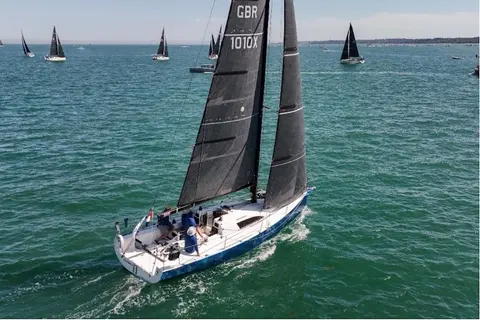
Mark Brown's JPK 1010 Jetpack led IRC Three on corrected time, followed by the Sun Fast 3200 Zanzibar and Swan 44 Astrid. Richard and Emma Breese's double-handed J/105 Mojo illustrated the frustration affecting the smaller boats when a patch of calm water erased hard-won gains across the Celtic Sea.
The Turning Point Ahead
The large Atlantic low, measured at approximately 999 hPa, had become the controlling force in the race. Southerly winds of 15 to 20 knots provided the leaders with their northbound express, while boats further south waited to connect with the same moving roadway.
That advantage was never guaranteed to last. The leading yachts still had to negotiate Muckle Flugga before turning south into upwind conditions. High pressure advancing from the Atlantic threatened to leave later arrivals with north-westerly winds and much less favourable angles along the western approaches.
Muckle Flugga therefore represented more than a remote mark on a chart. It promised a complete change in the character of the contest, replacing the roaring downwind passage with a punishing return towards Cowes through tired bodies, heavy seas, shipping lanes, wind farms and complex tidal waters.
At the front, Pace had taken command by recognising when the Atlantic had opened its door and driving through it with conviction. Hundreds of miles astern, sailors surrounded by fog or silence were still waiting for that same door to open, knowing that offshore racing can reward patience almost as suddenly as it punishes hesitation.
The Round Britain and Ireland Race has never been won through speed alone. It belongs to the crew that can keep making sound decisions after the warmth has gone, the bunks are wet and the coastline offers no shelter. On Day Four, Pace looked magnificent beneath the Hebridean sky, although the long road around Britain and Ireland still had many more stories to tell.