Sunday morning started early.
The destination was the Weymouth & Portland National Sailing Academy, just outside Weymouth, where some of the fastest windsurfers in the world had gathered for the 2026 Musto iQFOiL World Championships.
I had never visited the Academy before. For somewhere capable of hosting an Olympic sailing regatta and now a World Championship, arriving was remarkably straightforward. The car went into a space almost opposite the venue and, within minutes, I was walking into what felt less like a conventional sailing club and more like a temporary international village built around boards, sails, foils and speed.
It is an impressive set-up.
Large marquees had been erected around the site and turned into temporary homes for teams arriving from around the world. Outside, equipment covered the preparation areas. Boards lay on the ground, sails were being assembled, foils checked and competitors moved between it all with the purposeful air of people who knew there was serious racing ahead.
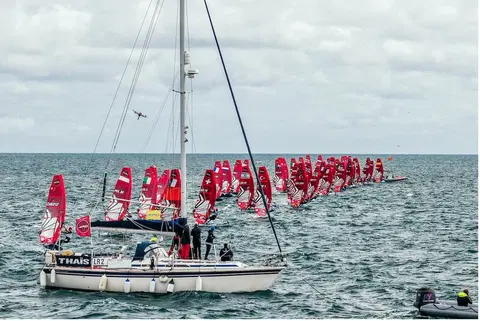
The numbers explain the scale. 186 competitors representing 41 nations have gathered at Weymouth & Portland for six days of racing, culminating in Saturday's Medal Series. It is the first major iQFOiL championship staged in Britain and the first World Championship in an Olympic windsurfing discipline on British waters since 2009.
Watching the world prepare One of the pleasures of arriving before the racing starts is being able to see the other side of a World Championship. There are no dramatic mark roundings, no frantic finishes and no medals being handed out. Instead there are people working.
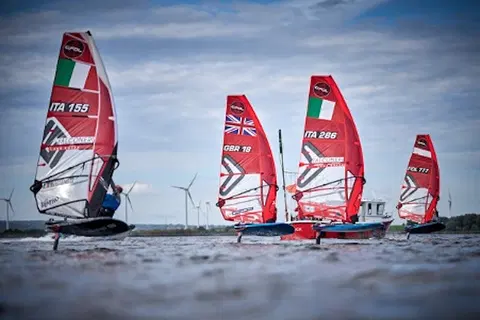
I spent some time watching the Italian team setting up. Red sails and boards were spread across the preparation area while sailors and support crews quietly went through the business of getting everything ready. From a distance, iQFOiL can look deceptively simple. There is a sailor, a board and a sail. Walk around the equipment ashore and you realise there is considerably more going on.
The hydrofoil underneath one of these boards is a substantial piece of engineering. Seen out of the water, with its long mast and wide carbon wings exposed, it becomes much easier to understand how the board can rise clear of the surface.
Once flying, an iQFOiL board can reach around 35 knots roughly 65 kilometres per hour. Reducing contact with the water dramatically reduces drag and turns Olympic windsurfing into something that occasionally appears closer to low-level flight.
The irony is that something capable of looking so effortless at 30-plus knots can be distinctly cumbersome when somebody has to carry it down a slipway. Watching competitors launch brought that home. Boards were lifted, sails manoeuvred and those long, vulnerable foils carefully guided towards sufficiently deep water. There is plenty of glamour once the racing starts. Getting the machinery there is rather more practical.
A quieter World Championship than expected What did surprise me was the crowd or rather, the lack of one. For the opening weekend of a World Championship, I had expected rather more people.
Perhaps that will change as the week develops and particularly when the championship reaches its climax in Weymouth on Saturday. The organisers are planning a Fan Zone around Weymouth Pavilion for the Medal Series, complete with big-screen coverage and activities ashore.
On Sunday morning, however, things were pleasantly relaxed. For somebody with a camera, that was no bad thing. I could wander around the venue, look closely at the equipment and watch the various national teams preparing without fighting through a crowd.
Eventually, another attraction presented itself.
Coffee !!
The Academy clubhouse has a fine first-floor balcony overlooking the preparation areas. Armed with a very decent cup, I sat back and watched proceedings from above. Below were sails, boards, team marquees and sailors from around the world preparing for a World Championship. Beyond them lay Portland Harbour.
It wasn't a bad way to spend a Sunday morning.
Olympic waters meet a new generation There is another reason Weymouth & Portland feels appropriate for this championship. The Olympic rings remain a reminder that this was the sailing venue for the London 2012 Olympic Games. Fourteen years later, Olympic windsurfing looks markedly different.
The RS:X equipment of the previous era has gone. iQFOiL was introduced for the Paris 2024 Olympic cycle, replacing RS:X and bringing hydrofoiling into Olympic windsurfing. Men and women use the same board, foil and 4.9-metre mast, although sail areas differ 8 square metres for the men and 7.3 square metres for the women. Racing can include course races, short sprints and marathon racing, placing very different demands on the competitors.
The machinery may have changed dramatically, yet the fundamentals remain familiar to any sailor. Wind still matters. Tide matters. Position matters. Reading the water matters. Getting the start wrong remains an excellent way of making life difficult for yourself.
Technology has changed how quickly everything happens. Home waters, home champions
There is a particularly strong British story running through this championship. Britain arrived in Weymouth with not one but both reigning iQFOiL World Champions. Emma Wilson and Andy Brown won the women's and men's world titles in 2025 and now have the unusual opportunity to defend those titles on home waters. Wilson already has two Olympic bronze medals, including bronze at Paris 2024, and the British Sailing Team has established itself as a significant force in the foiling class.
That puts additional attention on the British sailors this week, although anyone expecting an easy home-water procession only needs to look around those international team tents to appreciate the quality of the opposition. The women's field includes Olympic Champion Marta Maggetti of Italy alongside European Champion Tamar Steinberg of Israel and a deep collection of established and emerging international talent. The men's fleet is similarly formidable.
Sunday was about preparation. On Monday, the talking stopped. Steinberg starts with four wins
The first day of World Championship racing opened with Upwind Sprints, short races that immediately placed a premium on acceleration, speed and quick tactical decisions. The women's fleet subsequently managed two Course Races as well, completing four races during the day.
Tamar Steinberg could hardly have made a more emphatic start. The reigning European Champion won all four races, leaving Weymouth at the top of the women's standings with a perfect opening-day record. Germany's Stella Bilger finished the day second overall, with Norway's Maya Gysler third.
Six days is a long World Championship and plenty can change, but four wins from four is a fairly persuasive way of announcing your intentions.
Nothing between the men The men's opening was rather different. Conditions prevented the planned Course Racing, leaving the fleet to complete four Upwind Sprints. With competitors divided across six heats, the result was an extraordinarily tight opening leaderboard.
Four sailors finished the day level on points. European Champion Luuc van Opzeeland of the Netherlands took the overall lead on the tiebreak, with Poland's PaweB Tarnowski, France's Nicolas Goyard and Israel's Yoav Omer right there with him.
It is difficult to ask for a much closer opening to a World Championship.
There is also something appropriate about such fine margins in this class. At these speeds, decisions that look insignificant from ashore can become expensive very quickly.
More than simply going fast Seeing the equipment close up also changed my perception of iQFOiL. Speed is the obvious attraction. A windsurfer travelling at 30 knots while the board flies above the surface makes a spectacular photograph and an even better piece of video.
Yet concentrating entirely on the speed misses something. These are athletes combining physical effort, balance, tactics and an increasingly sophisticated understanding of foil behaviour. Championship racing can require everything from short explosive sprints to longer course and marathon races. The qualification series eventually reduces the field to ten men and ten women for Saturday's knockout Medal Series.
There is nothing particularly leisurely about it. Standing beside the equipment on Sunday also gave a sense of how far windsurfing has travelled. The Olympic rings overlooking Portland Harbour belong to one generation of Olympic sailing; the carbon foils scattered around beneath them point towards another.
It's an appropriate line for a sport in which the competitors themselves spend much of their time trying to do precisely that lifting clear of the water and balancing on a foil while travelling at speeds that would have seemed extraordinary in Olympic windsurfing not so many years ago.
When I left Weymouth & Portland on Sunday, the site was still in preparation mode. Sails were being rigged. Boards were being moved. Teams were making final adjustments. The waters of Portland Harbour looked almost peaceful.
Twenty-four hours later, Tamar Steinberg had four victories beside her name and Luuc van Opzeeland was leading a men's fleet separated by the narrowest of margins.
By Saturday, two new World Champions will have been crowned. For Old Sea Dogs, however, perhaps the most revealing part came before the first starting signal. It was being able to walk amongst those extraordinary flying machines, watch the world's best preparing them for battle and then sit above it all with a cup of coffee while a World Championship quietly gathered itself beneath the balcony.
Sometimes it pays to arrive early.