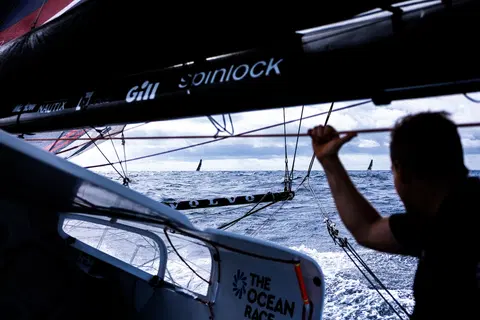
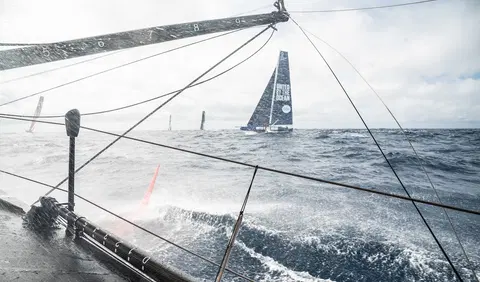
The North Atlantic had removed almost every comfortable margin by the seventh morning, leaving four of the world's most accomplished IMOCA crews gathered around the northern edge of a high-pressure system with less than 1,000 nautical miles separating them from Lorient.
Kojiro Shiraishi's DMG MORI Global One retained the narrowest of leads, although Paul Meilhat's United by the Ocean and Francesca Clapcich's 11th Hour Racing were both within four miles in distance to the finish. Boris Herrmann's Team Malizia had closed substantially overnight and remained close enough to threaten every calculation being made ahead.
After nearly a week of heavy seas, structural punishment, torn sails and damaged equipment, the first Ocean Race Atlantic was approaching its final phase without producing a clear favourite. The leading boats were no longer charging through the low-pressure system that carried them across much of the ocean, because a stubborn ridge of high pressure had slowed the fleet and forced the navigators north.
The fastest route towards France was no longer the straightest line on the chart. It required patience, precise positioning and an accurate judgement of how quickly the high would move south-east towards the Brittany coast.
DMG MORI Holds the Narrowest Advantage
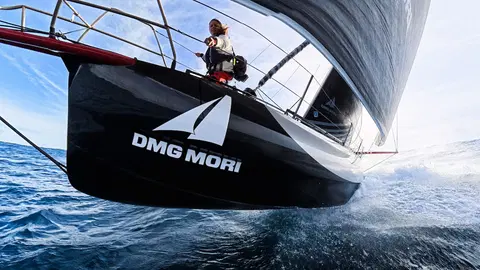
DMG MORI Global One occupied the southernmost position among the leading group, with navigator Nicolas Lunven watching the sun rise over a race that remained almost impossibly close.
Approximately 12 knots of wind carried the Japanese yacht towards the edge of the high, although the boats immediately behind appeared slightly faster as Shiraishi's crew approached softer pressure.
Lunven expected the high-pressure system to migrate south-east, eventually releasing the fleet into more favourable reaching conditions towards Lorient. Such a forecast offered the possibility of a fast and comparatively pleasant conclusion, yet the timing of that movement remained uncertain.
A boat that reached the new breeze only half an hour before its rivals could gain several miles. The leading crew could also be punished first if its route carried it too deeply into the weakening wind.
Shiraishi's position carried particular significance because DMG MORI Global One was competing in its first major offshore race. The new Guillaume Verdier design was created for the team's wider programme leading towards The Ocean Race 2027 and the 2028 Vende Globe.
The skipper brought enormous solo experience to the campaign, having completed Vende Globe circumnavigations while becoming the first Asian sailor to finish the celebrated race. Fully crewed competition creates a different rhythm, although Shiraishi surrounded himself with sailors capable of accelerating the learning process.
Lunven finished sixth in the 2024-25 Vende Globe and previously navigated aboard Team Malizia during The Ocean Race 2022-23. Sam Davies added four Vende Globe campaigns and experience as skipper of the all-female Team SCA in 2014-15, creating one of the most knowledgeable crews in the fleet.
Three Boats, Four Miles and No Rest
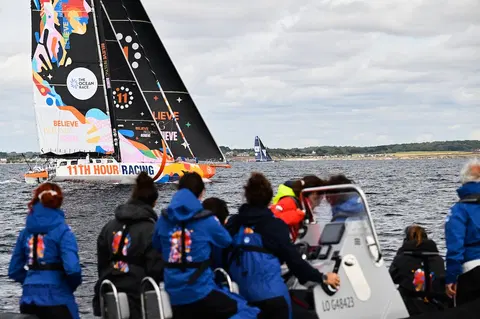
The distance separating DMG MORI Global One, United by the Ocean and 11th Hour Racing was almost insignificant after more than 2,000 nautical miles.
Meilhat's French campaign remained second, continuing a consistently strong passage aboard the yacht that won The Ocean Race Europe in 2025 under its former Biotherm identity.
The French skipper understands how quickly a race can change near the finish. His career includes victory in the 2018 Route du Rhum and extensive competition within the IMOCA class, giving him the tactical experience required for the shifting approach to Brittany.
Clapcich's 11th Hour Racing held third and carried a boat already proven across the world's oceans. The yacht raced as Malizia Seaexplorer in 2022-23, when Herrmann's team won the Southern Ocean leg from Cape Town to Itaja and set a fully crewed IMOCA 24-hour distance record during the passage from Newport to Aarhus.
Navigator Will Harris believed the decisive moment might arrive within the final 100 miles. His concern centred upon the speed at which the blocking high moved away and the order in which the boats entered the new wind approaching north-west France.
The finish at Lorient is not protected from wider Atlantic weather. Local coastal effects, tides, islands and changing wind directions can compress a fleet that appeared settled offshore.
A lead of several miles may disappear rapidly if the first boat reaches lighter air beneath the land while those approaching from astern retain stronger offshore pressure. Every crew must continue driving until the finishing line because the tracker can offer reassurance without providing security.
Malizia Repairs Its Wounded Foil
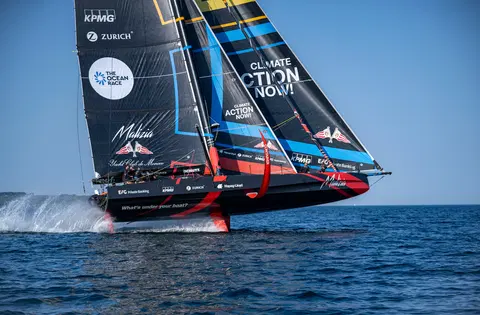
Team Malizia's Atlantic crossing had been shaped by the damage discovered at the inboard end of its port foil. The problem prevented the crew from adjusting the foil's angle of attack correctly, robbing the new yacht of performance and contributing to the loss of an early lead.
Lighter wind and flatter water overnight finally provided an opportunity to improve the system. Following advice from the shore team, Herrmann's crew constructed bumpers inside the foil case to move the foil into a more effective position.
The improvised solution produced approximately 1.6 degrees of positive rake, replacing the damaging negative setting that had been holding the bow too low.
Foil rake changes the angle at which the appendage meets the water. A more effective angle generates lift, raising the bow, reducing the wetted surface of the hull and allowing the yacht to accelerate with less resistance.
Herrmann immediately reported a healthier attitude, with the bow raised and the boat gaining several knots. The repair could not restore the full adjustment range of an undamaged system, although it returned enough performance to make Malizia dangerous during the final approach.
Such work reveals the less glamorous reality behind high-technology ocean racing. Designers create components using advanced software and carbon construction, yet sailors must sometimes repair them at sea with materials carried aboard and advice passed through a satellite connection.
The ability to improvise has defined ocean racing since the earliest Whitbread crews repaired rigs and hulls thousands of miles from assistance. Modern boats may fly above the water, although the sailors remain mechanics, riggers and problem-solvers whenever something fails.
The High-Pressure Roadblock
A high-pressure system generally produces descending air, lighter wind and difficult transitions around its edges. Navigators aim to avoid the quiet centre while positioning the boat where the circulating breeze provides the strongest and most useful direction.
In the Northern Hemisphere, wind circulates clockwise around high pressure. The leading group therefore sailed north of the system, seeking reaching conditions that could carry them east and eventually south-east towards Lorient.
This diversion increased the distance sailed, but distance alone does not determine the quickest route. An IMOCA travelling at 20 knots along a curved path will arrive much sooner than a boat drifting at six knots on the direct line.
Weather models describe the expected development of the system, while routing software combines those forecasts with each yacht's predicted performance. The resulting route remains a recommendation rather than a certainty because small errors in the position or movement of the high can transform the fastest theoretical option.
The leading crews must also consider their rivals. A conservative route may protect the existing position, while a more aggressive course could produce victory or leave the yacht trapped beneath the high.
A Southern Opportunity for the Backmarkers
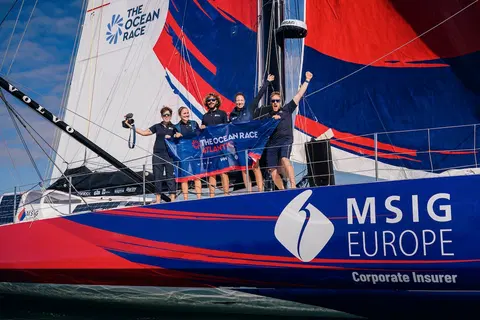
Oliver Heer's Embrace The Challenge and Conrad Colman's MSIG Europe remained 280 and 344 miles behind the leading group respectively, yet their separation created a different strategic opportunity.
The four leaders had invested heavily in the northern route around the high-pressure system. The two trailing boats could approach Lorient more directly if the forecast southern wind arrived as expected.
Embrace The Challenge had lost considerable ground after suffering damage to its mainsail during a reefing manoeuvre. Liz Wardley completed an extensive repair aboard the moving yacht, allowing the crew to resume racing without continued concern over the damaged sail.
Wardley's experience stretches across numerous circumnavigations and demanding professional campaigns. Repairing the mainsail at sea required patience, sailmaking skill and the ability to work within an uncomfortable hull while the race continued outside.
Heer's team could now focus upon finding the fastest direct route rather than moderating its pace to protect the repaired sail. Recovering the full deficit remained unlikely, although the weather offered a chance to reduce a separation created by damage rather than poor sailing.
MSIG Europe faced an even greater speed disadvantage because Colman's yacht was the only non-foiling IMOCA in the race. Its older hull could not match the sustained reaching speeds of the latest designs, but a more direct path gave the New Zealand crew another opportunity to demonstrate tactical persistence.
Backmarkers Rule the Super Sprint
The changing geography of the race produced an unexpected result in Tuesday's Super Sprint. Embrace The Challenge covered the greatest distance during the 20-minute test, with MSIG Europe taking second and Team Malizia finishing third.
The Super Sprint measures distance through the water rather than progress towards Lorient, rewarding the team that extracts the greatest speed from the conditions available during the fixed period.
Heer and Colman benefited from more favourable wind and sea state while the leading boats struggled nearer the high. Their result demonstrated why overall position and immediate boat speed can tell entirely different stories.
Team Malizia's third place strengthened its lead in the Super Sprint series, adding another encouraging result after the improvised foil adjustment.
Winning the sprint competition would provide recognition for Malizia's speed, although the transatlantic finishing order remains the prize that matters most. Herrmann's repaired boat must convert its regained pace into miles towards Lorient while passing three rivals that have shown impressive consistency.
From Whitbread Separation to IMOCA Compression
The closeness of the leading group illustrates how dramatically ocean racing has changed since the first Whitbread Round the World Race departed Portsmouth in 1973.
Those early fleets could become separated by hundreds or thousands of miles, with position reports arriving slowly and crews possessing little reliable knowledge of their rivals. Ramon Carlin's Sayula II won the inaugural race on corrected time after a circumnavigation measured in months rather than days.
Purpose-built maxis gradually replaced many converted production yachts, while satellite navigation, sophisticated weather models and professional shore teams transformed offshore strategy.
The Volvo Ocean Race era introduced increasingly specialised yachts through the Whitbread 60, VO70 and one-design VO65 generations. Crews became smaller, speeds increased and race followers gained access to positions that had once remained hidden for days.
IMOCA yachts joined the round-the-world event in 2022-23, connecting the French tradition of solo ocean racing with the fully crewed heritage of the Whitbread and Volvo races.
The inaugural Ocean Race Atlantic represents the next stage of that development. Four-person gender-balanced crews are driving foiling yachts across 3,000 nautical miles while On Board Reporters transmit the experience from inside the fleet.
The technology has changed beyond recognition, although the essential tactical problem remains familiar. Every navigator must decide whether greater wind justifies additional distance, while every skipper must balance speed against the survival of the boat.
Lorient Waits Beyond the High
Lorient represents more than another finishing port because much of the IMOCA world is based around its harbours, yards and technical workshops. Sailors commonly describe the region as Sailing Valley, reflecting its concentration of designers, builders, sailmakers and professional offshore teams.
For Meilhat and many members of the fleet, reaching Lorient will feel like returning home. Shiraishi's new boat was built in France, Malizia's campaign developed within the same technical community and Clapcich's team also operates from Brittany.
Familiarity will offer little assistance during the final miles. The high-pressure system must move, the new wind must arrive and each crew must choose the correct moment to turn towards the coast.
Four boats remain locked inside a contest that has already survived a punishing low-pressure system, damaged foils, torn sails and exhausting changes of pace. The opening 2,000 miles created the contenders, although the final thousand will decide which campaign understood the Atlantic most clearly.
DMG MORI leads, United by the Ocean waits three miles away, 11th Hour Racing remains within striking distance and Team Malizia has repaired enough of its wounded wing to rejoin the fight.
Lorient lies beyond the quiet air, but nobody has yet found the open door.