The Licence for the Boat
Ofcom issues two kinds of licence for leisure boats. The Ship Radio Licence covers the radio equipment on a particular vessel: a fixed VHF set, handheld VHFs used on that boat, AIS, an EPIRB and other equipment. It is free when applied for through Ofcom’s online licensing portal, or £20 on a paper application, and it stays valid for the lifetime of the vessel. It assigns the boat a call sign and an MMSI, the nine-digit number used for Digital Selective Calling, and both stay with that boat. The licence cannot be transferred: when a boat is sold, the owner surrenders it and the new owner applies for a new one.
The Ship Portable Radio Licence covers one item of portable equipment from each of a limited number of categories, such as a handheld VHF, and can be taken from boat to boat. It does not assign a ship call sign. Ofcom states that it is valid only within UK territorial seas: for using a radio on the high seas or in another country’s waters, including a personal locator beacon or man-overboard device, a Ship Radio Licence is needed.
Ofcom notes that using radio equipment without a licence is an offence, with a penalty of up to £5,000 and/or six months in prison.
The Certificate for the Operator
Both types of licence require that the radio is operated only by, or under the direct supervision of, a person holding a certificate of competence granted on behalf of the Maritime and Coastguard Agency. The minimum is the Short Range Certificate (SRC), which covers VHF and VHF DSC equipment in Sea Area A1, roughly within range of a coast radio station. The RYA administers the SRC for the MCA.
The SRC course takes about ten hours, followed by an exam, and the minimum age is 16. The RYA’s exam fee is £76. The SRC replaced the older VHF Restricted certificate; Ofcom states that holders of the older certificate may still use ship radio but may not use DSC unless they hold an SRC. A certificate holder must produce it if asked by a person authorised by Ofcom or by an overseas authority.
The licence and the certificate are separate: the licence belongs to the boat, and the certificate to the person.
Channels Used in UK Waters
The Maritime and Coastguard Agency’s guidance note MGN 324 sets out how VHF should be used. Channel 16 is for distress, urgency and very brief safety communications, and for calling to establish other communications, which then continue on a working channel. Channel 70 is reserved for Digital Selective Calling and is never used for voice. Port and Vessel Traffic Services channels are for operational messages only.
MGN 324 lists Channels 6, 8, 72 and 77 for ship-to-ship communication in UK waters, and Channel 13 for navigation safety between ships. Channel 80 is the channel most UK marinas use; Channel M (37) is used by some, including Brighton Marina, which answers on 80 or 37.
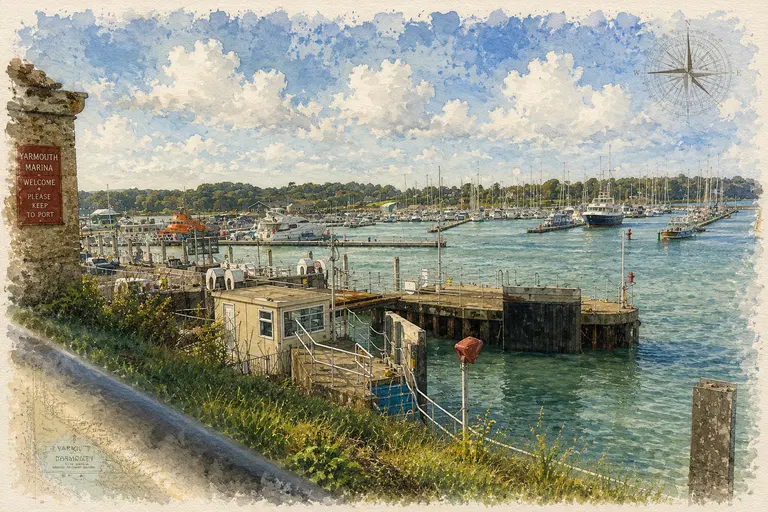
Ports and harbour authorities use their own working channels, which are listed in every Old Sea Dogs harbour guide. Examples on the south coast are Dover VTS on Channel 74, Ramsgate Port Control and Shoreham Harbour Radio on 14, Poole VTS on 14, Newhaven Radio on 12, Cowes Harbour Radio on 69, Yarmouth Harbour on 68 and Lymington Harbour on 66.
| Channel | Use |
|---|---|
| 16 | Distress, urgency, brief safety messages and initial calling |
| 70 | Digital Selective Calling only — never voice |
| 6, 8, 72, 77 | Ship-to-ship in UK waters |
| 13 | Navigation safety between ships |
| 80 (some marinas also M/37) | Marinas |
| 62, 63, 64 (sometimes 10) | Coastguard maritime safety information broadcasts |
| Port channels (e.g. 12, 14, 66, 68, 69, 74) | Harbour authorities and Vessel Traffic Services |
Calling a Marina or Harbour
MGN 324 requires every station to identify itself before each transmission. A routine call to a marina is made on the marina’s working channel, not on Channel 16. It names the station being called, then gives the boat’s own name, and once the marina answers, states the request: for example a visitor berth for one night, with the boat’s length, beam and draught.
Before transmitting, listen to make sure the channel is free. If the marina is busy or does not answer, wait before calling again. Harbour authorities sometimes need a call first: at Dover, boats call Dover VTS on Channel 74 from two miles out before calling Dover Marina on 80, and at Newhaven, boats call the marina on 80 for a berth and then Newhaven Radio on 12 for clearance to enter.
MGN 324 also warns against using VHF to agree collision-avoidance manoeuvres, because of the risk of misidentifying the vessel called, and notes that not all vessels carry AIS.
Distress and Urgency Calls
For distress, the ADMIRALTY small-craft folios set out the call: MAYDAY three times, then the boat’s name, call sign and MMSI, position, nature of distress, assistance required, and the type of boat, number of crew and intentions. Urgency calls begin PAN PAN three times.
A DSC radio connected to GPS sends a distress alert with the boat’s MMSI and position at the press of a button, which is why the MMSI from the Ship Radio Licence is programmed into the set. The Coastguard can also be reached by telephone on 999 in the UK.
Coastguard Safety Broadcasts
HM Coastguard broadcasts maritime safety information, including the inshore waters forecast, gale warnings and navigational warnings. Each broadcast is announced on Channel 16 and then made on Channel 62, 63 or 64 (occasionally 10), depending on the aerial.
Solent Coastguard makes full broadcasts at 07:30 and 19:30 local time, with shorter updates at 01:30, 04:30, 10:30, 13:30, 16:30 and 22:30. Dover Coastguard’s full broadcasts are at 07:10 and 19:10, with updates at 01:10, 04:10, 10:10, 13:10, 16:10 and 22:10. NAVTEX receivers on the south coast pick up the Niton station.
| Station | Full broadcasts (local time) | Example aerials and channels |
|---|---|---|
| Solent Coastguard | 07:30 and 19:30 | Needles 62, St Boniface 63, Portland 63, Newhaven 62 |
| Dover Coastguard | 07:10 and 19:10 | Fairlight 62, Langdon 64 |
Using VHF Abroad
Outside UK territorial seas the boat needs a Ship Radio Licence rather than a Ship Portable Radio Licence, and the operator needs a certificate: the SRC is recognised internationally. In France, the CROSS coastguard centres keep watch on Channel 16 and broadcast weather in French on their own channels, and the marinas at Cherbourg, Calais, Boulogne and Dunkerque work on Channel 9. In the Dover Strait, the Channel Navigation Information Service broadcasts traffic information on Channel 11.
Frequently asked questions
How much is a ship radio licence?
Ofcom issues the Ship Radio Licence free through its online licensing portal, or for £20 on a paper application. It is valid for the lifetime of the vessel.
Do I need an SRC to use a handheld VHF?
Yes. Ofcom’s licences require maritime radio to be operated by, or under the direct supervision of, the holder of a certificate of competence, and the minimum is the Short Range Certificate.
Can I use a Ship Portable Radio Licence in France?
No. Ofcom states that the Ship Portable Radio Licence is valid only within UK territorial seas. Use abroad or on the high seas needs a Ship Radio Licence.
What is VHF Channel 70 for?
Channel 70 is reserved for Digital Selective Calling and is never used for voice.
When does the Coastguard broadcast the inshore forecast?
Solent Coastguard’s full broadcasts are at 07:30 and 19:30 local time and Dover Coastguard’s at 07:10 and 19:10, announced on Channel 16 and made on Channel 62, 63 or 64.