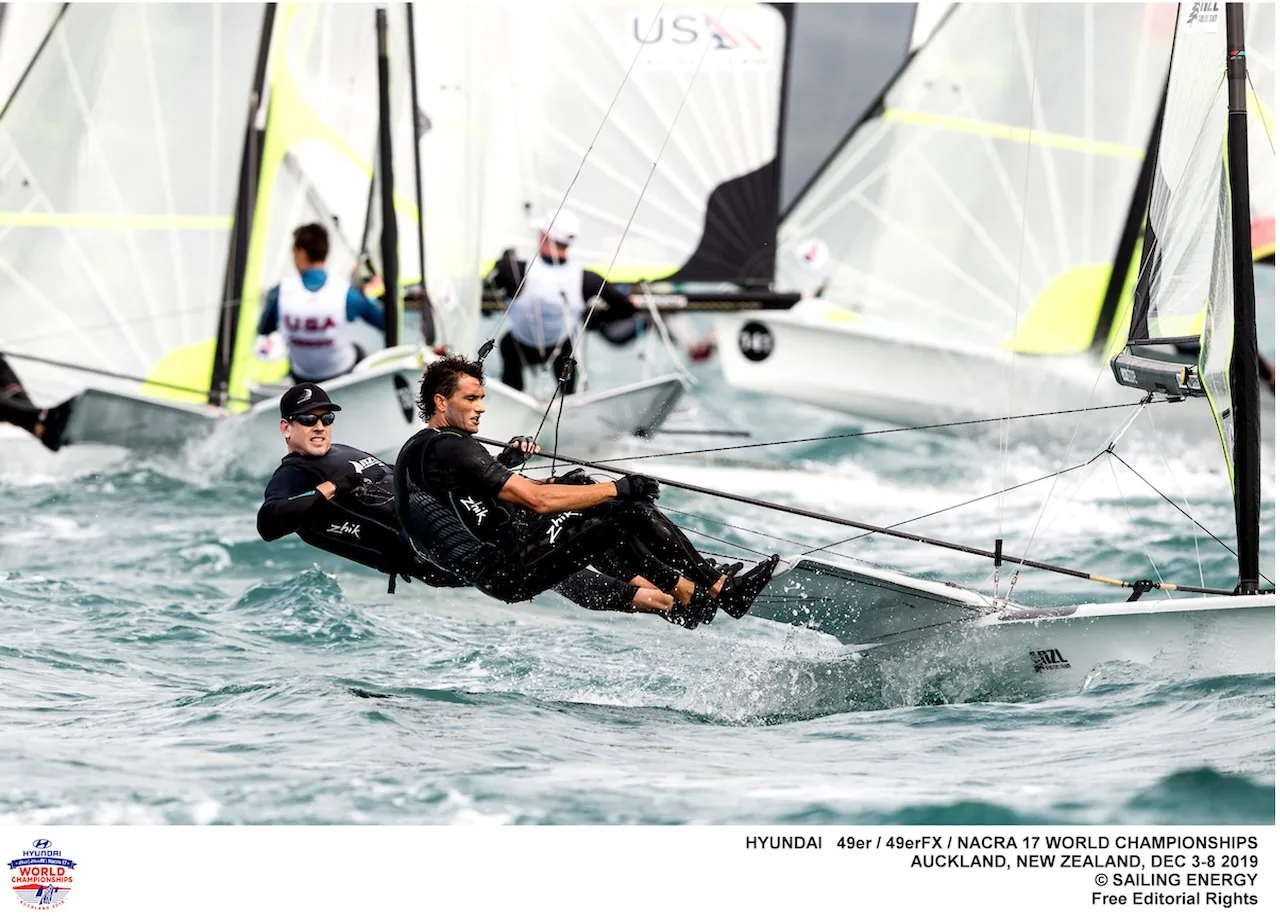
The 49er has spent much of its Olympic history being ruled by kings, yet the first complete season of the Los Angeles 2028 cycle ended without any crew managing to climb onto more than two podiums.
Seven major regattas stretched from the 2025 World Championship in Cagliari to the San Pedro Olympic Classes Regatta on the future LA28 waters. Those events produced 21 podium places shared between 16 crews representing 15 nations across five continents. Nobody reached three podiums, nobody made six top tens and no crew established the dominance once regarded as almost normal within the class. Seb Menzies and George Lee Rush of New Zealand won the 2026 World Championship in Quiberon and the European Championship in Eckernförde. Germany’s Richard Schultheis and Fabian Rieger claimed victories at the Trofeo Princesa Sofía in Palma and the San Pedro regatta. Those two crews led the season by winning twice, although neither converted that success into a third podium. Behind them waited enough competitive depth to make every start line uncertain.
Sixteen Crews Sharing Twenty-One Podiums
Only five teams managed two podium finishes across the seven major regattas. Menzies and Lee Rush completed their world and European championship double, while Schultheis and Rieger combined victories in Palma and Los Angeles. Americans Nevin Snow and Ian MacDiarmid reached the podium twice, as did Dutch former world champions Bart Lambriex and Floris van de Werken. Britain’s James Grummett and Rhos Hawes completed the group by finishing second at both the European Championship and San Pedro. Every other podium crew appeared once. Such distribution is particularly unusual within a technical skiff class where superior boat handling, established coaching and refined equipment settings have traditionally allowed leading partnerships to dominate for several seasons.
Five crews won the seven regattas. Diego Botín and Florián Trittel secured the 2025 World Championship in Cagliari, while Menzies and Lee Rush won at Quiberon and Eckernförde. Schultheis and Rieger prevailed in Palma and San Pedro, with China’s Zaiding Wen and Tian Liu winning in Hyères before Joshua Richner and Nilo Schärer of Switzerland took Kiel Week. The geographical spread was equally striking. Austria, Britain, China, Denmark, France, Germany, Ireland, Israel, the Netherlands, New Zealand, Poland, Spain, Switzerland, Uruguay and the United States all reached a podium. Thirty different crews from 18 nations recorded at least one top-ten finish, a remarkable figure when a Gold Fleet contains only 25 boats.
Deep Fleets and Few Easy Races
These results did not emerge from small or weakened entry lists. The 2025 World Championship in Cagliari attracted 84 boats, while 101 teams competed in Palma. Quiberon assembled 82 crews for the 2026 Worlds, Kiel Week welcomed 90 and the European Championship gathered 93. Grummett and Hawes joined Schultheis and Rieger as the most consistent crews of the period, with both teams recording five top-ten results from seven events. Nobody managed six. That absence of sustained dominance separates the current season from earlier periods when the leading teams could expect to remain close to the podium even during an imperfect week.
A modern 49er fleet punishes small errors immediately. A poor start places the boat in disturbed wind, one mistimed tack can lose several lengths and a difficult final approach may turn fifth into fifteenth before the finish. Speed remains essential, although possessing speed no longer guarantees control of the regatta.
The Class Once Belonged to Dynasties
The 49er entered Olympic sailing at Sydney 2000 after Australian designer Julian Bethwaite created a skiff intended to reward athleticism, technical precision and fearless handling. Chris Nicholson established the first great dynasty by winning three consecutive world championships between 1997 and 1999. Spanish sailors Santiago López-Vázquez and Javier de la Plaza then won the 2000 Worlds, although Finland’s Jyrki Järvi and Thomas Johanson claimed Olympic gold in Sydney. British sailors Ian Barker and Simon Hiscocks took silver, while Jonathan and Charlie McKee secured bronze for the United States. None of the three Olympic medal nations had won a world championship during that first cycle.
The years that followed produced a succession of celebrated champions. Spain’s Iker Martínez and Xabier Fernández won gold at Athens 2004 before taking silver at Beijing four years later. Australians Nathan Outteridge and Iain Jensen dominated the London 2012 cycle, with Outteridge collecting four world titles as a helm between 2008 and 2012 before winning Olympic gold on the waters of Weymouth and Portland.
Peter Burling and Blair Tuke then established the most commanding run in class history. The New Zealanders won four consecutive world titles between 2013 and 2016 before securing Olympic gold in Rio. Their control went beyond results because they changed expectations surrounding preparation, athleticism and high-speed decision-making. Rivals frequently entered regattas believing silver might be the realistic prize. Lambriex and van de Werken created another dynasty by winning three consecutive world championships from 2021 through 2023. Their success gave the Paris cycle a familiar hierarchy even while the fleet beneath them remained exceptionally deep. The current cycle has produced two world champions from two nations in two seasons, with neither champion dominating the year surrounding that victory.
Why the Fleet Has Become So Close
Snow believes the leading explanation begins with boat speed. More crews are now sailing close to the theoretical performance limit of the 49er, including teams near the front of Silver Fleet. Equipment variation has reduced following improvements introduced after the Tokyo cycle. Masts have become more consistent, while upwind sails built upon fixed moulds offer less opportunity for performance differences between individual pieces of equipment.
Coaching has also become broader and more sophisticated. Video captured by class cameras, broadcasters and individual coaches allows sailors everywhere to study manoeuvres, body movements and tactical decisions once visible only to well-funded national programmes. The coaching fleet at the Quiberon World Championship illustrated how much knowledge has moved from the racecourse into support boats. Thirty-five of the 98 registered coaches were former Olympians, while ten had won 13 Olympic medals between them.
Three were Olympic champions: Fernández, Järvi and Spanish Nacra 17 gold medallist Antón Paz.
The sailors who created earlier golden generations are now teaching their knowledge throughout the fleet, reducing the advantage once held by a small number of established nations. Schultheis extends that argument further. Leading crews previously possessed enough speed and boat handling to survive a week of ordinary tactical sailing. The current fleet requires winners to execute every part of the regatta successfully because technical competence merely preserves the opportunity to compete. Five different winners produced their finest performances at different events. Nobody carried one decisive advantage across every wind range and venue.
A Calendar That Punished Specialists
The season offered strong wind, drifting light air, offshore breeze, unstable pressure and steadier open-water racing, sometimes within the same regatta. A crew specialising in one range could win races without sustaining a complete campaign. Heavy-weather speed offered limited protection when the next event demanded delicate movement through light air. The seven-regatta schedule therefore rewarded adaptability while exposing every weakness. Teams needed reliable starting, tactical patience and confidence across a wide variety of sea states.
That diversity also helps explain why podiums circulated so widely. A crew perfectly suited to one venue could defeat the established leaders, yet the advantage rarely travelled intact to the next event.
Did the Scoring Format Create the Parity?
Palma, Hyères and Kiel used a scoring format that compressed the qualification phase. After the fleet divided into Gold and Silver groups, normal qualification points were removed. Each crew carried its qualification rank into the final stage as a single score, meaning the leading qualifier started with one point, second with two and the remaining positions continued accordingly. Such a system creates an obvious concern because several days of racing can be reduced to one number, potentially changing who wins the regatta. A conventional rescoring of all individual races, using one discard without resetting the standings, changed two winners.
Snow and MacDiarmid would have taken Palma instead of Schultheis and Rieger, while France’s Erwan Fischer and Clément Péquin would have won Hyères rather than Wen and Liu. Richner and Schärer remained the Kiel Week winners under either system. The wider pattern barely changed. Sixteen different crews still occupied the podiums, nobody achieved three podium finishes and the revised season produced six separate winners rather than five.
The format influenced two trophies, but it did not manufacture the remarkable competitive depth.
The Missing Kings May Return
Any argument surrounding a new era must acknowledge the leading crews who stepped away. Botín and Trittel paused their 49er campaign during 2026 because of commitments involving the America’s Cup and Spain SailGP Team. The Olympic champions intend to return for the 2027 World Championship in Gdynia. Lambriex spent time away from the boat after becoming a father, returning late in 2025 before recording four top-ten finishes across the seven analysed events, including bronze at Quiberon. Fischer also stepped away following the birth of his child, leaving Péquin to sail temporarily with Fischer’s brother Kevin. The original partnership nevertheless won Palma in 2025 and took bronze in Hyères during 2026.
The fleet experienced a similarly open year after Burling and Tuke departed following Rio 2016. Šime and Mihovil Fantela then won the 2018 World Championship, and a recognisable hierarchy gradually returned. The same could happen during the next two seasons. Returning champions may reassert themselves, while one of the current contenders could turn repeated top tens into a sustained run of podiums.
For now, uncertainty remains the defining feature.
Fifteen Nations Chasing Twenty Places
Olympic qualification will transform sporting openness into unforgiving arithmetic. Only 20 nations will contest the men’s skiff event at Los Angeles 2028, with one boat permitted per country. The United States receives the host quota, leaving the remainder to be distributed through the World Championship, continental qualification and the Last Chance Regatta. Eight national places are due to be awarded at the 2027 Sailing World Championships in Gdynia, scheduled from 22 July to 1 August. Six will be decided through continental qualification, with five remaining opportunities expected at the Last Chance Regatta in Europe during early 2028. Eleven of the 15 podium nations from the opening season are European, yet Europe receives only one continental qualification place. Crews that fail to secure one of the eight places in Gdynia may therefore find themselves fighting an exceptionally strong collection of rivals for the final five tickets.
The official World Sailing qualification document sets out Gdynia’s role within the LA28 qualification pathway. At least one nation that reached a major 49er podium during this opening season will miss the Olympic Games. The depth of the top-ten list suggests several more strong programmes may suffer the same fate.
The Road Tightens From Palma
The fleet now receives its only substantial break before the qualification campaign begins in earnest. Racing resumes at the Trofeo Princesa Sofía in Palma on 26 March 2027, followed by the French Olympic Week in Hyères during April. Dutch Water Week arrives at the end of May, with Kiel Week following in June.
The World Championship in Gdynia brings the first major allocation of Olympic places during late July. Three weeks later, crews will race on the Los Angeles Olympic waters during the Test Event from 27 August to 4 September. The European Championship follows at La Palma in the Canary Islands during November 2027, before another World Championship in Tangier from 31 January 2028.
The Last Chance Regatta and the Olympic Games will complete a sequence offering little space for recovery, injury or an extended loss of form.
A Fleet Without a Favourite
Menzies and Lee Rush won the two championships of 2026, while Schultheis and Rieger claimed two of the other major trophies. Neither partnership reached a third podium. Three of the seven events were won by teams that lifted no other trophy during the season. Two dozen crews can arrive in Palma next March with credible reasons for believing the next victory might belong to them. Several possess championship medals, while others have already demonstrated enough pace to defeat every established name.
The first 49er generation lived with the same uncertainty because crews were still discovering how to sail the boat. Twenty-eight years later, the equipment is understood in extraordinary detail, but knowledge has travelled so widely that dominance has become harder to maintain.
Olympic skiff racing once belonged to kings. The road to Los Angeles currently belongs to anyone quick enough to seize it.