On a quiet mid-ocean morning the only sounds should be the rush of water past the hull and the occasional creak of rigging under a steady breeze. For decades blue-water sailors have accepted that those peaceful hours would eventually be interrupted by the clatter of a diesel engine or the high-pitched whine of a generator as batteries ran low. That compromise is now being removed from the equation for owners of new Oyster yachts. Oyster Yachts has added the Remoran Wave 3GS hydrogenerator, complete with the EasyLift system, as a standard-fitted option, supplied and supported throughout the United Kingdom by Advance Yacht Systems. The decision places proven, silent charging technology at the heart of a marque already synonymous with serious ocean passagemaking.
The principle of drawing electrical power from a yacht’s own motion is far from new. Early experiments with towed generators and fixed shaft systems appeared on long-distance cruising yachts in the 1970s and 1980s, when owners of heavy-displacement vessels first sought ways to reduce engine hours on passages measured in thousands of miles. Those early units were often heavy, inefficient at low speeds and prone to fouling or damage. Over successive decades the technology matured through lighter materials, improved turbine designs and more sophisticated regulators. The modern hydrogenerator converts the energy of water flowing past a submerged impeller into usable current with far greater efficiency, beginning to charge at speeds as low as three knots and delivering meaningful output once the yacht is properly under way.
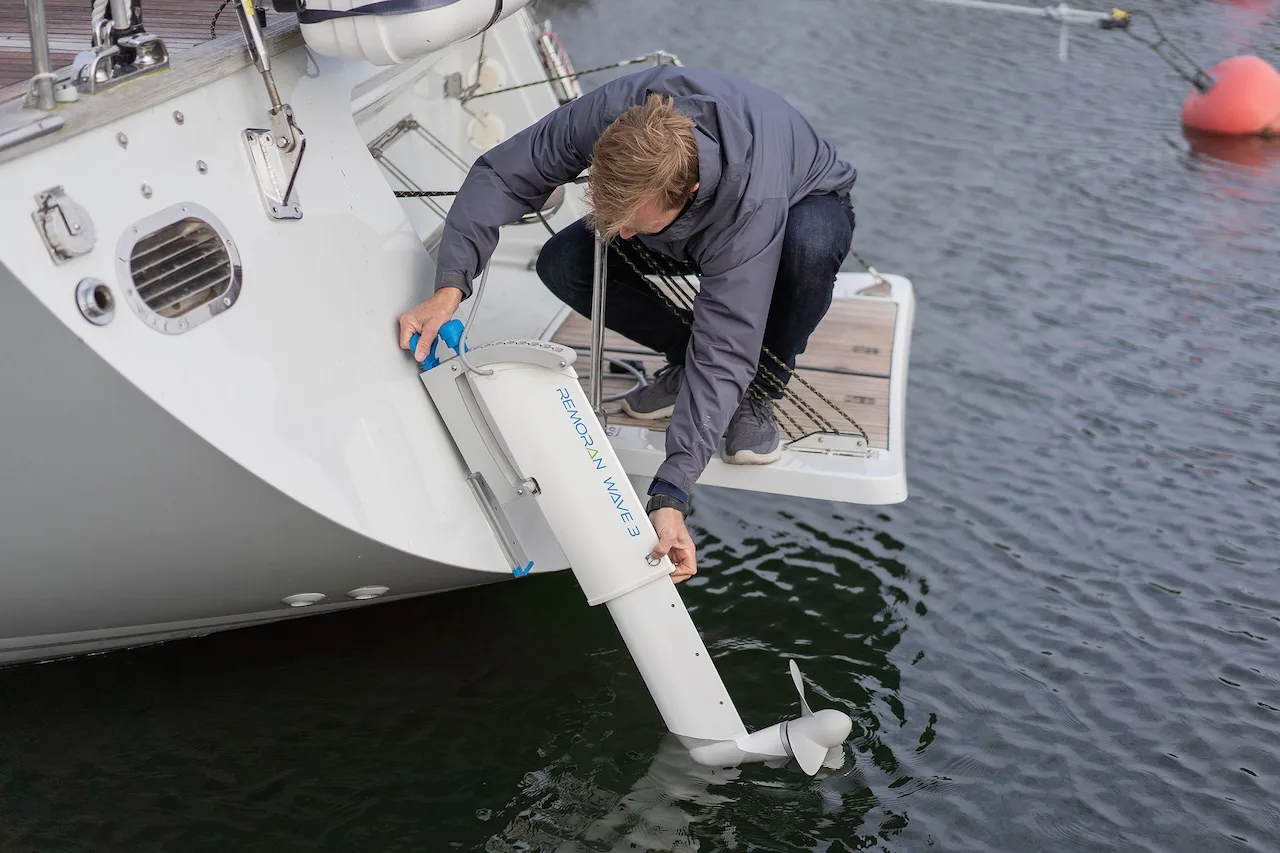
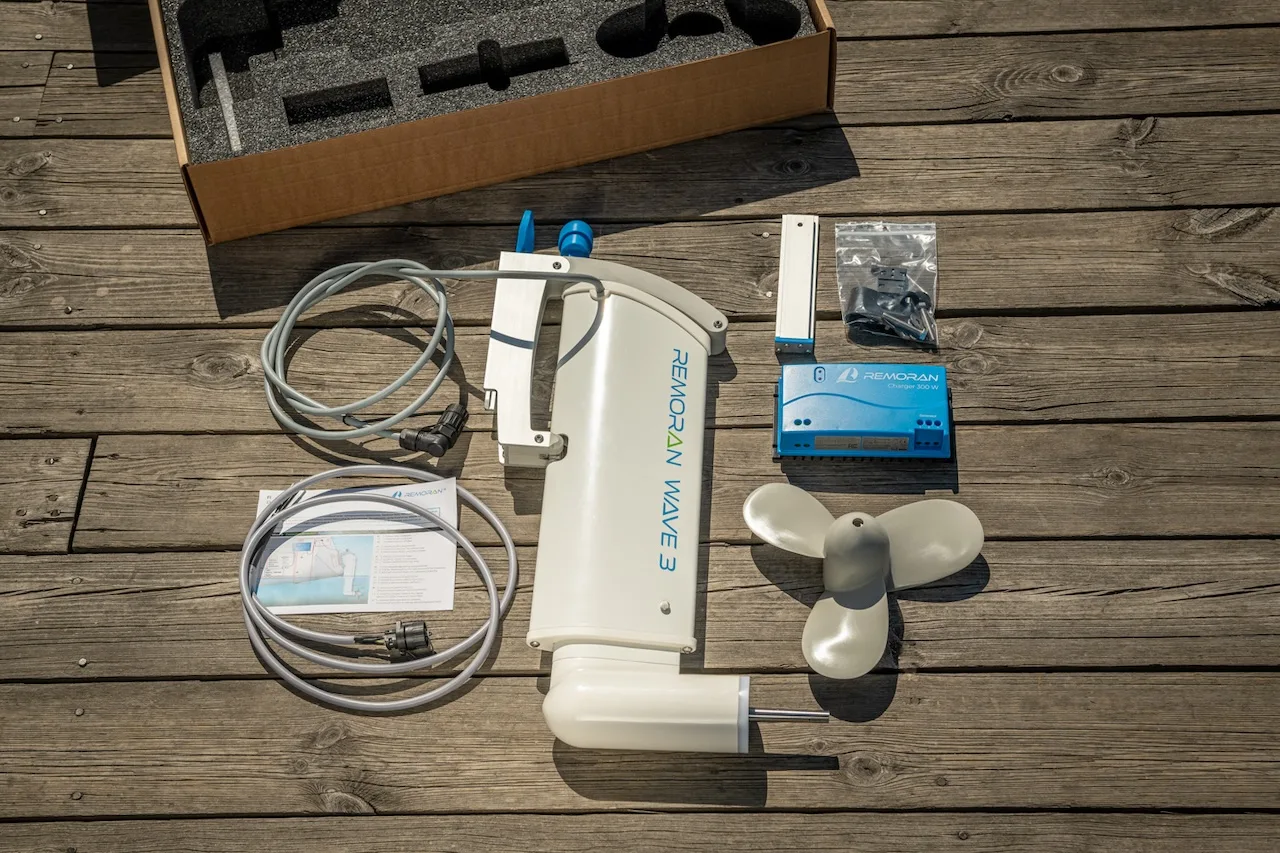
On an Oyster, a vessel designed from the outset for continuous ocean miles rather than short coastal hops, such a system finds a natural home. The Remoran Wave 3GS is a compact, transom-mounted unit weighing just 7.5 kilograms. It can be angled between zero and forty degrees to match the geometry of the stern and begins producing power at three knots of boat speed, feeding up to three hundred watts into a twelve-volt or twenty-four-volt battery bank. Lead-acid, AGM and lithium chemistries are all supported, giving owners flexibility in their electrical architecture. Monitoring is handled through a Bluetooth connection to the Remoran app, so charge status and output can be checked from the cockpit or the saloon without leaving the comfort of the interior. The unit carries a two-year warranty, a practical detail for yachts that may spend months or years between professional service ports. Several owners of the new Oyster 595 have already specified twin units, recognising that on longer passages the combined output provides a reliable means of keeping the house bank topped up while the yacht simply covers the miles.
Deployment and recovery have traditionally been the practical drawbacks of any transom-mounted hydrogenerator. The EasyLift option addresses this directly. A one-hundred-centimetre lifting rail and one-hundred-and-fifty-centimetre lifting rod allow the turbine to be lowered into the water and raised clear again from the safety of the deck. Adjustment is intended for boat speeds below ten knots, so the operation remains controlled and straightforward even when the yacht is making good progress. Once raised, the unit sits clear of the water, protected from the worst of any residual following seas or harbour manoeuvres. The combination of light weight, adjustable angle and deck-operated lift removes many of the traditional objections that once kept hydrogenerators off production yachts.
Around-the-world sailor Mike Hutchinson has already demonstrated the real-world durability of the Wave 3GS on his own yacht Distraction. After thirty-one thousand miles the unit required almost no attention beyond a single occasion when polypropylene fouling needed clearing from the propeller. That kind of set-and-forget reliability matters on a serious blue-water yacht, where every system must earn its place by reducing rather than adding to the workload. Nick Creed, Supply Chain Project Manager at Oyster Yachts, observes that owners increasingly wish to spend longer periods away from the dock, lying in remote anchorages and making longer passages with far less reliance on the main engine. The Wave 3GS provides a proven method of keeping the house bank charged while under sail, reinforcing the self-sufficiency for which an Oyster is designed. Rob Cotterill, Director at Advance Yacht Systems, notes that the unit has already proved itself on ocean passages and that an Oyster option is a natural home for the technology. Samuli Aura, CEO of Remoran Oy, adds that Oyster’s yachts are built for long, comfortable passagemaking and therefore form ideal platforms for the Wave 3GS.
Oyster Yachts itself has spent more than fifty years refining vessels intended for exactly this kind of independence. Each yacht is handcrafted in the United Kingdom, combining traditional boatbuilding skills with modern production methods. The resulting boats are known for structural strength, ocean-going performance and the ability to carry their owners anywhere in comfort and safety. Collectively the fleet has logged more than twenty million blue-water miles and completed over one hundred circumnavigations. That pedigree creates a clear expectation among owners that systems fitted to an Oyster will match the same standards of durability and thoughtfulness. Adding a hydrogenerator that begins charging at three knots and can be managed from the deck without drama is a logical extension of that philosophy.
The wider significance of the decision lies in the gradual shift toward energy independence on cruising yachts. As more sailors choose to linger in remote anchorages or to cross oceans without the constant accompaniment of a running engine, the ability to harvest power silently from the yacht’s own motion becomes increasingly valuable. Solar panels have their place, yet they are limited by night, cloud and the physical space available on deck. A hydrogenerator works whenever the yacht is moving at a modest speed, day or night, in any weather. On a well-found Oyster making steady progress under sail, the continuous trickle of current can keep domestic systems, navigation electronics and refrigeration running without the need to start the diesel. The result is quieter nights, cooler engine rooms and fewer hours spent listening to machinery.
Advance Yacht Systems, the UK specialist that supplies and supports the Remoran range, already represents a portfolio of onboard power, climate and water systems including Paguro, Westerbeke, Cristec, Fogstar, Dessalator and Frigomar. Their role ensures that Oyster owners have access not only to the hardware but to technical advice, spare parts and after-sales service. That continuity of support is essential for yachts that may be operating thousands of miles from their home port for extended periods.
Looking ahead, the quiet addition of the Remoran Wave 3GS to the Oyster options list signals a broader evolution in what serious passagemaking yachts are expected to provide. Owners who once accepted engine noise as the price of electrical independence can now choose a different balance. The water flowing past the hull becomes a continuous source of power, the batteries stay charged, and the diesel remains silent until it is truly needed. On an Oyster, built for the long haul and already proven across every ocean, that silent contribution fits the character of the yacht itself.