
Southern Escape Complete as the 2026 RORC Transatlantic Fleet Locks into the Trade Winds









Since departing Lanzarote on Sunday, the fleet initially compressed along the North African shoreline, bows edging steadily southwest as the wind gradient strengthened. By Day 3, that compression had eased. Courses opened, spacing increased, and the race slipped into its first true offshore phase — long miles, systems checks, watch routines and the steady accumulation of distance across open water.
This is where the RORC Transatlantic Race begins to reveal its character.
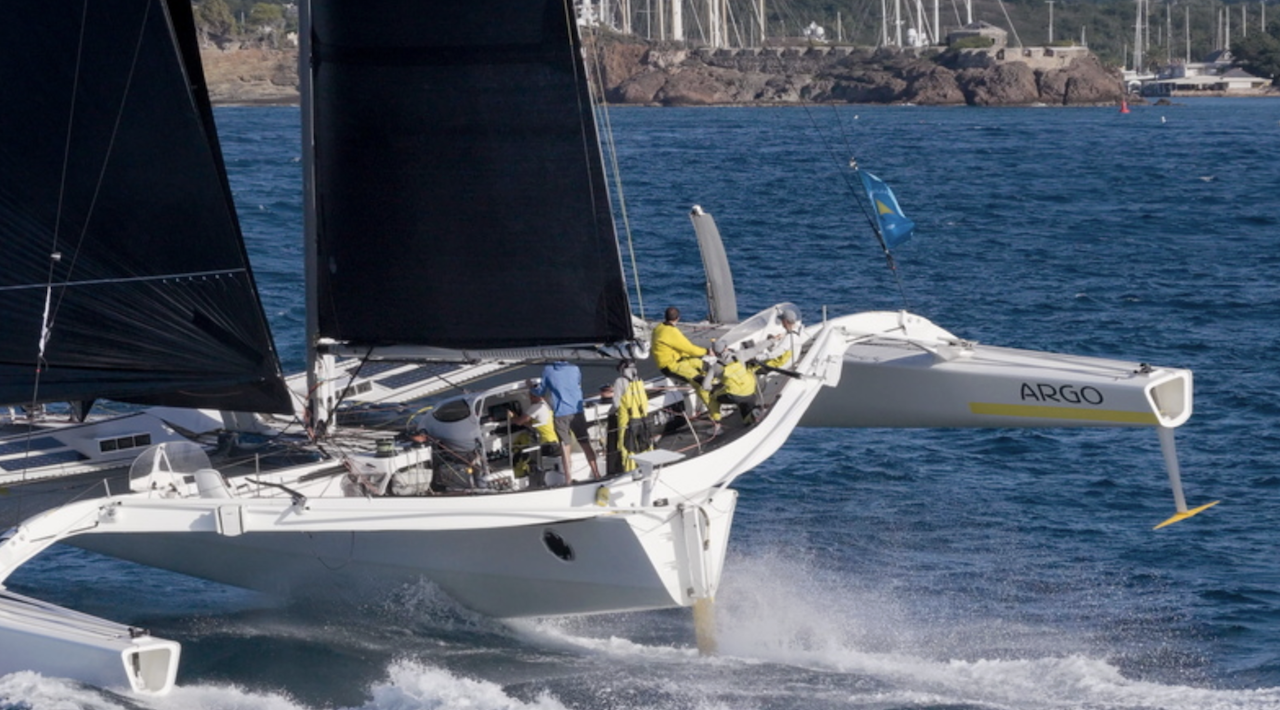
Argo and Zoulou light the blue touchpaper
At the sharp end, the MOD70 trimarans Argo and Zoulou are already deep into their element. With the breeze building, both boats have been posting eye-catching numbers, regularly pushing into the high twenties and touching over 30 knots as they run into stronger pressure.
As of 1010 UTC on Day 3, Argo held an advantage of around 40 nautical miles over Zoulou, with both multihulls entering a wind band that promises sustained, high-speed running over the next several days. The tone has been set early — wet decks, relentless pace and an Atlantic that suddenly feels very wide indeed.
“We’re still going downwind, which is good — 1700 miles to go and life on board is good,” said Sam Goodchild from Argo. “It’s a bit bumpy, which actually makes driving quite fun.”
Crewmate Charles Ogletree echoed the sentiment: “Argo is ripping along. It’s very wet in the big waves, but we’re having fun — and we’re nearly halfway to Antigua already.”
Raven commits to high-mode efficiency
Among the monohulls, Raven continues to assert herself at the head of the IRC fleet. Over the past 24 hours she logged a formidable 550-nautical-mile day, averaging 22.92 knots, while sailing a noticeably higher mode than many of her rivals.
This is Raven at her most efficient — operating at her best VMG angle and fully exploiting the benefits of her foils rather than chasing lower, faster-looking angles.
Navigator Will Oxley explained the logic: “We’re sailing a higher angle — maybe 130 degrees compared to others at 145 — so we’re definitely sailing more miles. But that’s Raven’s VMG mode. If we sail lower, we slow down, just like a multihull.”
“The sails are trimmed to apparent wind angle, and most of the time we have very little heel. Communication between the driver, trimmers and foil controller is all about staying locked into that apparent wind, with the traveller constantly adjusted to maintain the right heel angle.”
It’s disciplined, repeatable sailing — exactly what long Atlantic races reward.
Palanad 4 leads the IRC numbers
Just behind Raven, Palanad 4, skippered by Antoine Magre, is sailing a quietly impressive and measured race. At this early stage, she sits IRC overall leader on corrected time, demonstrating the consistency and positioning that so often matter more than raw pace over 3,000 miles.
“Conditions have been fantastic so far — clear nights, big stars and more breeze than we expected,” said Magre. “The boat is right on her polars and we’re very happy with how she’s performing.”
“Strong trade winds mean big speeds, but also big loads, so the focus is on sailing fast while protecting the boat. We did break a sheet yesterday, but there’s still a long way to go. We’re fully focused on our race and staying in our lane.”
It’s a classic Atlantic mindset: patience now, options later.
Jackknife settles into open-ocean rhythm
Further back in the fleet, Jackknife, co-skippered by Sam and Andrew Hall, has made a solid transition from the Canary Islands phase into true blue-water sailing. Currently leading her class and sitting fourth overall, her early progress reflects a balanced approach — pushing when it makes sense, preserving the boat when it doesn’t.
“We had a really good first 36 hours and the boat feels strong,” said Sam Hall. “The reaching conditions favour the bigger, more modern designs right now, but once we get back into VMG sailing it should get interesting.”
“There’s a long way to go and plenty of variables ahead, but we’re happy with where we are and how the boat is going.”
Superyachts: classic lines, modern miles
Among the largest yachts in the fleet, Swan 128 Be Cool, skippered by Luca Serra, has found the breeze she was built for. Reporting close to 30 knots of wind, Be Cool has remained fully under control while sustaining boat speeds over 20 knots as she stretches south and west.
She now sits almost 80 miles south of her superyacht rival Linnea Aurora, and around 50 miles ahead on the water. After IRC correction, however, Linnea Aurora currently holds a 13-hour advantage, keeping the duel finely balanced.
Despite being the largest yacht in the race, Linnea Aurora has enjoyed an excellent opening act. Navigator Tom Robinson described ideal conditions for settling into life offshore.
“So far, so good. The weather has aligned well for this race. Conditions have been gentle, which has been perfect for easing the crew into life offshore — especially as many on board are crossing an ocean for the first time.”
“It’s been sunny, with clear nights and plenty of stars, making the transition into watch systems and life at heel a positive experience.”
From a tactical perspective, Robinson notes that the race has been shaped more by big-picture positioning than direct boat-on-boat moves.
“A developing low near the Bay of Biscay compressed the Azores High over the Canaries, shortening the usual wind shadow and allowing boats to head west sooner than expected. That’s why you’re seeing such a wide north–south spread across the fleet.”
“We’re now pushing west at best speed, aiming to hook into the clockwise rotation of the Azores High and set up the final approach to Antigua.”
The Atlantic opens up
As the fleet enters its first sustained trade-wind phase, the defining traits of each campaign are beginning to show. The next few days promise stronger breeze, bigger seas and rapidly increasing daily mile counts, as crews settle fully into the long, demanding cadence of an Atlantic crossing.
The race is still young — but the direction is set, the patterns are forming, and the ocean is now very much in charge.