
From Record-Breakers to Corinthian Triumphs, the 2026 RORC Transatlantic Race Sets a New Benchmark









From overall and class victories under IRC, to record-breaking multihull and monohull performances, the race showcased the depth of both professional and Corinthian talent across an international fleet. It was also a race marked by tragedy, serving as a sobering reminder of the inherent risks of offshore sailing and the importance of safety, experience and mutual support at sea. Against that backdrop, the achievements of the competitors stand as a powerful testament to endurance, teamwork and respect for the ocean.
Innovation proven: a father-and-son overall victory
Overall victory on IRC corrected time went to Palanad 4, the Mach 50 owned by Olivier Magre and skippered by his son Antoine Magre. Their success was not only a triumph of performance, but of belief—belief in a bold scow-bow design and in a shared campaign built on trust and preparation.
“Winning the RORC Transatlantic Race with my son is a dream come true,” said Olivier Magre. “As a father, it is the greatest result I could imagine in sailing. I am incredibly proud of Antoine. On the boat, he is the boss—he makes the decisions and the crew follows him.”
For Antoine, the result validated the concept behind the boat. “This race is a very strong first proof of concept for the Mach 50,” he said. “We believed in the potential of the scow-bow under IRC, but it had to be proven offshore. Winning overall here really sets the bar. To do it with my father on board is something I will never forget.”
Argo: record-breaking pace in a brutal MOD70 duel
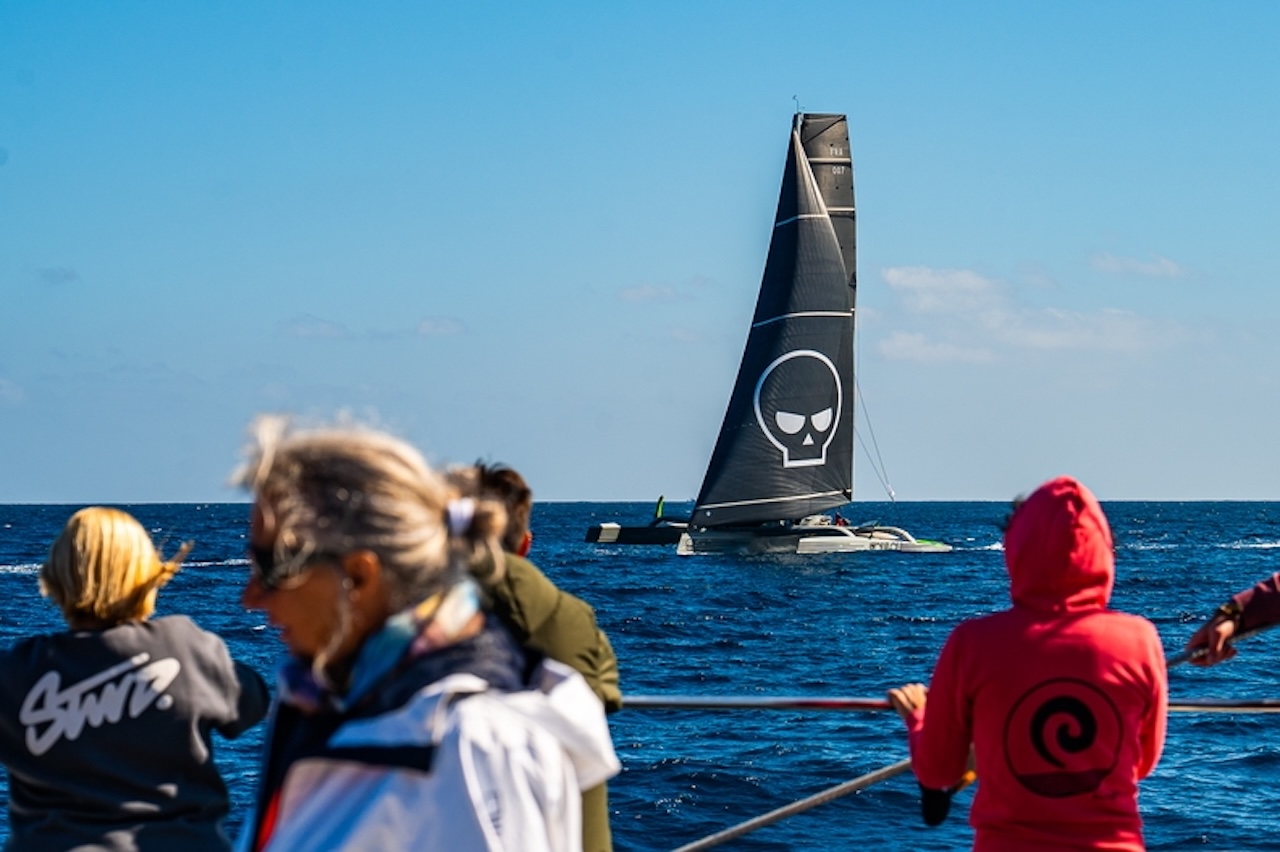
At the sharp end of the fleet, the MOD70 trimarans delivered one of the most intense match races the Atlantic has seen. Argo set a new Multihull Race Record for the Lanzarote–Antigua route, stopping the clock at 4 days, 23 hours, 51 minutes and 15 seconds after a relentless duel with Zoulou, finishing just 2 hours and 32 minutes ahead.
Skipper Chad Corning described a race fought at the limit. “We knew it was going to be close, and that’s exactly how it played out. We built a small lead early, but they pushed hard the whole way. The intensity never dropped.”
“Once we hit the trades, it went to another level,” he added. “Thirty knots day after day, long dark nights—like skiing a black run blindfolded. This race was won in the preparation. Months of refit work at Marina Lanzarote paid off when it mattered most.”
Raven: Monohull Line Honours at sustained 30-knot speed
The 34-metre Baltic 111 Raven, skippered by Damien Durchon, delivered one of the defining performances of the race. Raven claimed Monohull Line Honours, won the IMA Transatlantic Trophy, and set a new Monohull Race Record of 6 days, 22 hours, 27 minutes and 47 seconds—the first foil-assisted monohull of her size to complete a transatlantic race.
“Raven is incredibly stable,” said Durchon. “The better she performs, the safer she becomes. The side foils generate enormous righting moment, backed up by water ballast and hull-form stability. If a foil stalls, she simply behaves like a conventional yacht.”
“At 25 knots she already feels fast,” he added. “Above 30 knots, you’re moving quicker than the waves themselves. It’s demanding sailing—but remarkably manageable.”
Ino Noir: grit and consistency deliver second overall
Ino Noir, the Carkeek 45 owned by James Neville, finished in 9 days and 6 hours, securing second overall under IRC. The result extended a strong sequence of podium performances and underlined the value of consistency in a relentlessly tough race.
“It was windy the whole way with a brutal sea state,” Neville said. “There was no let-up. We pushed hard early, but a few days out we started breaking equipment and had to rein it in. Finishing second overall after that intensity feels very satisfying.”
Jackknife: a standout Corinthian story
Few performances captured the spirit of the race quite like Jackknife, the 30-year-old J/125 owned and skippered by Sam Hall, sailing with his father Andrew Hall. After 11 days and 13 hours at sea, Jackknife finished third overall under IRC and won IRC Two—one of the most impressive results of the entire fleet.
“Getting Jackknife across the Atlantic safely was always the first goal,” said Andrew Hall. “She’s one of the smallest and oldest boats here, but it was always Sam’s dream.”
“Winning IRC Two and finishing third overall feels incredible,” added Sam. “We hand-steered the whole way. It was about endurance, balance and looking after the crew. Racing this boat together as father and son just felt right.”
Double-handed honours and superyacht success
In the Double-Handed division, victory on corrected time went to Kornog 2, the Pogo 12.50 sailed by Gilles Colubi and Ivan Osselin, completing the crossing in 13 days and 1 hour. Finnish entry Stimmy, sailed by Ari Huusela and Annika Paasikivi, completed the podium after 18 days and 6 hours, embodying the adventure-driven ethos of the class.
In the Superyacht Division, the Hoek-designed Linnea Aurora emerged as the best-placed yacht under IRC, earning the Superyacht Trophy after an elapsed time of 11 days and 13 hours.
“Managing a 160-tonne yacht for 3,000 miles is a real challenge,” said Sailing Master Magnus Woxen. “But teamwork, preparation and spirit carried us through. Reaching Antigua as division winners is hugely satisfying.”
Maxitude and the Yacht Club de France Trophy
Maxitude, the Lift 45 owned and skippered by Xavier Bellouard, finished in 10 days and 12 hours, securing the Yacht Club de France Trophy for the best-placed YCF member under IRC.
“When you see the names on that trophy, they’re skippers I deeply admire,” said Bellouard. “To be associated with it is very special. This race represents one of the greatest challenges in offshore sailing.”
A race dedicated to Walross 4
The 2026 RORC Transatlantic Race is dedicated to the crew of Walross 4. Following a tragic mid-Atlantic accident resulting in the loss of a crew member, the team completed their crossing with immense courage and professionalism. The RORC, fellow competitors, Calero Marinas and the Antigua Yacht Club have all expressed their deepest condolences to the crew member’s family and to the Walross 4 team.
Looking ahead
The 2027 edition of the race will start from Marina Lanzarote in January, continuing the partnership with the International Maxi Association and the Yacht Club de France. As part of the RORC Season’s Points Championship, the race remains a cornerstone of global offshore competition.
In 2026, the Atlantic delivered speed, innovation, heartbreak and triumph in equal measure. Above all, it reminded everyone involved that offshore racing is never just about the finish line—it is about how you cross the ocean to reach it.