

From Nevis to St. Barts the Caribbean 600 Turns Tactical as Class Battles Intensify









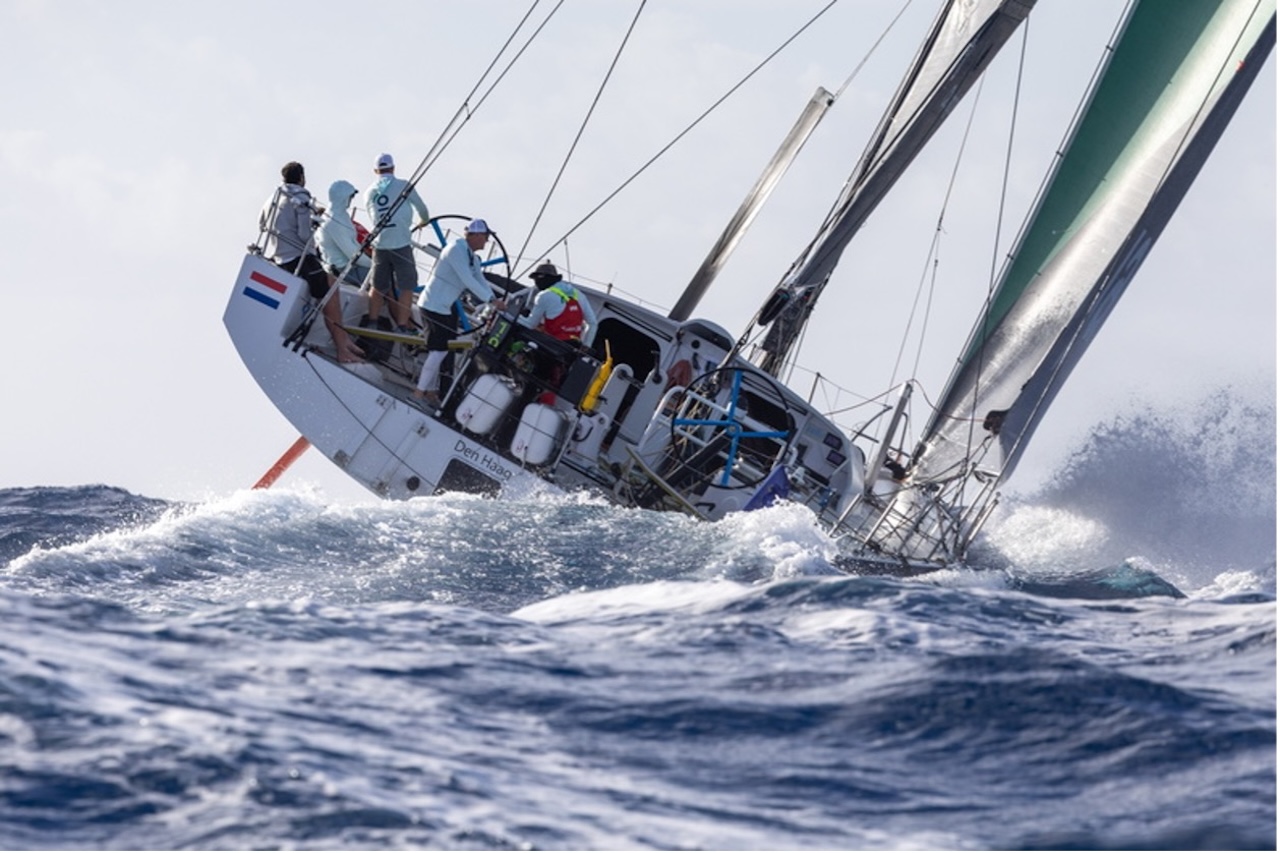
From Nevis to St. Barts, the race has begun to fragment into high-speed duels, tactical compression zones and developing class battles. Each island transit reshapes the leaderboard. Each pressure line rewards patience and punishes impatience.
And this year’s edition is proving especially tactical.
Instead of the classic reaching angles that often dominate the Caribbean 600, the trade winds have been sitting further south-east than usual. That subtle shift has changed the geometry of the course, forcing crews into longer periods of upwind sailing and tight reaching.
It’s a race of VMG, positioning and discipline.
The result is a fleet that remains remarkably compressed across multiple divisions.
The race may be beginning to take shape — but it is far from settled.
The Northern Islands: Where the Race Tightens
The northern arc of the course is always a decisive phase of the Caribbean 600.
From Antigua the fleet charges north-west toward Barbuda, before threading through the chain of islands that includes Nevis, Saba, St. Barts and Anguilla. Each island produces wind shadows, acceleration zones and abrupt tactical decisions.
A crew that rounds a headland in pressure can suddenly open miles.
A crew that hesitates for even a few minutes can lose them just as quickly.
The islands are beautiful from a distance. Up close, they are unforgiving racecourse features.
By Day Two the fleet had begun to stretch out across these islands, but the corrected-time margins remain tight across most classes.
IRC Super Zero: Balthasar vs Leopard 3
Among the larger boats, the IRC Super Zero fleet is already shaping into a tight contest.
At the Anguilla Channel, the Mills 72 Balthasar held the corrected-time advantage, with the Farr 100 Leopard 3 just four minutes and forty-one seconds behind.
In third position sat the VO65 Jajo, skippered by Tony Rey.
These large offshore yachts thrive on power reaching, but the tighter angles of this year’s race are forcing more manoeuvres and greater tactical awareness.
At speeds approaching 20 knots, even small course changes can have dramatic effects on the leaderboard.
With the southern leg still to come, the battle between Leopard 3 and Balthasar remains very much alive.
Class40: Solano Opens a Gap
Further down the fleet, the Class40 division has begun to spread slightly.
At the St. Barts transit point, Robin Follin’s Solano (FRA) held a commanding lead on the water.
More significantly, Solano produced the fastest sector time from Saba to St. Barts, extending their margin over Mateo Calvic’s FPFP-TP (FRA) to more than 35 minutes.
In third place, Mike Hennessy’s Scow-bow Class40 Scowling Dragon continued to hold position, roughly half an hour behind FPFP-TP.
Fourth place belonged to Jean-Yves Aglae’s Martinique Horizon (FRA).
The Class40 fleet is known for relentless pace and narrow margins, but Solano’s performance through the northern islands suggests they have found the right combination of pressure and routing.
Still, the long southern leg of the Caribbean 600 has undone many Class40 leaders before.
IRC One: A Battle of Seconds
One of the tightest contests of the race so far is unfolding in IRC One.
At the Saba transit, Bruce Chafee’s RP42 Rikki (USA) jumped two places to take the class lead after corrected time.
The margin? Just 51 seconds ahead of Sam Hall’s J/125 Jackknife (GBR).
Behind them, Yves Grosjean’s Neo 430 Afazik Impulse (FRA) advanced into third place, while Xavier Bellouard’s Lift 45 Maxitude (FRA) slipped into fourth.
The numbers illustrate how close the class remains:
Less than 30 minutes separates second from fourth
Small performance deltas define the order
One good island rounding could reshuffle everything
As offshore sailors often say, there’s still plenty of golf left to play.
IRC Two: Belladonna Sets the Pace
In IRC Two, the fleet rounded Saba and began the push toward St. Barts with Richard Dilley’s GS46 Belladonna holding the class lead.
Behind them, Vic Cox and Peter Dunlop’s J/122 Mojito (GBR) trailed by around 12 minutes on corrected time.
Just a few minutes further back, Ray Rhinelander’s J/133 Bella J, skippered by Sarah Nicholson, remained firmly within striking distance.
Further down the order, boats like Panacea X and Whistler remained close enough that a single tactical gain could alter the standings dramatically.
Rather than sudden ranking shifts, this phase of the race has been defined by steady time deltas.
Small gains. Small losses.
But they accumulate.
Why Guadeloupe Changes Everything
While the northern islands have begun to shape the race, many experienced Caribbean 600 sailors know the real drama often unfolds further south.
The approach to Guadeloupe is notorious.
Here the towering volcanic island blocks the trade winds, creating an enormous wind shadow on its western side. Boats arriving in the lee can find themselves almost stopped while competitors just a mile away sail in full pressure.
The area has earned a reputation among sailors as the “Guadeloupe Casino.”
You make your bet — inshore or offshore — and wait to see whether the wind pays out.
Many Caribbean 600 races have been won or lost here.
And with the fleet still relatively compressed, the upcoming transition could dramatically reshape the leaderboard.
The Character of the Caribbean 600
Part of what makes the Caribbean 600 so compelling is its constant variety.
In the space of a single race, crews experience:
High-speed trade wind reaching
Upwind tactical battles
Wind shadows and acceleration zones
Night navigation through island chains
Sudden weather shifts
Unlike many offshore races that follow long open-water legs, the Caribbean 600 demands constant decision-making.
Every few hours another island appears.
Another tactical puzzle begins.
A Race Still Wide Open
As Day Two unfolds, the race has begun to reveal its structure — but not its winner.
Across multiple classes the margins remain tight. Tactical positioning continues to matter. And the trade winds are offering no easy answers.
The fleet now turns its attention south toward Guadeloupe and the long southern leg of the course.
There, stamina, navigation and patience will matter as much as raw speed.
The Caribbean 600 rarely produces a simple story.
And this year’s edition looks set to deliver another classic.
Salt in the air. Trades in the rigging. And still a long way to go.