
Jackknife Shines, Linnea Aurora Leads the Superyachts as the 2026 RORC Transatlantic Fleet Reaches Antigua









What this edition has underlined—yet again—is the extraordinary breadth that defines the RORC Transatlantic Race: modern race machines and classic yachts, fully-crewed and double-handed teams, professional campaigns and deeply personal ambitions, all sharing the same ocean and the same finish line.
Jackknife delivers a defining Corinthian performance
Few results have resonated as strongly as Jackknife, the J/125 owned and skippered by Sam Hall, sailing with his father Andrew Hall. Finishing on 23 January after 11 days and 13 hours at sea, Jackknife claimed third overall under IRC and victory in IRC Two.
Raced with a Corinthian crew aboard one of the oldest boats in the fleet, the 30-year-old design delivered a masterclass in preparation, seamanship and consistency. Against newer, larger and more powerful opposition, Jackknife proved that experience and discipline still matter at the very top of offshore racing.
It is a result that will be remembered long after the spray has washed off the decks—one of the defining stories of the 2026 race.
Linnea Aurora tops the Superyacht division
In the Superyacht Class, the Hoek-designed 128-footer Linnea Aurora, skippered by Phil Martinson, has completed her crossing in an elapsed time of 11 days and 13 hours. On IRC corrected time, Linnea Aurora emerged as the leading superyacht, securing the Superyacht Trophy for the 2026 RORC Transatlantic Race.
Elegant, powerful and disciplined, Linnea Aurora combined classic long-range offshore capability with measured race management—setting a clear benchmark for how large displacement yachts can compete seriously across the Atlantic.
Maxitude completes a milestone Atlantic ambition
Maxitude, the Lift 45 owned and skippered by Xavier Bellouard, finished on 22 January after 10 days and 12 hours at sea. For Bellouard, the race represented the fulfilment of a long-held personal ambition: crossing the Atlantic in competitive mode.
The campaign was further rewarded with the Yacht Club de France Trophy, awarded to the best-placed Yacht Club de France member under IRC. For the all-French team, it capped a deeply satisfying and purposeful transatlantic passage.
MOCRA multihulls complete their race
The MOCRA multihull division is now complete. Wellness Training, sailed by offshore legend Marc Guillemot, finished on 20 January in an elapsed time of 9 days and 9 hours, securing the final podium position in class.
Calamity, the Ocean 50 sailed by Timo Tavio and Kimo Nordstrom, suffered a broken boom during the crossing. The crew are safe, and the boat is now in Jolly Harbour, Antigua, preparing for repairs ahead of the RORC Caribbean 600.
Strong depth across the IRC fleet
Further up the IRC order, Ino Noir, the Carkeek 45 owned by James Neville, finished on 20 January just after sunset, completing the race in 9 days and 6 hours. On corrected time, Ino Noir secured second overall under IRC, continuing a strong run following a podium finish in the previous edition.
NeoJivaro / Afazik Impulse, the Neo 430 sailed by Yves Grosjean, finished in 11 days and 18 hours. While just outside the podium in IRC One, the result marked a significant personal achievement after Grosjean had previously postponed his Atlantic plans due to a skiing injury.
Also completing the crossing with solid performances were the VO65 Sisi, skippered by Gerwin Janssen and Paul Lucan, finishing in 10 days and 7 hours, and the V69 Nacira, skippered by Mattia Correrini, crossing the line in 11 days and 2 hours.
Double-handed honours and the final miles
In the Two-Handed division, the 86-foot ketch Adrien, sailed by Arthur Hubert and Christoph Bachmann, was the first double-handed yacht to finish, completing the crossing in 11 days and 5 hours.
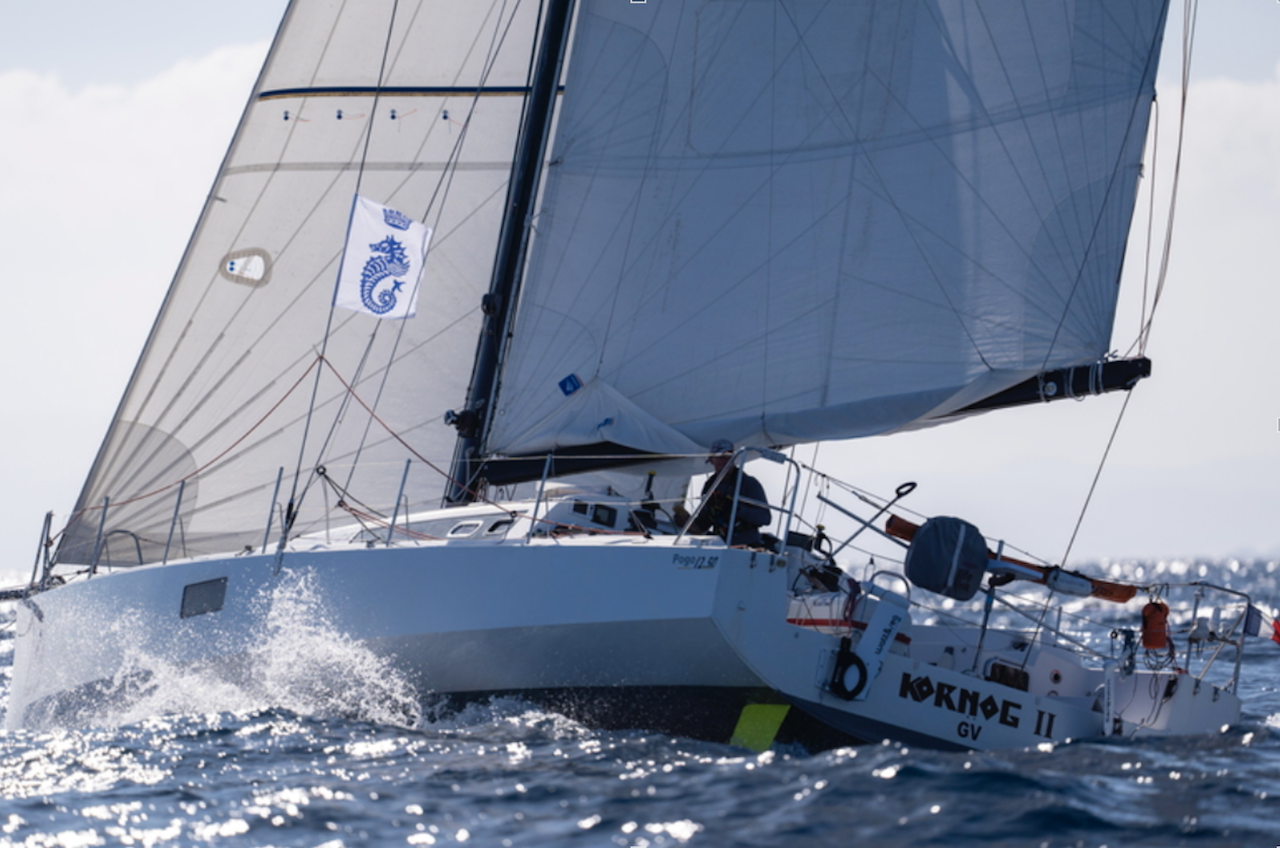
However, on corrected time, victory went to the Pogo 12.50 Kornog 2, sailed by Gilles Colubi and Ivan Osselin, who completed the race in 13 days and 1 hour, finishing at 01:31:08 UTC on 25 January.
Still racing toward Antigua are several determined crews. Rock ’n’ Roll, the Owen Clarke 40, has approximately 270 nautical miles remaining, while Solaris 55 Team 42 is closing in with around 310 miles to go. Both crews are deep into the final phase of their Atlantic crossings as the trades continue to deliver fast—but physically demanding—conditions.
Spirit of the race: Stimmy and Walross 4
The Finnish Sun Fast 3300 Stimmy, sailed double-handed by Ari Huusela and Annika Paasikivi, remains at sea around 660 nautical miles from Antigua and is expected to be the final finisher. Their race continues to embody the seamanship, patience and quiet determination that sit at the heart of the RORC Transatlantic Race.
Germany’s Walross 4 is approximately 415 nautical miles from completing her crossing, with the young crew continuing steadily west. All competitors already arrived in Antigua have expressed their deep condolences following the tragic loss of a crew member aboard Walross 4. The ASV-Berlin Yacht Club and RORC continue to provide full support and assistance as the team prepares for arrival.
A warm Caribbean welcome
The Antigua Yacht Club hosted an informal welcome gathering for arriving RORC Transatlantic Race crews, joined by local sailors following their Saturday race meeting. Complimentary food and drink were shared by more than 100 sailors, a reminder that after the miles, the fatigue and the salt, the race always ends the same way—together.
The Atlantic has spoken. The stories are written. And Antigua, once again, has welcomed them home.