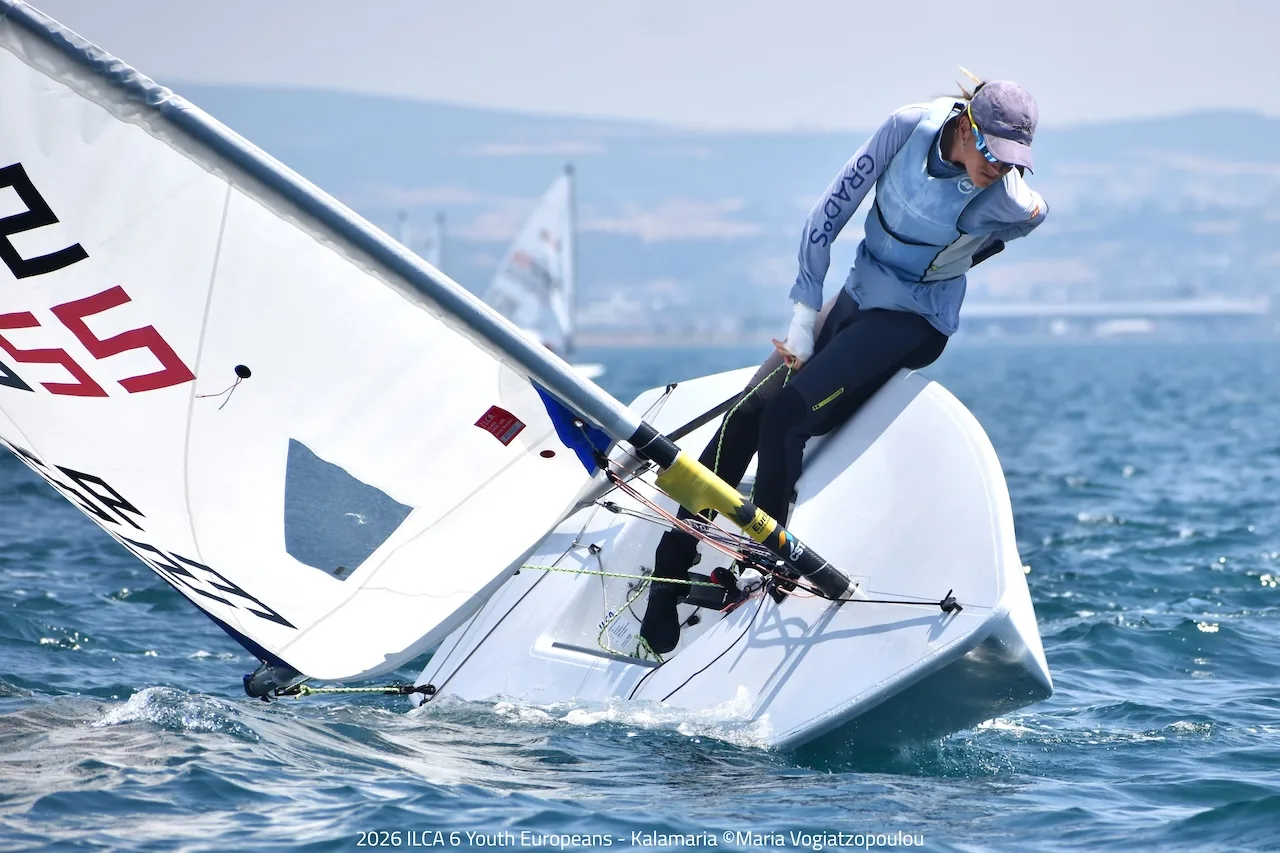
Future Stars Shine Bright at the 2026 ILCA 6 Youth European Championships
Every Olympic sailor begins somewhere.
Before the medals, the world championships and the America's Cup campaigns, there are youth championships where reputations are forged, confidence is built and future stars quietly announce their arrival on the international stage.
The 2026 ILCA 6 Youth European Championships and Open European Trophy, held in Thessaloniki, Greece, provided exactly that stage.
For an entire week, some of the world's finest young sailors battled across the waters of the Thermaic Gulf, producing racing that was as unpredictable as it was impressive. The championship concluded with a fitting finale as light morning breezes gradually developed into perfect racing conditions, allowing organisers to complete both scheduled races for every fleet and bring the regatta to a satisfying conclusion.
By the time the final race finished, twelve races had been completed across six fleets, producing deserving champions and confirming that the future of competitive sailing remains in exceptionally capable hands.
A Championship That Tested Every Skill
Youth sailing often produces some of the closest and most competitive racing anywhere in the sport.
Unlike professional campaigns backed by large budgets and extensive shore teams, youth championships frequently come down to pure sailing ability.
Boat handling.
Boat speed.
Tactical awareness.
Mental resilience.
The ability to recover from setbacks.
Those qualities were evident throughout the championship.
The final day proved particularly demanding.
A lack of breeze delayed racing ashore by thirty minutes as race officials waited patiently for suitable conditions to develop.
Patience was rewarded.
The first races began in just four to five knots of wind, forcing competitors to concentrate on delicate sail trim and maintaining momentum. As the afternoon progressed, the breeze steadily strengthened through eight and ten knots before reaching approximately fourteen knots by the final races.
Those changing conditions demanded versatility.
The sailors who succeeded were those capable of adapting throughout the day, adjusting both their tactics and boat handling as the championship reached its climax.
Hermione Ghicas Added Another Major Title
Competing on home waters often brings additional pressure.
Friends, family and local supporters naturally expect success, while familiarity with the venue can sometimes become an added burden rather than an advantage.
Hermione Ghicas handled that pressure with remarkable composure.
The Greek sailor secured the 2026 ILCA 6 Youth European Championship title, adding another prestigious trophy to an already impressive sailing career.
Having captured the 2025 ILCA 6 Youth World Championship, Ghicas arrived in Thessaloniki carrying the weight of expectation.
She left having confirmed her place among the most talented young female sailors currently competing anywhere in the world.
Winning a championship on home waters creates memories that last a lifetime.
Doing so while wearing the mantle of world champion demonstrated maturity beyond her years.
Italy's Marina Murri produced a consistently strong championship to claim the silver medal, while Beata Dokoupilova of the Czech Republic completed the European Championship podium after another excellent week's sailing.
The Open European Trophy mirrored much of the European Championship standings, with Ghicas once again taking victory ahead of Murri. New Zealand's Chloe Turner completed the podium, highlighting the increasingly international appeal of youth ILCA competition beyond Europe alone.
Sofia Berteotti Continued Her Remarkable Rise
Italy enjoyed further success in the Under-17 Girls' Championship thanks to Sofia Berteotti.
Her victory represented a second European title within twelve months, following her triumph at the 2025 EurILCA Team Racing Championship, also held in Greece.
Few young sailors manage to back up one major international success with another so quickly.
Berteotti's latest victory suggested she possesses not only outstanding boat speed but also the consistency required to succeed at the highest levels of youth sailing.
Turkey's Derin Bartan secured second place after a determined performance throughout the week, while Spain's Francisca Puig Bonet rounded off the podium following a championship marked by steady improvement and composure under pressure.
Jiri Tomes Dominated the Boys' Championship
The boys' fleet produced equally compelling racing.
At the end of twelve races it was Jiri Tomes of the Czech Republic who emerged as the outstanding performer.
His consistency throughout the championship earned him not only the European Championship title but also the Under-17 European Championship, completing an impressive double.
Tomes rarely allowed mistakes to dictate his regatta.
His ability to remain near the front of the fleet race after race ultimately proved decisive.
Italy's Manuel Henk Vos pushed hard throughout the week and finished only three points behind in second place, underlining just how competitive the championship had become.
Spain's Nikko Palou completed the overall European podium after delivering a series of excellent performances across changing conditions.
The Open European Trophy produced a slightly different outcome.
Brazil's Erik Scheidt topped the standings, demonstrating once again how attractive European youth championships have become for sailors from around the world.
Tomes finished second overall in the Open Trophy, while Manuel Henk Vos claimed third.
Thessaloniki Proved a Worthy Host
Successful championships depend upon far more than good racing.
Behind every start sequence lies months of planning by volunteers, race officers, sailing clubs and organising authorities whose efforts often pass unnoticed once the competition begins.
The Nautical Athletic Club of Kalamaria Thessaloniki received widespread praise for delivering a championship that combined excellent race management with warm Greek hospitality.
Running six fleets over twelve races requires considerable organisation.
Changing weather conditions only added to the challenge.
Race officials demonstrated patience when necessary and decisiveness once suitable conditions arrived, ensuring competitors received a fair championship decided on the water rather than by circumstance.
Those qualities helped produce an event remembered as much for its atmosphere as for the racing itself.
The Importance of Youth Championships
Youth championships have always occupied a special place within sailing.
Today's junior sailor often becomes tomorrow's Olympian, offshore skipper, America's Cup helmsman or SailGP strategist.
Names that now dominate professional sailing first appeared in results sheets remarkably similar to those published this week in Thessaloniki.
That progression remains one of sailing's greatest strengths.
Unlike many sports, young sailors regularly compete alongside experienced champions at club level before gradually working their way through national and international competition.
Events such as the ILCA 6 Youth European Championships provide the essential bridge between promising junior sailor and accomplished international competitor.
The lessons extend well beyond results.
Competitors learn independence.
Travel.
Preparation.
Sportsmanship.
Resilience.
They discover how to recover from disappointing races and remain focused when championships are decided by only a handful of points.
Those experiences stay with sailors throughout their careers, regardless of whether they eventually pursue Olympic medals or simply continue enjoying the sport they love.
A Bright Future for International Sailing
Looking across the launching areas in Thessaloniki, it was impossible not to feel optimistic about the future of sailing.
The standard of racing remained exceptionally high.
Competition was fierce but respectful.
Friendships formed ashore despite intense rivalries afloat.
The next generation demonstrated not only remarkable talent but also the values that have always defined sailing at its best.
When the boats were finally lifted ashore and the medals presented, another chapter had been written in the long history of youth sailing.
Some of these names will undoubtedly become familiar to sailing fans over the coming decade.
Olympic Games.
World Championships.
The Ocean Race.
The America's Cup.
Those journeys often begin at championships like this.
For Hermione Ghicas, Jiri Tomes, Sofia Berteotti and many others, Thessaloniki may prove to be remembered as one of the defining moments in careers that are only just beginning.