A Chilly Departure and a Famous Passage: The Noakes Sydney Gold Coast Yacht Race Once Again Tested Australia's Offshore Elite
There are few finer places on earth to begin an offshore yacht race than Sydney Harbour.
On a crisp Australian winter's morning, with the Sydney Opera House gleaming beneath blue skies and spectators lining the harbour foreshore, the fleet gathered for one of the country's classic offshore contests. The sunshine disguised the fact that the crews were about to embark on a race where patience, tactical judgement and endurance would matter every bit as much as boat speed.
Once the yachts slipped beneath the sandstone cliffs of Sydney Heads and turned north, the protection of the harbour disappeared astern. Ahead lay 386 nautical miles of open water, stretching along Australia's magnificent eastern coastline towards Main Beach on Queensland's Gold Coast.
The Noakes Sydney Gold Coast Yacht Race has never been simply about sailing north. It has always been about reading the weather, understanding the East Australian Current and making hundreds of small decisions that ultimately determine whether a crew arrives in celebration or frustration.
This year's race promised exactly that.
A Race With Nearly Four Decades of Offshore Heritage The Sydney Gold Coast Yacht Race first took place in 1986, created by the Cruising Yacht Club of Australia (CYCA) to provide offshore sailors with an important winter challenge. While the Rolex Sydney Hobart Yacht Race has long been regarded as Australia's most famous offshore event, the race to the Gold Coast quickly carved out its own reputation.
Unlike the often brutal southern route to Hobart, competitors headed north into warmer waters, but that never made the challenge easier.
The east coast of Australia is one of the most tactically demanding stretches of ocean anywhere in the world. The powerful East Australian Current, made famous well beyond sailing circles, can either reward or punish crews depending upon how well they position themselves. Sea breezes develop and disappear with little warning. Coastal headlands bend the wind in unexpected ways. Offshore pressure lines appear and vanish within hours.
Victory has rarely belonged to the fastest yacht alone.
Instead, it has usually rewarded the crew capable of combining excellent seamanship with intelligent navigation and a willingness to adapt as conditions changed.
Over the years the race has attracted some of Australia's finest offshore sailors, world-class racing yachts and ambitious Corinthian crews eager to test themselves against one of the country's classic passages. Many campaigns have used it as valuable preparation for the Rolex Sydney Hobart later in the year, while others simply relish the opportunity to race one of the Pacific's most beautiful coastlines.
A Beautiful Start to Another Atlantic-Style Adventure
Although considerably shorter than many ocean races, the Sydney Gold Coast Yacht Race shares something with the great offshore classics of Europe. The race begins in spectacular surroundings before gradually becoming a battle against weather, fatigue and the sea itself.
This year's start unfolded beneath bright winter sunshine, accompanied by a gentle breeze of between eight and thirteen knots. Conditions inside Sydney Harbour remained light and patchy, demanding concentration from every helm before the fleet reached open water.
Last year's overall winner, Smuggler, wasted little time stamping her authority on proceedings. She became the first yacht to clear Sydney Heads, immediately establishing an early advantage over her rivals.
Following close behind came V5, Koa, Caol Ila and Gusto, each determined not to allow the defending champion too much freedom during the opening miles.
One of the most impressive departures belonged to Caol Ila. Her experienced crew handled the powerful Maarten 67 with admirable precision through the inconsistent harbour breeze, maintaining momentum while others occasionally struggled in the lighter patches.
Big Boats and Small Boats Shared the Same Ambition One of offshore racing's greatest attractions lies in the extraordinary variety of yachts competing together. Towering maxi yachts often find themselves locked in battle with boats almost half their size.
This year's race demonstrated exactly that. The fleet's largest yacht, Antipodes, found herself closely accompanied by two determined forty-footers, Ambition and Back 2 Black, both performing well above their handicap during the opening stages.
Watching vastly different yachts race together has always been part of offshore sailing's appeal. Modern handicap systems ensure that success depends not on budget or length alone but on preparation, consistency and intelligent sailing.
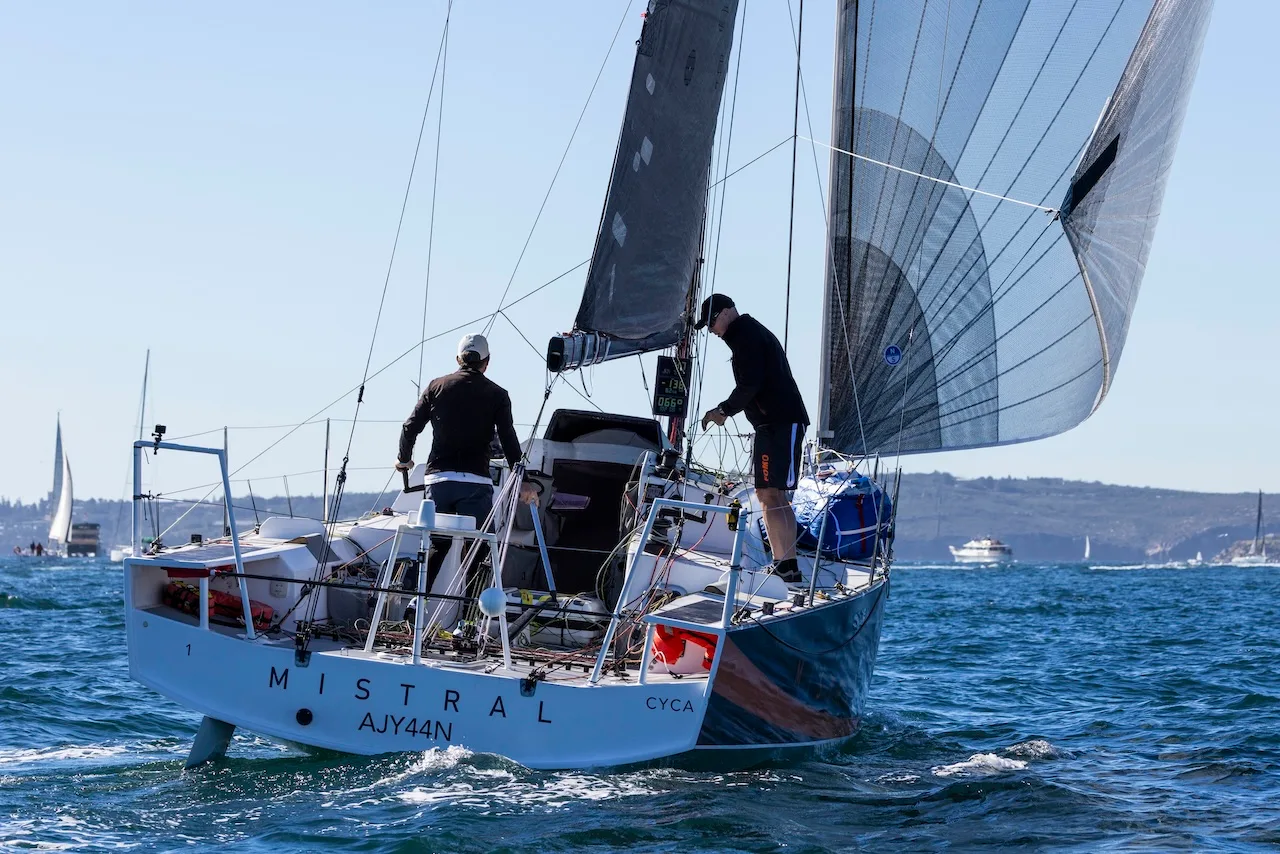
Every crew begins believing they have an opportunity. That belief keeps offshore racing wonderfully unpredictable. Double-Handed Racing Continued Its Remarkable Rise Another fascinating contest developed within the fleet. Double-handed offshore racing has experienced remarkable growth throughout Australia in recent years, attracting sailors who relish the additional physical and mental demands of racing with only two people aboard. Leading that division through Sydney Heads was Disco Trooper, becoming both the first double-handed yacht and the leading thirty-footer into the Pacific. Mistral remained close enough to maintain constant pressure, while Annie Stevenson's Dehler 30 also enjoyed an encouraging start before settling into the long tactical race north. Sailing offshore with only two crew members transforms every aspect of the race.
Helming. Navigation. Cooking. Sail changes. Maintenance. Rest.
Everything falls upon just two sailors. Managing fatigue becomes every bit as important as maintaining speed. Many experienced offshore competitors argue that double-handed sailing represents one of the purest forms of yacht racing, demanding complete trust between two individuals while rewarding careful planning rather than brute manpower.
The Weather Was Always Going to Decide the Race
If the opening conditions appeared almost idyllic, the forecast suggested something altogether different awaited the fleet. Meteorologists predicted that the breeze would steadily weaken before becoming light and highly variable over the following days. Such forecasts delight navigators. They also create headaches. Bigger yachts naturally seek stronger pressure further offshore, hoping superior speed allows them to escape developing wind holes. Smaller boats often favour coastal routes where local breezes may continue after offshore winds collapse. Neither option guarantees success. Every routing decision becomes a calculated gamble. Finding only a few extra knots of breeze can translate into hours gained by the finish. Missing that pressure can prove equally costly. Those uncertainties have always been part of this race's unique character.
Preparation Still Wins Offshore Races Long before the fleet assembled in Sydney Harbour, every campaign had already invested months preparing for this moment.
Standing rigging had been inspected. Sails repaired. Safety equipment checked. Weather routing analysed. Food packed. Navigation systems updated.
Success offshore rarely begins on the start line. It begins inside boatyards and workshops where attention to detail often determines whether a yacht finishes strongly or spends valuable hours repairing avoidable failures.
Experienced ocean sailors understand a simple truth. Preparation creates confidence. Confidence allows better decisions. Better decisions usually produce better results. The Race Beyond the Horizon
Once the fleet disappeared beyond Sydney Heads, spectators gradually returned home. The real race, however, was only beginning. Nightfall would bring cooler temperatures.
Watch systems would settle into routine. Navigators would study fresh weather files while helmsmen searched constantly for elusive pressure. Some crews would discover favourable currents. Others would spend frustrating hours drifting beneath empty sails. By the time the Gold Coast skyline finally appeared on the horizon, every competitor would have accumulated hundreds of small stories.
Moments of brilliance. Moments of frustration. Quiet sunrises. Long nights. Shared meals. Hard decisions.
Those experiences explain why offshore sailors continue returning year after year. The trophies matter. The adventure matters even more.
Nearly forty years after the inaugural race, the Noakes Sydney Gold Coast Yacht Race remains one of Australia's great offshore classics because it offers something increasingly rare in modern sport.
No two editions are ever the same. Every race writes its own story.